
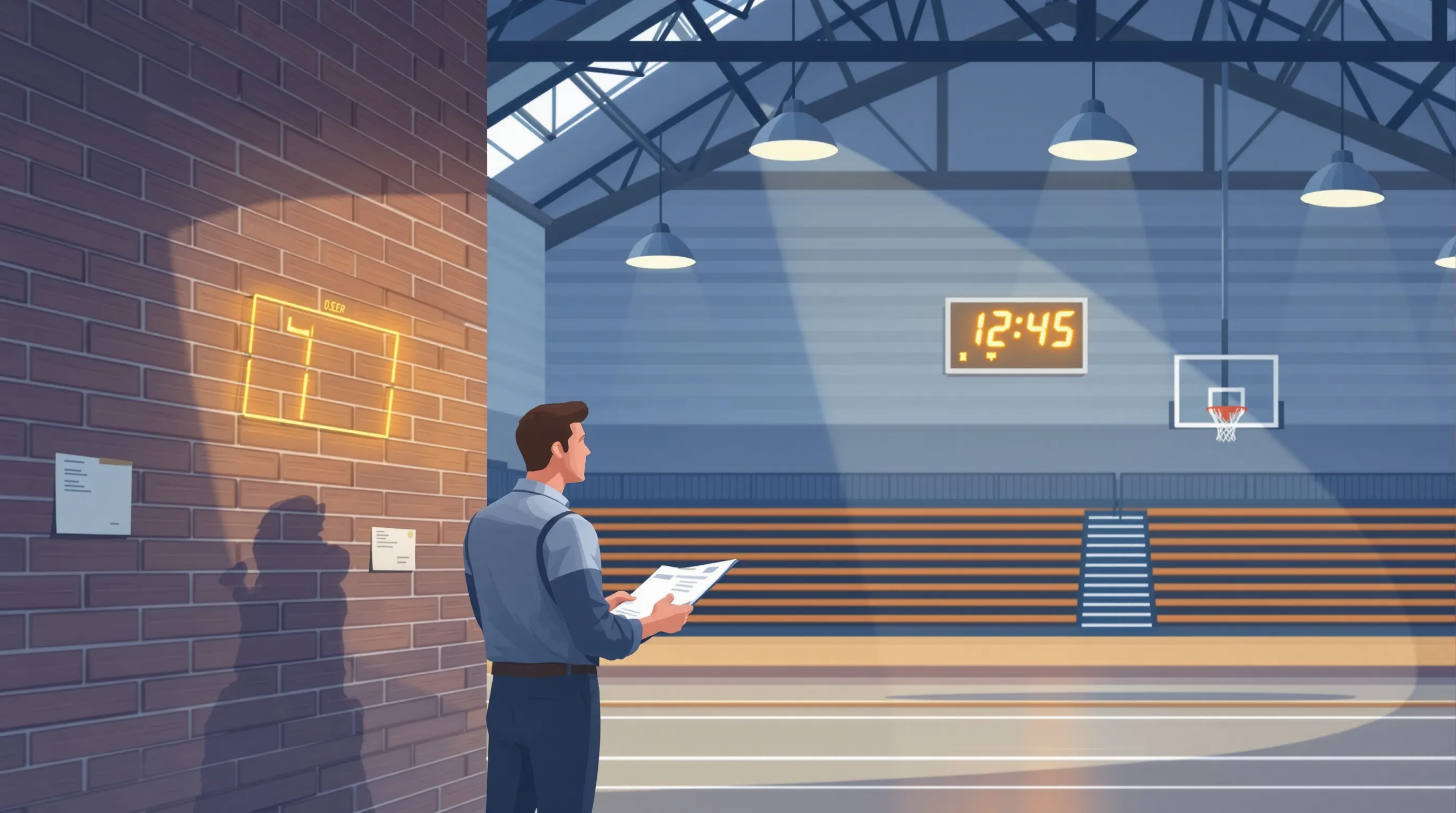
Whether a gym can take the LX2770 refers to three measurable checks, each derived from Electro-Mech's own documentation: wall capacity for a wall-hung cabinet, sightlines reaching 300 feet, and a dedicated 120 VAC circuit near the planned mount location. Electro-Mech recommends 25 feet of viewing distance per inch of digit height. The LX2770's 12-inch secondary rows, Period, Fouls, Time Outs, Player Number, and Player Foul: govern that 300-foot planning distance, not the larger 16-inch score and clock digits.
Wall type is the check most often left for the installer to confirm on arrival. Sightlines are calculable in advance. Power is almost always the easiest variable to resolve. Understanding which check carries the most risk determines where a facilities team should focus attention before the order is placed.
Quick Answer
The Short Answer: A gym can accommodate the LX2770, Electro-Mech's indoor basketball scoreboard: if the wall structure can carry a wall-hung cabinet, the farthest seat falls within 300 feet of the display, and a dedicated 120 VAC circuit is available near the planned mount location. Wall type is the variable most often unconfirmed before ordering; sightlines and power are calculable in advance.
Quick Answer
The LX2770 is Electro-Mech's indoor basketball scoreboard: a wall-hung display with 16-inch digits for scores and clock, and 12-inch secondary rows for Period, Fouls, Time Outs, Player Number, and Player Foul. Whether a gym can accommodate it means verifying three measurable conditions before the order is placed: wall capacity, sightlines, and a dedicated 120 VAC circuit.
Wall type is the first variable. Masonry, stud framing, and reinforced concrete each require different mount preparation, and only a site walkthrough confirms which applies. Service access, whether a lift or ladder can reach the cabinet after it hangs, is a separate question that belongs in the same walkthrough. Gyms undergoing a new build or renovation have an advantage here: outlets, cable routing, and lift clearance are far easier to plan while walls are still open.
Sightlines are calculable before anyone visits the site. Electro-Mech recommends 25 feet of viewing distance per inch of digit height. For the LX2770, the 12-inch secondary rows set the planning limit at 300 feet, the binding constraint for seating layout. Power is almost always the most predictable of the three checks.
What Three Questions Decide Whether Your Gym Can Take the LX2770?
Wall capacity, sightlines, and power supply are the three measurable checks. Each has a specific threshold derived from the LX2770's own spec sheet and installation manual.
I call this a site-check sequence because the order matters. Sport coverage comes first, confirm that the LX2770's basketball digit set matches what you actually play in that gym. Sightlines come next, since the farthest seat in a high school gymnasium can easily exceed the board's planning distance. Wall and power come last: they tend to involve the fewest surprises in most existing facilities, though wall type is where real variation shows up across buildings, as of .
A review of our LED scoreboard installation guidance across indoor gym projects shows wall type and service access vary most from site to site, while power requirements stay nearly uniform. Power is the easiest variable to resolve. Masonry, steel stud framing, and wood frame each accept the cabinet's mounting hardware differently, and knowing which material sits behind the planned location is the starting point for confirming whether the wall is ready.
Indoor scoreboards attach to a gym wall using the mounting hardware that ships with the cabinet. Steel posts, clamp assemblies, and concrete footings belong entirely to outdoor installations. None of that applies here. The LX2770 hangs from wall or ceiling anchor points, and the structure at the chosen location has to carry the cabinet weight plus any identification panels mounted alongside it.
Planning for all three checks before you order, rather than discovering a gap at installation time, keeps the project on schedule. A four-to-six-week lead time, sometimes longer, leaves no room for a facilities discovery that should have happened weeks earlier. A team that knows the wall type, has confirmed clearance above the floor, and has a circuit identified at the planned location walks into the ordering conversation with every variable already resolved.
Athletic directors make the program decision about which model fits the sports schedule. Facilities staff confirm the wall type, mounting height, and circuit location. Both conversations need to happen, and in that order, before a quote goes to purchase. If those two groups have not talked about the project together, the site check has not happened.
How Do You Check Sightlines for the LX2770?
Electro-Mech recommends 25 feet of viewing distance per inch of digit height, which puts the LX2770's planning distance at 300 feet: governed by its 12-inch secondary rows, not its 16-inch scores.
The sign industry applies a different standard: 50 feet per inch of lighted character height. Electro-Mech deliberately cuts that in half for scoreboards. A scoreboard carries captions alongside every digit row, and those captions have to be read from the same distance as the digits themselves. The 50-foot rule produces a theoretical maximum for a single-element sign. The 25-foot rule produces a planning distance where every element on the board is legible: scores, clock, and captions together.
The LX2770 has three digit-height groups. Its 16-inch rows display Guest Points, Home Points, and the Period Clock, those reach 400 feet at 25 feet per inch. Its 12-inch rows show Period, Fouls, Time Outs, Player Number, and Player Foul, and those set the binding planning limit at 300 feet. Captions run at 7, 5, and 4 inches.
| Row Group | Digit Height | Planning Distance at 25 ft/in |
|---|---|---|
| Guest Points, Home Points, Period Clock | 16 in. | 400 ft |
| Period, Fouls, Time Outs, Player No., Player Foul | 12 in. | 300 ft (planning limit) |
| Bonus and Possession indicators | 5 in. | 125 ft |
In practice, measure from the board location to the farthest occupied seat. At 300 feet or under, every row on the LX2770 is readable from every seat. Beyond 300 feet, the 12-inch secondary rows become difficult to read from the back rows. The board's own manual cites 300 feet as the distance to plan around, and that is the number I use when talking through gym readiness with schools.
The sightline check is a tape measure exercise. A compact auxiliary gym rarely pushes past 200 feet. A large varsity facility with elevated seating at the far end of the floor can exceed 300 feet, and that outcome matters before an order is placed, not after installation.
From what I have seen, the most common oversight is measuring to the nearest seat rather than the farthest. A 180-foot measurement from the board to the front row tells you almost nothing. The relevant distance is from the scoreboard to the last row of permanent seating, and if the gym uses a stage or a raised platform at the far end for overflow, that location counts too. Confirm the worst-case seat, and the rest of the seating takes care of itself.
What Is the Best Multi-Sport Gym Scoreboard for Basketball, Volleyball, and Wrestling?
The LX2770 covers basketball only, its digit set never extends to volleyball or wrestling. Schools running multiple sports in the same gym need a multi-sport model.
The LX2770's spec sheet labels it "Indoor Basketball." That is an exact description of the digit set, not a marketing category. The board displays Guest Points, Home Points, the Period Clock, Period, Fouls, Time Outs, Player Number, Player Foul, and Bonus and Possession indicators. Every element relates to basketball. There is no net-height counter, no set count, no scoring row for wrestling periods. If a sport does not appear in the digit set, the board cannot score it.
A gym that installs the LX2770 for basketball and later adds volleyball or wrestling to the same court will find the board cannot serve those sports. That becomes a second purchase. The takeaway is clear: resolve sport coverage before ordering, not after the board is on the wall.
For gyms that run basketball, volleyball, and wrestling in the same space, the LX2745 is the indoor multi-sport option. Its digit set covers all three sports in a single 8-foot by 6-foot cabinet weighing 140 lbs. The display rows include a 12-inch four-digit game clock in minutes and seconds format, 12-inch home and guest score rows, and 9-inch rows for period or match, fouls, won sets, and points. The elements those three sports each need.
| Model | Sport Coverage | Score / Clock Digit Height | Secondary Rows |
|---|---|---|---|
| LX2770 | Basketball only | 16 in. (scores and clock) | 12 in. (period, fouls, time outs, player rows) |
| LX2745 | Basketball, volleyball, wrestling | 12 in. (scores and clock) | 9 in. (period/match, fouls/won/points) |
The digit-height trade-off is real. The LX2770's 16-inch scores and clock are larger than the LX2745's 12-inch equivalents, which means the LX2770 reads farther under the 25-feet-per-inch rule. In practice, that advantage matters most in the largest gyms. For a gym with seating that extends well under 300 feet, the LX2745's 12-inch scores are entirely adequate. For a gym where basketball visibility is the primary requirement and the court doubles for volleyball or wrestling on secondary nights, the right model depends on what that specific program values more, sport coverage or maximum digit size.
What Does the Wall Check Actually Involve, and When Does a Structural Engineer Come In?
Wall structure is the variable most often underestimated before a gym scoreboard installation. Cable routing and service access each require site-specific confirmation that no spec sheet can substitute for.
For most gyms and most boards, the structural question is straightforward: identify the wall material at the planned mount location, confirm the framing can accept the fastener pattern, and verify the selected wall section can carry the cabinet weight plus any identification panels. In practice, that confirmation happens at the installer's walkthrough, not on paper months in advance.
However, the weight of a wall-mounted board is not uniform across Electro-Mech's catalog. Our data shows the heaviest indoor wall-mounted scoreboard we manufacture reaches 340 lbs. At that weight: which belongs to one specific model, not the LX2770, certifying that the wall and roof framing can carry the load requires a licensed professional engineer. That is not a task the installer confirms on site; it is an engineering engagement and a budget item. Buyers of larger indoor models should understand a PE may be part of the project, while buyers of the LX2770 itself are working with a lighter board.
A separate field variable is routing power and data to the cabinet. The rear access panel approach is cleanest: an opening in the wall sized to match the panel allows power and data connections without exposed runs. Where that is not feasible: poured masonry, finished tile surfaces, an alternative is a smaller opening routed to front-facing terminal blocks, which requires removing a digit face to make the connections. The takeaway is that how cables reach the cabinet is a site-specific decision. What is behind the wall at the chosen location determines which option works.
Service access matters for the same reason. Reaching the cabinet with a lift or a ladder must be practical for the original installation and for every future service call. A board positioned in an awkward location costs more to service each time. In a new build or renovation, planning that access path before walls close is far easier than retrofitting it later.
Balcony-front installations add another variable. When the board is within reach of spectators on a balcony, close enough to spill a drink on the cabinet or snag a cable, a shield mounted above the display protects it. In my experience, that is an installation detail that should appear in the pre-order conversation, not a retrofit project after the first home game.
What Are the LX2770's Exact Mounting, Height, and Power Specifications?
The LX2770 owner's manual specifies two lag bolts at most 3/8 inch in diameter, spaced 72 inches center to center, with the bottom of the cabinet a minimum of 8 feet above the floor.
Those are the three numbers a facilities team needs before confirming a wall location: fastener diameter, bolt spacing, and clearance height. The LX2770 can also be ceiling-mounted using two eye bolts, spaced 60 inches center to center, with a 1-inch opening that accepts chain or cable. Whichever method is used, the structure carrying the mount has to support the display cabinet plus any identification panels installed alongside it.
Power requirements are straightforward. The LX2770 base model draws 1.9 amps at 120 VAC, 60 Hz on a dedicated circuit. The LX2770-ETN variant, the version with Electronic Team Names, draws 3.4 amps on that same 120 VAC supply. The control console requires a separate 0.5-amp circuit. Electro-Mech recommends a dedicated breaker for the display. The cabinet ships with a built-in six-foot AC power cable.
The LX2770 is ETL listed to UL Standard 48 for Electric Signs. All LX-series scoreboards carry that listing. The five-year limited warranty covers factory labor on parts returned within five years of the invoice date, and technical support by phone or internet is available for the life of the product at no charge.
In practice, the 8-foot minimum height is a floor-clearance requirement, not an optimal viewing height. Hang it high enough that spectators can see the display over the heads of players and officials on the floor; low enough that a spectator does not have to crane their neck at a steep angle to read it. The right height is a judgment specific to each gym's seating geometry, which is why the installer confirms it on site rather than calculating it from dimensions alone.
A summary of the LX2770's mount and power specs from the owner's manual:
- Wall mount fasteners: Two lag bolts, maximum 3/8 in. diameter, 72 in. center to center
- Ceiling mount: Two eye bolts, 60 in. center to center, 1-in. opening for chain or cable
- Minimum cabinet height: 8 ft above the floor
- Display circuit (base): 1.9 A, 120 VAC, 60 Hz
- Display circuit (ETN): 3.4 A, 120 VAC, 60 Hz
- Console circuit: 0.5 A, separate circuit
- ETL listing: UL Standard 48 for Electric Signs
How Do You Verify Wall, Height, and Power Before You Order?
Gym readiness requires three confirmations before ordering: wall type and load capacity, floor clearance height, and dedicated 120 VAC circuit availability near the planned mount location.
Each of those three checks belongs to a different person on the facilities side. The athletic director identifies which sports are played in the space and where the scoreboard needs to be visible. The facilities manager, or whoever is responsible for the building's mechanical infrastructure, confirms wall construction and circuit availability. On a new build or during renovation, the general contractor confirms outlet and conduit placement before walls are closed. Trying to resolve any of these after the cabinet arrives on site adds cost and delay. The practical sequence is to gather all three answers first, then place the order.
Wall type is the one most often left unconfirmed. Masonry, stud framing, and reinforced concrete each respond differently to a hung cabinet. The LX2770 spec sheet describes mounting hardware for attaching the cabinet to a wall, but the installer determines what type of wall that actually is during the site walkthrough, not from a drawing. In my experience, facilities teams sometimes assume the wall is structurally sound because no previous equipment caused problems, when the real question is whether it can carry a mounted scoreboard at a specific height.
Height confirmation matters because the 8-foot floor-clearance minimum is a lower bound, not a prescription. A gym with a low-hanging HVAC duct or an elevated bleacher section may require a different height to maintain clear sightlines from both end zones of the court. The facilities manager needs to walk the floor and identify obstructions before an installer confirms the mounting height.
Power is the most reliably predictable variable. The LX2770 draws 1.9 amps on a single dedicated 120 VAC circuit. Most gyms that have been updated within the past 20 years have a suitable circuit somewhere in the vicinity. The question is where it terminates and how close it is to the planned cabinet location. Electro-Mech recommends confirming the circuit location with the facilities team before setting a mount position, not after.
The takeaway: the checklist is short, but it crosses departmental lines. Get the athletic director, the facilities manager, and, when there is a renovation underway. The general contractor in the same conversation before the order goes in.
LX2770 Gym Readiness Checklist

WALL
  [ ] Wall type confirmed (masonry / stud framing / reinforced concrete)
  [ ] Mount height: bottom of cabinet min. 8 ft above floor
  [ ] No HVAC ducts or bleacher structure blocking sightlines at planned height
  [ ] Service access confirmed (ladder or lift clears the cabinet)
  [ ] Balcony above mount location: overhead shield planned

SIGHTLINES
  [ ] Farthest spectator seat within 300 ft of display
  [ ] 16-inch digit rows visible from press box

POWER
  [ ] Dedicated 120 VAC / 60 Hz circuit within reach of cabinet
  [ ] Separate low-amperage circuit available for console

CABLE / CONTROL
  [ ] Data cable route from cabinet to console confirmed
      OR ScoreLink RF wireless selected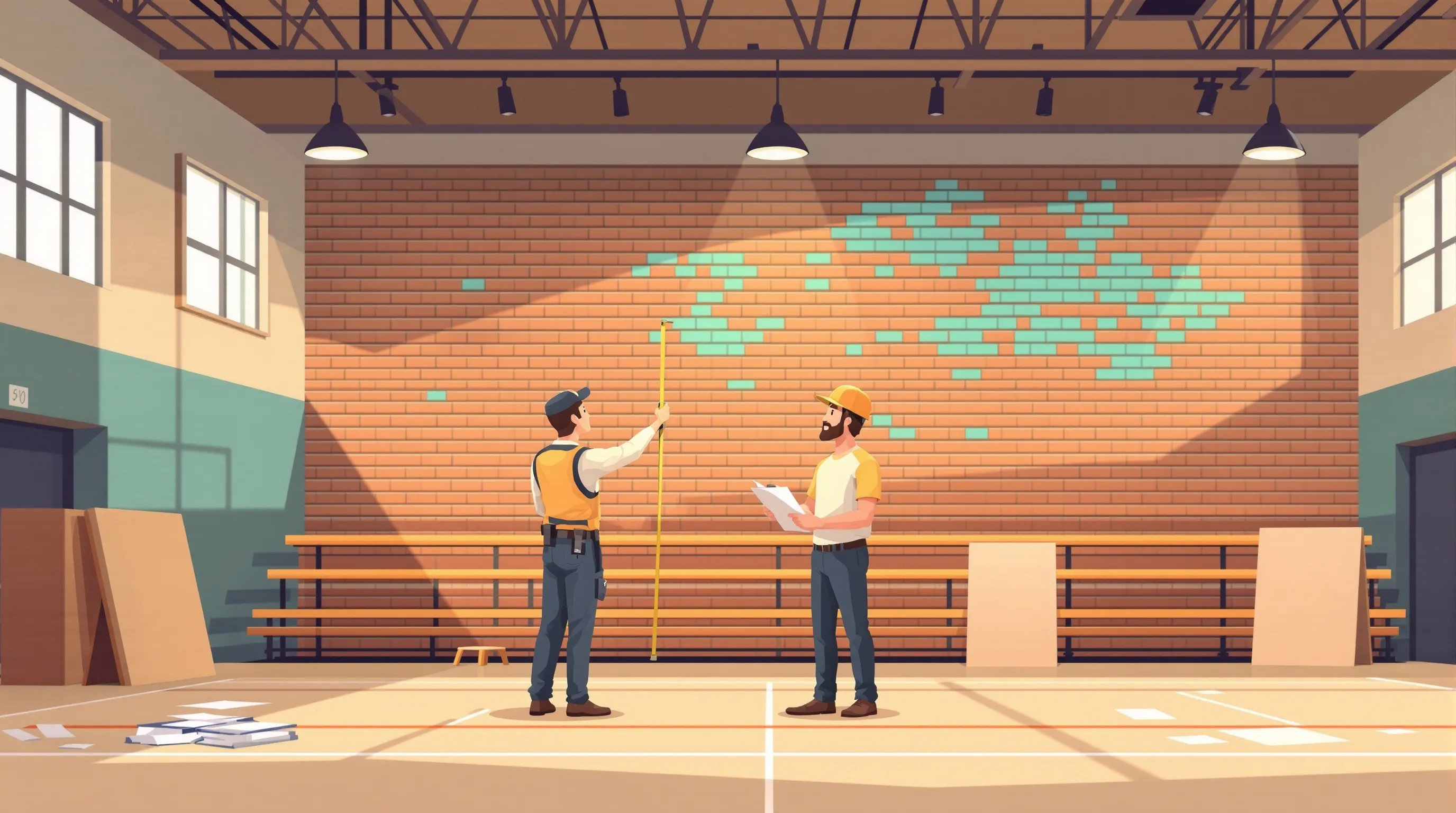
Without a site check
- Wall type unconfirmed at order time, installer discovers stud framing cannot support the cabinet; mount delayed
- Height chosen by eye, HVAC duct blocks sightlines from the end-line bleachers; board must be relocated
- No dedicated circuit near planned mount, electrician call adds cost and schedule days
- Service access overlooked, lift cannot clear the cabinet; first service call is a problem
After a pre-order site check
- Wall type confirmed with facilities manager, mounting hardware ordered correctly; install proceeds on schedule
- Clearance height walked with installer: cabinet bottom clears 8 feet, sightlines open from all seating
- Dedicated 120 VAC circuit located near mount, no electrical delay
- Service access planned, lift path confirmed before install day; ongoing maintenance straightforward
Key Takeaways
Key Takeaways
- Confirm wall type before ordering. Masonry, stud framing, and reinforced concrete each respond differently to a wall-hung cabinet. The installer verifies this at the site walkthrough, not from a drawing.
- Apply the 25-foot-per-inch rule to check sightlines. The LX2770's 12-inch secondary rows set the planning limit at 300 feet. Measure from the planned display location to the farthest seat before finalizing the position.
- Time the order to a renovation if possible. Outlet location, cable routing, and service access are far cheaper to plan while walls are open. Retrofitting all three after construction adds cost and complexity.
- Confirm service access at the chosen height. A lift or ladder must be able to reach the cabinet once it is mounted. This is a separate question from minimum clearance and belongs in the same site walkthrough.
- Wireless is the standard choice. About 4 of 5 Electro-Mech customers choose ScoreLink RF over a wired control cable. If a cable run is planned, confirm the route from the cabinet to the console location before finalizing the mount position.
Three site conditions determine whether a gym is ready for the LX2770, and each has a confirmed threshold. Wall type, sightline depth, and circuit location are the variables. None of them requires guesswork, all three can be resolved before the order is placed.
In my experience, the schools that run into delay at install day are almost always the ones that treated the wall check as someone else's responsibility. The installer arrives, finds stud framing where masonry was assumed, and the mount has to wait. Confirming wall type in the first conversation, not the final one, is the single change that most consistently keeps an installation on schedule.
The LX2770's five-year limited warranty and lifetime technical support by phone mean the relationship with Electro-Mech continues well past delivery. The cabinet's ETL listing to UL Standard 48 means it meets the safety standard for electric signs. Both are worth knowing before the decision is made.
If your gym falls within the 300-foot sightline limit, has a wall with the structural capacity to carry a hung cabinet, and has a dedicated 120 VAC circuit available near the planned mount location, the LX2770 is a confirmed fit. The Electro-Mech team can verify each of those conditions with you directly.
If the wall type or sightline math raises a question before you order, the Electro-Mech team can review the LX2770 spec sheet against your gym's actual dimensions. That conversation typically resolves the decision in a single call. Browse the full line of basketball scoreboards or request a quote to get started.
Written by
Chap McMichael
Vice President of Support Services, Electro-Mech Scoreboard Company
Chap McMichael is Vice President of Support Services at Electro-Mech Scoreboard Company, the family-owned manufacturer that has built scoreboards in Wrightsville, Georgia since 1963.
Connect on LinkedInFrequently Asked Questions About the LX2770 and Gym Readiness
Does the gym wall need to be a specific construction type to support the LX2770?
Wall type refers to the structural material carrying the mount: masonry, stud framing, or reinforced concrete. Each handles a wall-hung cabinet differently. The installer confirms which type applies during the site walkthrough; the LX2770 spec sheet includes mounting hardware appropriate for gym wall installations.
What is the correct mounting height for a gym scoreboard?
The LX2770 owner's manual specifies a minimum floor clearance for the bottom of the cabinet. Height above that minimum is a site judgment: high enough for spectators to see the display over players and officials on the floor, low enough that no one has to strain their neck at a steep angle to read the digits. Service access, whether a lift or ladder can reach the cabinet for maintenance, must be confirmed for the chosen height.
Is a gym renovation the right time to order a scoreboard?
A new build or renovation is the best possible time to plan a scoreboard installation. Outlet location, cable routing, and service access can all be positioned correctly while walls are open, at no retrofit cost. Addressing those three elements after construction is finished adds labor and complexity to the installation.
How does the data cable connect between the scoreboard and the control console?
Power and data run into the cabinet through an opening in the wall, either via the rear access panel or through the front of the cabinet at the terminal blocks, depending on the wall's construction. The preferred route is through the rear access panel, which keeps the connection clean and protected. ScoreLink RF wireless eliminates the cable run entirely; roughly 4 of 5 Electro-Mech customers choose that option.
What should be done if there is a balcony above the planned scoreboard location?
A balcony directly above the mount location requires a shield installed on top of the display cabinet to prevent spectators from reaching down and touching the hardware. The LX2770 owner's manual covers this scenario specifically. The shield is a standard consideration that the installer addresses during the site walkthrough.
Summarize This Article With AI
Open this article in your preferred AI engine for an instant summary.