
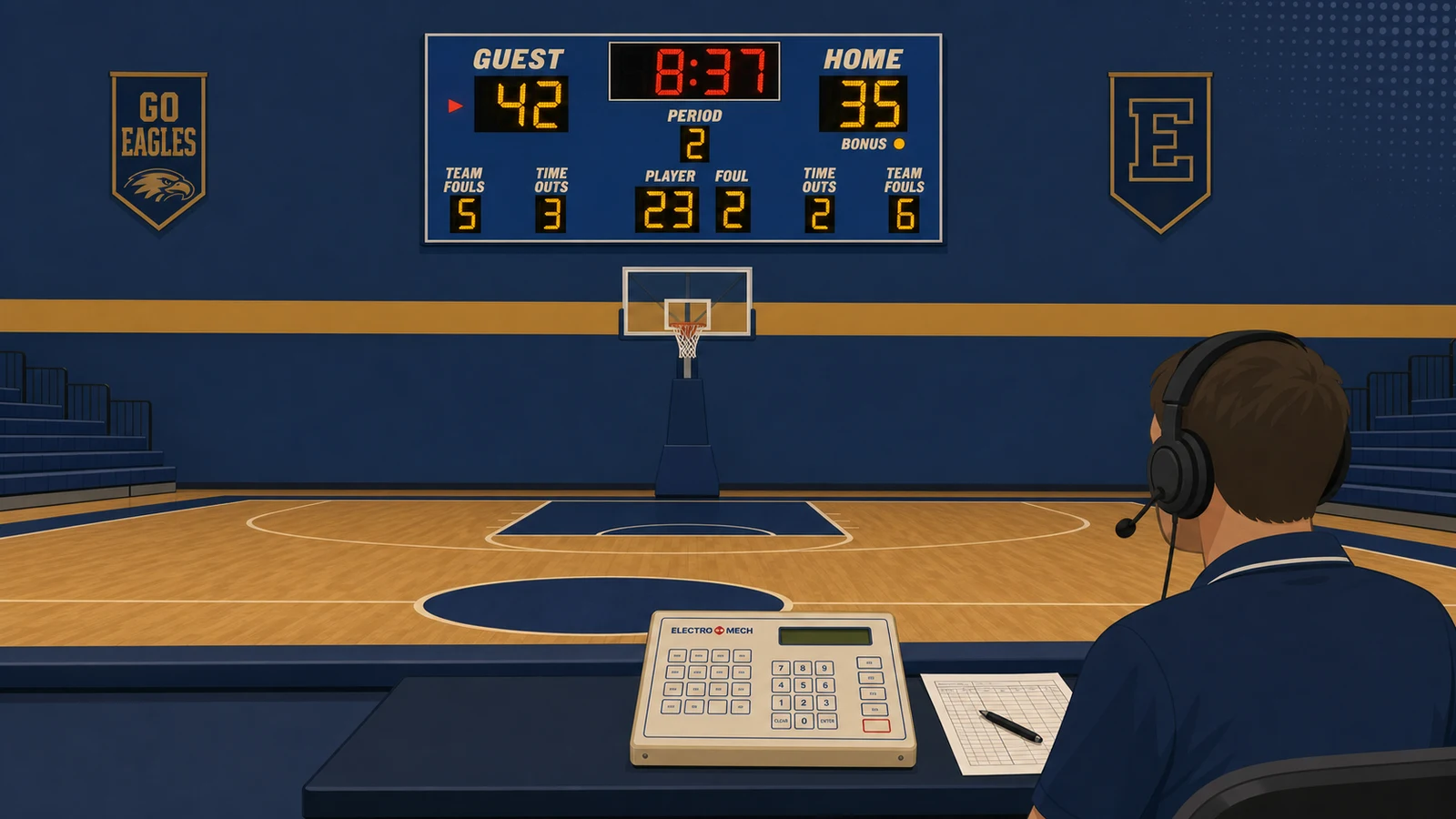
When a competition adds or changes a shot clock rule, the equipment question is smaller than it sounds. Shot clocks are a separate pair of displays that join the basketball console you already own, and the timing values themselves are programmed at the console rather than built into the hardware. This page covers what to order, where it mounts and how it is configured - and is deliberately silent about what any particular association's rules say, because that is theirs to publish and yours to confirm.
Quick Answer
The short answer: confirm the requirement with the body that governs your competition, then treat the equipment as an addition rather than a replacement. A set of two displays connects to any of the basketball console's four identical data ports, ships with a three-button handheld controller, and carries two programmable reset values set at the console - which is where a change in timing values is applied, without touching the hardware.
Who Decides the Rule, and Who Decides the Equipment
These are two separate questions and they are best kept separate.
The rule - whether a shot clock is required, at what level, and what values it uses - belongs to the association that governs your competition. State associations, college governing bodies and recreational leagues each publish their own requirements and change them on their own schedules. The only reliable source is that body's current published rule, and a scoreboard manufacturer is not it.
The equipment is what this page can speak to: what Electro-Mech builds, how it connects, how it mounts and how the timing values are set. Nothing about the hardware depends on which association you answer to, which is the useful part - a shot clock set bought for one rule set is programmable for another.
So the sequence is: confirm the requirement with your association, then read the rest of this page.
What a Shot Clock Is in This Catalogue
A shot clock is an accessory display, ordered as a pair, mounted behind the backboards, and driven by the same console that runs your scoreboard. Because shot time is linked to period time in basketball, the set is designed to be used along with a basketball scoreboard rather than standalone, and those scoreboards are run by consoles compatible with the shot clock set.
That is the whole architecture. There is no separate controller to buy, no second operator position required, and no modification to the scoreboard itself.
The Two Sets, and Which One Fits
| Model | Size (Each) | Digits | Weight (Each) | Current (Each) | Shows |
|---|---|---|---|---|---|
| LX2160 | 24 in. x 27 in. | 12 in. | 20 lbs. | 0.3 A | Shot time |
| LX2180 | 29 in. x 27 in. | 12 in., 6 in. | 30 lbs. | 0.5 A | Shot time plus Game Time, with a 6 in. Period Clock duplicating the main scoreboard |
The difference that matters is the second clock. The LX2180 repeats the Period Clock alongside the shot time, so the end of the gym where officials and benches sit has both numbers in one place. That is a convenience during normal play and it becomes more than a convenience in the closing seconds of a period, when everyone is watching two clocks at once.
Both are indoor products: the manual states they are designed for a dry environment and should not be installed or operated outdoors or in a wet location.
Does Your Console Already Support Them?
Almost certainly, if it is the basketball console that came with an Electro-Mech scoreboard. The console has a dedicated shot clocks key, and the manual notes it becomes useful once you have the optional displays and the three-button handheld controller that ships with them.
Two things to check before ordering rather than after:
- How many data outputs are free. The console has four, and they are all identical - two are nominally intended for the scoreboard and two for shot clocks or other displays, but any port drives any display. A gym with a single scoreboard has three free.
- Whether you want wireless. Each port drives a display directly through a single cable run, and up to ten displays can be daisy-chained in synchronisation. With the wireless option that practical limit disappears, and in a retrofit the appeal is not having to pull cable across a gym ceiling.
Reset Values: Where a Rule Change Actually Lands
This is the part that matters most when rules change, and it is the reason the hardware is rule-agnostic.
The console programs two reset values onto the top and middle buttons of the three-button handheld controller. With the shot timers stopped, the shot clocks key steps through the current display value and then each of the two reset values in turn; type a number, press enter, and that button now resets to that value. Pressing enter alone skips a prompt without changing it.
Practical consequences:
- A change in timing values is a console operation. Not a purchase, not a service call. Ten minutes and a note in the console case.
- Two values are available simultaneously. Which covers competitions that use different values in different situations, without anyone doing arithmetic at the table.
- The values persist. They are stored and used as defaults in future, which is convenient and is also why a value nobody remembers setting can surprise a new operator.
Attached to the console, shot clocks show 35 seconds on power-up. If your competition uses something else, that is the moment to program the reset values rather than to wonder about the display.
Mounting Behind the Backboards
Indoor shot clock displays are typically attached to the support structure behind basketball goals, and the cabinets include multiple mounting points so the installer has options. Two requirements govern the choice, and both come from the manual.
- The structure must support the added weight. Twenty pounds per display on the smaller set, thirty on the larger. Modest, but it is being added to a structure designed for a backboard rather than for a scoreboard.
- Vibration is a factor. The manual names it specifically for shot clocks mounted on basketball backboards. A backboard moves when the game is played, and a mounting method that ignores that will work loose.
Sightlines are simpler than for a main scoreboard: shot clocks are read by players, officials and the crowd behind the basket, all of whom are close. The 12 in. digits carry to about 300 feet at 25 feet of viewing distance per inch, which is far more than any gym needs.
Power and Wiring
Each display takes power from a standard 120 VAC outlet and draws very little - 0.3 amps on the smaller set, 0.5 on the larger. The manual recommends disconnecting the displays from power when they are not in use, with a dedicated disconnect switch installed within sight of them, isolating all load-carrying conductors but not the ground. The reason is protection from nearby lightning strikes and other power fluctuations travelling along the cables.
For data, one stereo cable runs from a console data output to the junction box at each display, or the wireless option removes that run entirely. The handheld controllers plug into RJ-45 sockets on the console back plate, and it does not matter which device goes into which socket.
The standard package includes two cabinets, one wired three-button handheld controller, two stereo patch cables, and two junction boxes when the order is configured for hardwired data.
Fitting Them Before the Rule Applies
A number of programmes fit shot clocks before their competition requires them, and the argument is practical rather than regulatory: a team that has practised against a shot clock plays differently from one meeting it for the first time in a tournament.
Two things make that easier than it sounds. The displays are light and the mounting is a modest job, and the console you already own drives them without modification. The same console can also use shot clocks as practice segment timer displays, with one caveat from the manual: a shot clock used that way will not sound its horn at the end of a segment.
If a rule change is anticipated rather than in force, the specification decision to settle now is which pair - the simpler set, or the version that also repeats the game clock. Moving from one to the other later means replacing the displays rather than adding to them.
What the Record Shows About Shot Clock Orders
Electro-Mech's sales and shipping record holds 8,810 basketball orders from 6,617 organizations, counted one per organization, model and city. Shot clocks appear as their own entries, because a set is one record and two displays. The counts below are model families: the record spells the same display with and without the LX prefix, and both spellings belong to the same product.
| Model | Entries | Note |
|---|---|---|
| 2160 family | 722 | Third most ordered basketball product overall |
| 2180 family | 304 | The pair that also shows game time |
More than a thousand sets between the two models. Whatever the rule position in a given state or division, shot clocks are a routine purchase rather than an unusual one.
Colleges buy differently from schools. Among the 405 college and university entries in the basketball record, the most ordered product is not a scoreboard: it is the 2180 shot clock pair at 79 entries, ahead of the 2655 scoreboard at 74 and the 2160 shot clocks at 69. College gyms already have a scoreboard; what they add is the shot clock, and usually the version that repeats the game clock.
One caution about reading this too literally. These are sales and shipping records: they say what was ordered and where it was sent, not what is hanging today, and a shipping address is sometimes a dealer rather than the gym.
Who Runs It During a Game
The operating arrangement is worth settling before the first game, because it decides how many people need training.
The console operator can edit the shot time directly with the shot clocks key, and a second official can run the clock from the floor with the three-button handheld controller. Most gyms end up with the second arrangement for the obvious reason: the person watching the ball is better placed to reset than the person at the table.
A handheld clock start-and-stop switch is also available for the game clock itself, and both handhelds use the same RJ-45 sockets on the console back plate. A gym running both has two devices plugged in and two people sharing the timing work, which is the normal shape of a scorer's table once shot clocks arrive.
One operational detail with a rule-change flavour: the horn. The shot timers sound their own horn at zero by default, and that setting is separate from the main horn at the end of a period and from the horn at the end of a time out. Three settings, all independent, all worth deciding deliberately rather than discovering during a close finish.
Planning the Retrofit in an Existing Gym
In a gym that has run without shot clocks, the awkward part is rarely the equipment. It is the route from the scorer's table to a point behind each backboard, in a building that was not designed for it.
The wireless option removes that problem. It carries data between console and displays over a radio link with a working range of about 750 feet - far more than the length of any gym - and it is what most retrofits use, because it avoids conduit above a ceiling that already carries lighting and avoids opening a wall a school would rather leave alone.
Cable remains the right answer where a route exists. A building with conduit already run to the backboard supports, or a refit happening alongside other work, can use a shielded two-conductor cable with a drain line. Runs are supported to 1,000 feet, and one rule applies wherever it goes: control cable and power never share a conduit.
Three people are involved in a retrofit, and the order matters. Facilities confirm what is behind each backboard support and where a receptacle and disconnect switch can go. An installer mounts the cabinets - light work, but at height and with vibration to design against. An electrician handles the circuit and the switch. Then ten minutes at the console programs the reset values, and the job is done.
Commissioning and the First Game
- Power up and confirm the default. Attached to the console, the displays show 35 seconds. If they do not, look at the data connection first.
- Program both reset values. Through the shot clocks prompts, so the handheld's top and middle buttons carry the values your competition uses.
- Test the handheld from the floor. From where the official will actually stand.
- Check all three horns. Shot clock at zero, end of period, end of time out - and decide which you want.
- Read the displays from the seats. From the corners and from behind each basket.
- Dim them if the room needs it. The LEDs can be dimmed to reduce glare under the lighting you actually have.
- Train two people. A shot clock only one person can run is a shot clock that stops working the week they are away.
And the housekeeping the manual asks for: keep the displays in their original packaging until installation day, and note any shipping damage on the delivery receipt before signing for it.
What to Confirm Before You Order
- The requirement itself, with your association. Which competitions, which levels, from when, and with what values.
- Which pair. Shot time only, or shot time plus game time.
- What is behind each backboard. And who confirms it can take the weight, with vibration in mind.
- How many console ports are free. And whether you want the wireless option instead of cable.
- Where a disconnect switch can go. Within sight of the displays, per the manual's recommendation.
- Who will run it. A second official with the handheld is the usual arrangement, and it is worth agreeing before the first game rather than during it.
What This Page Does Not Say
Deliberately, and it is worth being explicit about why.
- It does not state any association's rule. Requirements differ by state, by division and by level, and they change. The body that governs your competition publishes its own current rule, and that is the only source worth relying on.
- It does not recommend timing values. The console holds two programmable reset values precisely so that the equipment does not need an opinion about them.
- It does not claim compliance. A scoreboard displays what it is told to display. Whether an installation satisfies a competition's requirement is a question for that competition, not for a manufacturer's page.
What it does say is what the equipment is, how it connects and how it is configured - which is the part that stays true whichever way a rule goes.
Why This Question Comes Up Every Few Years
Shot clock requirements move. Associations adopt them at different levels, at different times, and occasionally revise the values. From a facility's point of view that produces a recurring question - do we need to buy something, and will it still be right next time?
The equipment answer has been stable for a long time, and it is worth stating plainly. The displays show a number. The console holds two programmable values and sends them to the displays. Changing a value is a console operation; changing which competitions use the clock is not an equipment question at all. A set bought for one rule set works under the next one.
That is the argument for treating a rule change as a scheduling problem rather than a procurement problem: confirm what your association requires and when, order the pair, book the mounting and the electrician, and program the values. The only decision that is genuinely irreversible is which of the two sets you buy - shot time alone, or shot time with the game clock repeated - because moving between them later means replacing displays rather than reprogramming them.
Putting It Together
The shape of this project, start to finish: confirm the requirement with your association, choose between the two sets, have facilities confirm what is behind each backboard, book an installer and an electrician for the same day, connect one cable per display or use the wireless link, and spend ten minutes at the console programming the two reset values and deciding the three horn settings.
Nothing in that list depends on which rule set applies to your competition, which is the point. The equipment is the stable part - it is the requirement that moves, and it moves in a document published by somebody else.
The only irreversible decision is which pair to buy, so spend the time there: shot time alone on the smaller displays, or shot time with the game clock repeated on the larger pair that colleges order most.
Keeping a Record
Write three things on a card inside the console case once the shot clocks are commissioned, and the next operator inherits a working system rather than a puzzle:
- The two reset values, and which handheld button carries each. As numbers, not as a description.
- The horn settings you chose. Shot clock at zero, end of period, end of time out.
- Whether the link is wired or wireless. And if wired, where the junction boxes are.
Add the date of the last full test. Systems that are tested before each season and recorded properly are the ones that never produce a Friday-night phone call.
One-Page Checklist
- Confirm the requirement with your association. Level, timing values, effective date.
- Choose the pair. Shot time alone, or shot time with the game clock repeated.
- Confirm the mounting. What is behind each backboard support, and who says it takes the weight with vibration in mind.
- Plan the link. A free console port and a cable route, or the wireless option.
- Plan the power. A receptacle per display, and a disconnect switch within sight.
- Program and record. Two reset values, three horn settings, written on a card in the console case.
- Train two people. One at the console, one with the handheld.
A shot clock is a small piece of equipment attached to a large amount of process, and almost all of the process belongs to other people - the association that sets the rule, the facilities team that confirms the mounting, the electrician who provides the circuit. The manufacturer's part is two displays, a handheld, a cable or a radio link, and two numbers programmed at a console.
Keep those two halves separate and the project stays simple.
Confirm the rule, order the pair, program the values. That is the project.
And keep the two halves separate in every conversation: what the competition requires is published by the body that governs it, and what the equipment does is described here. Mixing them is how a gym ends up buying against a rule that has already changed.
Key Takeaways
- The rule belongs to your association; the equipment is rule-agnostic and programmable.
- Shot clocks are an addition, not a replacement: a pair of displays on any of the console's four identical data ports.
- The LX2160 is 24 in. x 27 in. and 20 lbs. per display; the LX2180 is 29 in. x 27 in., 30 lbs., and repeats the game clock in 6 in. digits.
- Two reset values are programmed at the console onto the handheld's top and middle buttons, and they persist between games.
- Attached to the console, shot clocks show 35 seconds on power-up.
- They mount to the structure behind the backboards, where the manual names vibration as a factor, and run from standard 120 VAC outlets at 0.3 to 0.5 amps.
- In the sales record more than a thousand sets have shipped between the two models, and colleges order the game-time version most.
The equipment side of a rule change is a short conversation: confirm the requirement with the people who set it, choose between two pairs of displays, find a mounting point behind each backboard and program two values at a console you already own.
Adding shot clocks this season? Request a quote from Electro-Mech and say which scoreboard you have and whether you want the pair that also shows game time.
Frequently Asked Questions
Do I need a new scoreboard to add shot clocks?
No. Shot clocks are a separate pair of displays that connect to a data output on the basketball console you already use. The scoreboard is unaffected.
Where do I confirm what my competition requires?
With the association that governs it. Requirements and timing values are published by those bodies and change on their own schedules; a manufacturer's page is not the authority on them.
Can the timing values be changed later?
Yes, at the console. Two reset values are programmed onto the top and middle buttons of the three-button handheld controller, and they can be re-programmed at any time. A change in values does not require new hardware.
What do the displays show on power-up?
35 seconds, until the operator or the handheld changes the value.
What is the difference between the two sets?
The LX2160 is a pair of 24 in. x 27 in. displays at 20 lbs. each showing shot time. The LX2180 is a pair of 29 in. x 27 in. displays at 30 lbs. each that also shows Game Time, with a 6 in. Period Clock duplicating the main scoreboard.
Where do they mount?
On the support structure behind the basketball goals. The cabinets include multiple mounting points, the structure must take the added weight, and the manual names vibration as a factor in choosing the mounting method.
What power do they need?
A standard 120 VAC outlet each - 0.3 amps on the LX2160 and 0.5 on the LX2180 - with a disconnect switch recommended within sight of the displays.
Can they be used for practice before the rule applies?
Yes, and many programmes do. The same console can also use shot clocks as practice segment timer displays, though a shot clock used that way will not sound its horn at the end of a segment.
Do the shot clocks have their own horn?
Yes, and by default they sound it when the count reaches zero. That setting is separate from the main horn at the end of a period, and either can be turned off at the console.
AI Summary
AI Summary: Adding shot clocks to an Electro-Mech basketball scoreboard is an addition rather than a replacement, and the hardware is rule-agnostic: the requirement itself belongs to the association governing your competition, while the timing values are programmed at the console. A set of two displays connects to any of the console's four identical data ports and ships with a three-button handheld controller whose top and middle buttons carry two programmable reset values that persist between games. The LX2160 is 24 in. x 27 in., 20 lbs. per display, 12 in. digits, 0.3 amps; the LX2180 is 29 in. x 27 in., 30 lbs., and repeats the game clock in 6 in. digits at 0.5 amps. Displays show 35 seconds on power-up, mount to the structure behind the backboards where vibration is a stated factor, and run from standard 120 VAC outlets with a disconnect switch recommended. In the sales record more than a thousand sets have shipped, and colleges most often order the version that also shows game time.