
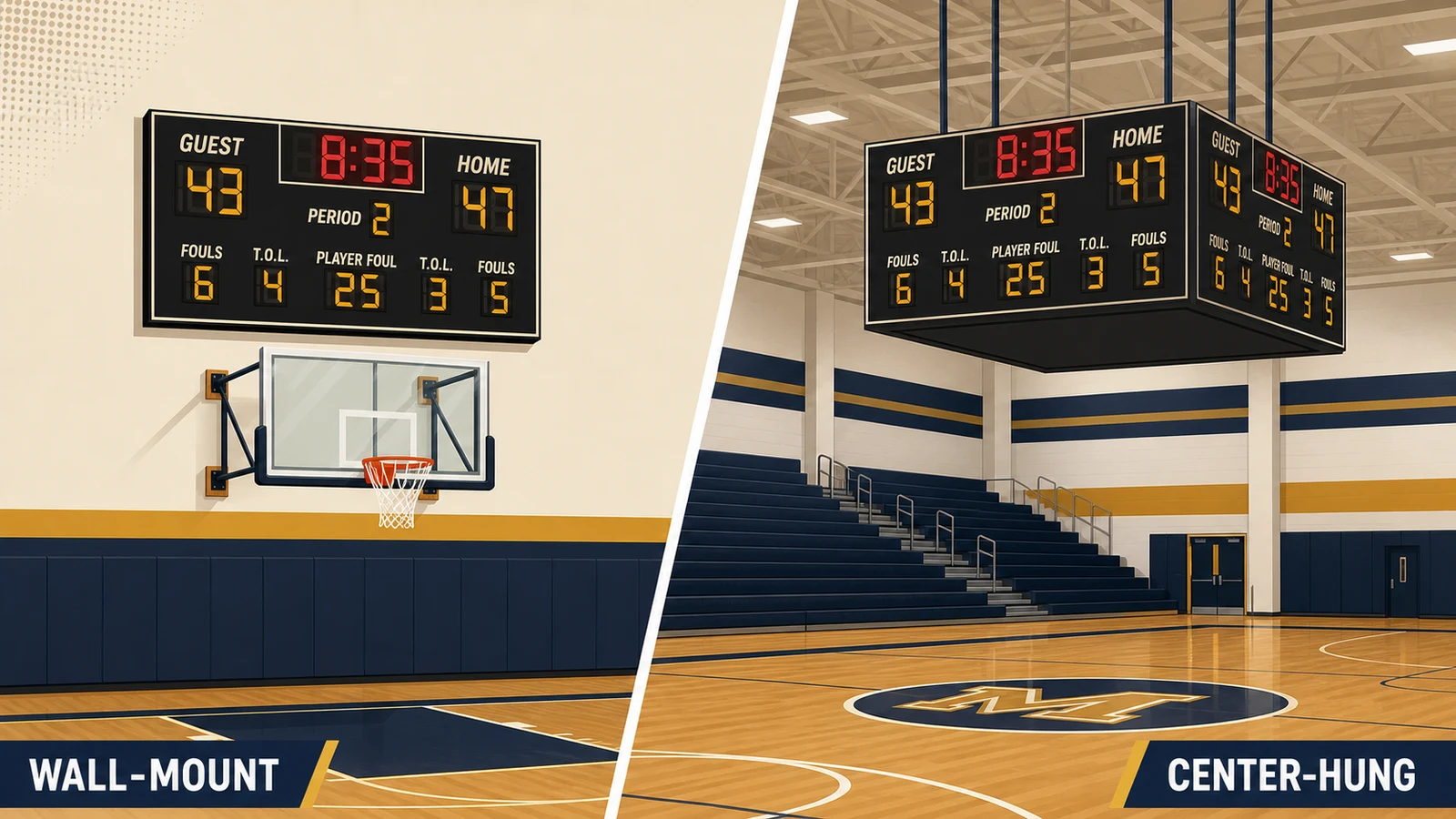
The short answer: most school and club gyms need a wall-mount LED scoreboard, not a center-hung video display - the right format is set by court count, sightlines, and ceiling, not features.
Center-hung refers to a display suspended over center court; wall-mount fixes to an end wall. Both formats run the same LED display technology. The building decides, not the feature list: court count, sightlines, and what the wall or the roof can carry.
Quick Answer
An indoor LED basketball scoreboard is a programmable display mounted on a wall or suspended over center court; for most school and club gyms, the wall-mount version is the right choice. Both formats show the same figures, so structure and budget - not features - decide. Electro-Mech sizes the scoreboard to the venue.
An indoor LED basketball scoreboard is a programmable display that shows score, time, fouls, and stats for a gym, mounted on a wall or suspended over the court. The mounting choice, not the feature list, decides the purchase. According to coaches on r/basketballcoach, gyms without a reliable scoreboard fall back on scorekeeper errors, paper stats, and no display for fans - which means that reliability, not spectacle, is the real problem. Electro-Mech frames the decision around the venue. Get the format right first. Everything else follows.
Wall-mount or center-hung: which gym scoreboard decision are you really making?
Wall-mount and center-hung scoreboards answer one facility question - how your gym is shaped and used - not which product is objectively better, so match the format to the venue.
Both mounting formats carry the same display technology. The decision comes before the feature list: court count, sightlines and ceiling structure settle which format a gym can take, and only then does the specification of the display itself matter.
The reality is that the feature set rarely decides this. Capability is not the scarce thing in this category. What actually changes is the format you mount. Wall-mount fixes to an end wall. Center-hung suspends over center court. One answers a single-court high school gym. The other earns its premium in a multi-court arena. From what I have seen, buyers who start with the venue, not the brochure, rarely overspend.
So the question is not which scoreboard is best. It is which scoreboard fits where you play. Get that right and everything downstream - cost, install, sightlines - falls into place.
How do wall-mount and center-hung scoreboards actually differ?
Beyond mounting, the two formats differ in serviceability, configuration, and the structure they demand - and both come from established display manufacturers, so the category itself is not the risk.
Start with serviceability, because that is where money quietly leaks. Both mounting formats carry the same display technology. Support runs Monday to Friday, 8 to 5 Eastern. In practice, a scoreboard that flags its own fault before tip-off is worth more than one extra feature. The takeaway: ask what the scoreboard does when something breaks.
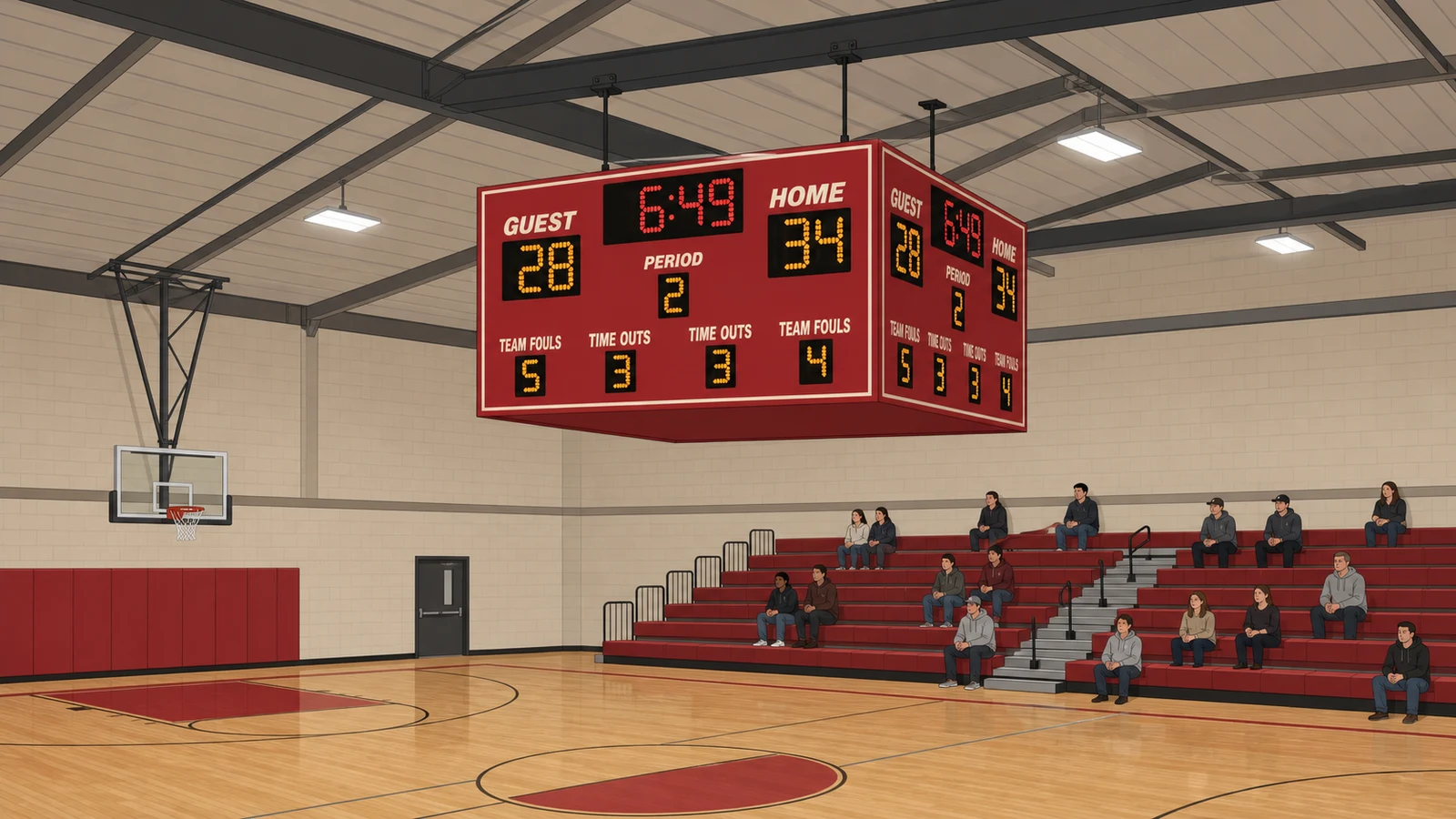
The formats also differ in how they attach. Wall-mount needs a solid end wall and a power and data run. Center-hung needs rigging, ceiling load capacity, and clear suspension points. Configuration follows the mount - a wall scoreboard is sized to one viewing axis, while a suspended scoreboard is built for multiple faces. Both formats come from the same catalogue and the same build: aluminium cabinets, the same digit sizes and the same console family. What differs is where the load goes - into an end wall, or into the roof structure above the court.
Why is center-hung the harder call, and where does under-spending backfire?
Center-hung adds rigging, ceiling load, and orientation problems most gyms cannot justify, while under-spending on cheap scoreboards backfires into game-day failures - both extremes cost more than a right-sized wall scoreboard.
Suspended video looks impressive until you price the structure around it. A centre-hung display is bound by what the ceiling can carry and by where the steel actually runs, and those two constraints decide the shape and position of the thing long before anyone chooses a model. On our own line, every single-face indoor model can be built four-sided and centre-hung instead, so the question is rarely whether a cabinet exists for it - it is whether the roof structure above the court takes the load, and what the rigging costs on top of the display.
The opposite mistake is just as costly. According to an r/basketballcoach thread, one coach bought a cheap digital scoreboard off Amazon whose stand broke fast and became more hassle than it was worth, then improvised with an iPhone and a spare television. The takeaway: an improvised display is not a scoreboard program. Electro-Mech's buyer guidance frames this directly - a scoreboard chosen for one season's budget rarely survives many seasons of use. What this means: spend once on durable, structure-appropriate hardware, not twice on regret.
Before
After
What changes when a gym replaces guesswork with a real LED scoreboard?
Before a proper scoreboard, gyms battle scorekeeper errors, no fan display, and constant stat requests; after one, scoring is accurate, visible to every seat, and self-monitoring.
| Game-day reality | Before: improvised setup | After: programmable LED scoreboard |
|---|---|---|
| Scorekeeping | Manual and error-prone | Programmable and accurate |
| Fan display | None or a phone on a stand | Visible to every seat |
| Stats | On paper, if tracked at all | Shown on the scoreboard |
| Reliability | Breaks without warning | Diagnostics flag faults early |
Both mounting formats carry the same display technology. That is the real upgrade. Every seat reads the same number. The scoreboard stops being a liability.
Which scoreboard suits a gym that also hosts volleyball and wrestling?
The right answer matches your seating, not just your sports: one programmable wall scoreboard covers a single-court gym, while busy multi-court venues with seating on several sides favor center-hung.
Basketball is rarely the only sport in the building. Capability is not the scarce thing in this category. A scoreboard built for one sport leaves the others squinting. Each sport seats fans differently. Basketball fills the end and side bleachers. Volleyball orients to the sidelines. Wrestling pulls every eye to a mat at center floor. In practice, the right scoreboard is the one every one of those crowds can read.
That seating math is what tips a busy gym toward center-hung. A suspended scoreboard shows the same information to four sides at once, which matters when bleachers wrap the floor. The takeaway: count your seating orientations before your sports. Electro-Mech treats captions for a second sport as a configuration of the cabinet, not a separate purchase - a single programmable scoreboard can be set up for basketball, volleyball, and wrestling on one display. What this means: a single-court gym usually consolidates onto one wall scoreboard, while a multi-court field house is where center-hung visibility starts to pay. Neither answer is wrong - the gym decides.
So which scoreboard should your gym actually buy?
Choose wall-mount if you have a single court, a clear end wall, and a fixed budget; choose center-hung only for large multi-court venues already built to hang it.
Run the choice through three gates: court count, sightline, and structure. One court with a clear end wall passes straight to wall-mount. Multiple courts or wrap-around seating point to center-hung. No ceiling rigging budget closes the gate on suspended scoreboards entirely. Both mounting formats carry the same display technology. In practice, if you hesitate at any gate, wall-mount is the safer default.
Two questions deserve answers before you sign. First, how long will the scoreboard last? Buyers hunting for the longest-lasting LED scoreboards for outdoor stadiums are really asking about lifespan and maintenance, and the same question applies indoors, where remote diagnostics stretch service life. Second, will one vendor cover your other venues - say, the best outdoor football scoreboards for high school stadiums - so a single relationship spans the campus? Electro-Mech builds across indoor and outdoor sports, which keeps support and control consistent. The takeaway: pick the scoreboard for the gym, but pick the maker for the program. What this means: the cheapest scoreboard and the wrong maker fail the same way.
Key Takeaways
What should you remember before buying?
Five quick rules decide most gym scoreboard purchases - match the format to your court, your sightlines, your structure, your budget, and your other sports.
- Single court with a clear end wall? Choose wall-mount.
- Multi-court venue with seating on several sides and the ceiling to support it? Consider center-hung.
- Buy one programmable scoreboard to cover basketball, volleyball, and wrestling.
- Skip the cheapest consumer scoreboards; they break and fail on game day.
- Pick a scoreboard with remote diagnostics and real vendor support.
The format decision outlasts the trend. Gyms will keep buying wall-mount LED for single courts and reserving center-hung for arenas, even as scoreboards evolve into connected stat platforms. Both mounting formats carry the same display technology. Judge the venue first - court count, sightlines, and what the wall or the roof can carry - and let the specification follow from it.
What the Indoor Line Actually Offers
Both mounting strategies draw on the same cabinets, so it is worth seeing the range before the argument about mounting begins. Every specification below is from the product pages on this site.
| Model | Cabinet Size | Digit Heights | Weight | Current at 120 VAC | Note |
|---|---|---|---|---|---|
| LX2330 | 6-1/2 ft. x 3 ft. | 9 in., 6 in. | 75 lbs. | 0.9 A | The smallest indoor cabinet |
| LX2350 | 9 ft. x 3 ft. | 12 in., 9 in. | 90 lbs. | 1.2 A | Bonus and Possession built in |
| LX2655 | 9 ft. x 5 ft. | 12 in., 9 in. | 133 lbs. | 1.5 A | The layout the rest of the line is built around |
| LX2550 | 9 ft. x 5 ft. | 12 in., 9 in. | 135 lbs. | 1.5 A | Time Outs Left in place of Player/Foul |
| LX2665 | 10 ft. x 5 ft. | 12 in., 9 in. | 150 lbs. | 1.7 A | Removable caption plates for volleyball and wrestling |
| LX2770 | 14 ft. x 6 ft. | 16 in., 12 in. | 220 lbs. | 1.9 A | The largest indoor basketball scoreboard |
The whole indoor ladder spans 75 lbs. to 220 lbs. That is the number that matters most in a mounting conversation: an indoor scoreboard is a cabinet that hangs on wall hardware, not a structure that needs footings. On the largest model the mounting tabs take two lag bolts of at most 3/8 in. diameter at 72 in. centres, or two ceiling eye bolts at 60 in. centres with a 1-inch opening for chain or cable.
Electrically the range is just as narrow - 0.9 to 1.9 amps at 120 VAC, with the console on its own circuit at 0.5 amps and a dedicated breaker recommended. Whatever the mounting decision, the electrical work is a standard circuit.
What Gyms Actually Order
Electro-Mech's sales and shipping record holds 8,810 basketball orders from 6,617 organizations in all 50 states, shipped between 1997 and 2025, counted one per organization, model and city.
Two models are more than half of it. The 9 ft. x 3 ft. LX2350 and the 9 ft. x 5 ft. LX2655 together account for 5,053 entries. Both are wall-mounted cabinets. Read by the name of the buying organization, 5,091 entries are schools, 584 parks and recreation departments, 581 churches and private facilities and 405 colleges.
That is the honest context for a wall-mount against centre-hung decision: the overwhelming majority of gyms in this record hang a modest cabinet on an end wall, and the centre-hung question arises at a small minority of buildings - the ones with seating on several sides and a roof structure able to carry a four-sided assembly.
One caution about reading this too literally. These are sales and shipping records: they say what was ordered and where it was sent, not what is hanging today, and a shipping address is sometimes a dealer rather than the gym.
What Four-Sided Actually Costs You
A four-sided centre-hung assembly is not a mounting preference. A model designated -4 draws four times the power of the single-faced version and weighs more than four times as much, and that load goes into the roof structure of the building.
Three consequences follow, and they are the reason this decision belongs to facilities before it belongs to athletics:
- The roof has to be assessed. By somebody who knows the structure, before a model is chosen rather than after.
- The electrical picture changes. Four faces means four times the scoreboard's draw - the one case in an indoor installation where the circuit is not trivial.
- Service is different. A suspended assembly needs rigging access for repairs. A wall cabinet needs a ladder.
Where one face genuinely cannot be seen from every seat, the cheaper answer is often an auxiliary display driven from the same console. Each console port drives a display directly, and displays can be daisy-chained in synchronisation, so a second face on the opposite wall is a smaller project than a centre-hung assembly.
What to Bring to a Quote
Electro-Mech quotes each project individually rather than publishing a price list. A request carrying these comes back faster and closer to final:
- The wall or the roof, and what is behind it. The answer that decides whether a centre-hung assembly is even possible.
- The distance to the farthest seat. At roughly 25 feet of viewing distance per inch of digit height.
- Which sports use the court. Basketball only, or basketball with volleyball and wrestling - which decides whether removable caption plates belong on the order.
- Player and Foul, or Time Outs Left. A scorer's-table preference worth asking about.
- Shot clocks, and which pair. Separate products: one shows shot time, the other adds Game Time.
- Wired or wireless. And if wired, the path a cable would take across the gym.
Commissioning Either Way
Whichever mounting you choose, the last hour of the installation is when problems are still cheap:
- Run every digit from the console. Points, the clock, the period, fouls, and the indicators.
- Check all three horn settings. End of period, shot clock at zero, end of time out.
- Set two brightness levels. Fifty are available - one for a full house, one for a practice.
- Read the face from the corners. And from the front row, where a stand roof or a suspended assembly can cut the sightline.
- Confirm the wireless link from the scorer's table. From the position that will be used on a game night.
- Train two people. One is not enough for a season.
Write the settings on a card inside the console case. Scorers change from year to year, and almost every mystified phone call two seasons later is a setting nobody recorded.
The Questions That Actually Decide It
Stripped of everything else, this decision comes down to five questions about the building rather than about the scoreboard.
- Where does the seating sit? Along one side, or on several sides? Seating on one axis is a wall-mount answer; seating that surrounds the floor is what makes a centre-hung assembly worth considering at all.
- What can the roof carry? A four-sided model weighs more than four times the single-faced version and draws four times the power. That is a structural question that belongs to facilities before it belongs to athletics.
- What is behind the end wall? On the largest indoor cabinet the mounting tabs take two lag bolts of at most 3/8 in. at 72 in. centres. Modest hardware, but it has to land on something.
- How will it be serviced? A wall cabinet needs a ladder. A suspended assembly needs rigging access, every time.
- How far is the farthest seat? At roughly 25 feet of viewing distance per inch of digit height, most school gyms are comfortably served by 12 in. digits.
Answer those five and the mounting decision usually answers itself. Where the questions produce a split verdict - seating on several sides but a roof nobody wants to load - the middle path is a wall cabinet plus an auxiliary display on the opposite wall, driven from the same console.
What the Line Does Not Claim
- No sport-mode switch. A second sport on the floor is handled by removable caption plates on the model built for them, not by a console setting.
- No construction grades. The cabinets are extruded aluminum across the line.
- No IP or weatherproof ratings. Not on any Electro-Mech cabinet - the claim turns up in gym specifications copied from outdoor documents and does not belong there.
- No 100,000-hour LED modules. Electro-Mech does not make LED modules and makes no lifetime claim about any component or assembly other than individual LEDs, where the statement is that the majority keep working while holding at least half their original brightness over that span.
- Video displays are a different product. With their own specifications, electrical scope and quote.
None of that changes the mounting decision, but all of it changes how two quotes should be compared - and a document offering grades or ratings for these cabinets is describing something other than this line.
A closing note on how this decision usually resolves. In Electro-Mech's record, the overwhelming majority of gyms hang a modest wall-mounted cabinet on an end wall, and the two most ordered models are exactly that. Centre-hung is the right answer for a specific kind of building - seating on several sides, a roof designed to carry the load - and it is worth a structural conversation rather than a preference. Where a gym sits between the two, an additional display on the opposite wall usually settles it for less than a suspended assembly costs to hang.
Whatever the outcome, the decisions that make a gym scoreboard work are the same either way: a wall or roof that can take it, a digit height matched to the farthest seat, captions that read correctly for every sport that uses the floor, and somebody at the console who has run it once before the first game.
Everything above comes from the product pages and owner's manuals for the cabinets themselves, and from Electro-Mech's own sales and shipping record. Where a detail differs from the manual that shipped with your scoreboard, that manual is the authority for your installation.
Measure the room, ask the facilities team, and let the mounting follow from what the building can actually carry.
One more practical note for the specification itself: whichever mounting you choose, the console, the wireless option and the shot clock arrangement are the same. Nothing about the choice between an end wall and a suspended assembly changes how the scoreboard is operated, which is worth saying to a scorer's table that has heard the debate and wondered whether their job is about to change. It is not.
Frequently Asked Questions
These answers cover the questions gym buyers ask most about indoor scoreboards - mounting, use across several sports, cost drivers, durability, and what one scoreboard can actually do.
Is a wall-mount or center-hung scoreboard better for a school gym?
Wall-mount suits a single court with a clear end wall and a tighter budget. Center-hung fits larger, multi-court venues built to support it.
Can one scoreboard handle basketball, volleyball, and wrestling?
Yes. A several sports scoreboard is a programmable scoreboard configured for several sports. Capability is not the scarce thing in this category.
What drives the cost of an indoor LED scoreboard?
Size, mounting type, and structure drive cost more than the display itself. Suspended scoreboards add rigging and ceiling work that wall-mount scoreboards avoid.
Do LED scoreboards do more than show the score?
Yes. Modern scoreboards show player stats, team logos, video graphics, and sponsor ads, turning the scoreboard into a fan-experience and revenue tool.
How long should an indoor LED scoreboard last?
A quality LED scoreboard is a multi-year investment, so durability and support matter more than the lowest price. Electro-Mech sizes scoreboards to the venue.
Summarize This Article With AI
Open this article in your preferred AI engine for an instant summary.
How this article was created
This guide was drafted with AI assistance and reviewed by the Electro-Mech editorial team, which edits for accuracy and fact-checks each claim against the cited industry, vendor, and community sources. Automation speeds research and structuring so editors can focus on judgment and verification, helping readers get a clear, current answer faster without sacrificing accuracy.
The last practical point: whichever way the decision goes, get the facilities team into the conversation before a model is chosen rather than after. Every expensive surprise in this category - a wall that will not take the cabinet, a roof nobody will load, a sightline blocked by something that was always there - is a building fact that somebody already knew.
A gym scoreboard is a fifteen-year purchase in a room that will not change much in that time. Spending an hour on the room first is the cheapest part of the project.