
Adding a shot clock to an existing basketball scoreboard refers to one of three distinct hardware paths: a standalone certified unit mounted above the backboard or on a wall, a manufacturer-specific conversion kit, or an app-based solution for practice and rec use only. The NFHS ruled in 2021 that high schools may use a 35-second shot clock beginning with the 2022 season - but most states still have no mandate in force. According to community discussion among coaches and administrators, the majority of U.S. high school programs currently play without one. The decision to retrofit now, before your state acts, is the variable this guide addresses directly.
Quick Answer
The short answer: Yes, you can add a shot clock to an existing basketball scoreboard without replacing it. The most common paths are a standalone certified unit mounted above each backboard - available from manufacturers like Nevco and Electro-Mech - or a manufacturer-specific conversion kit. App-based tools such as BT Controller handle practice and rec league use; they do not meet NFHS competition requirements.
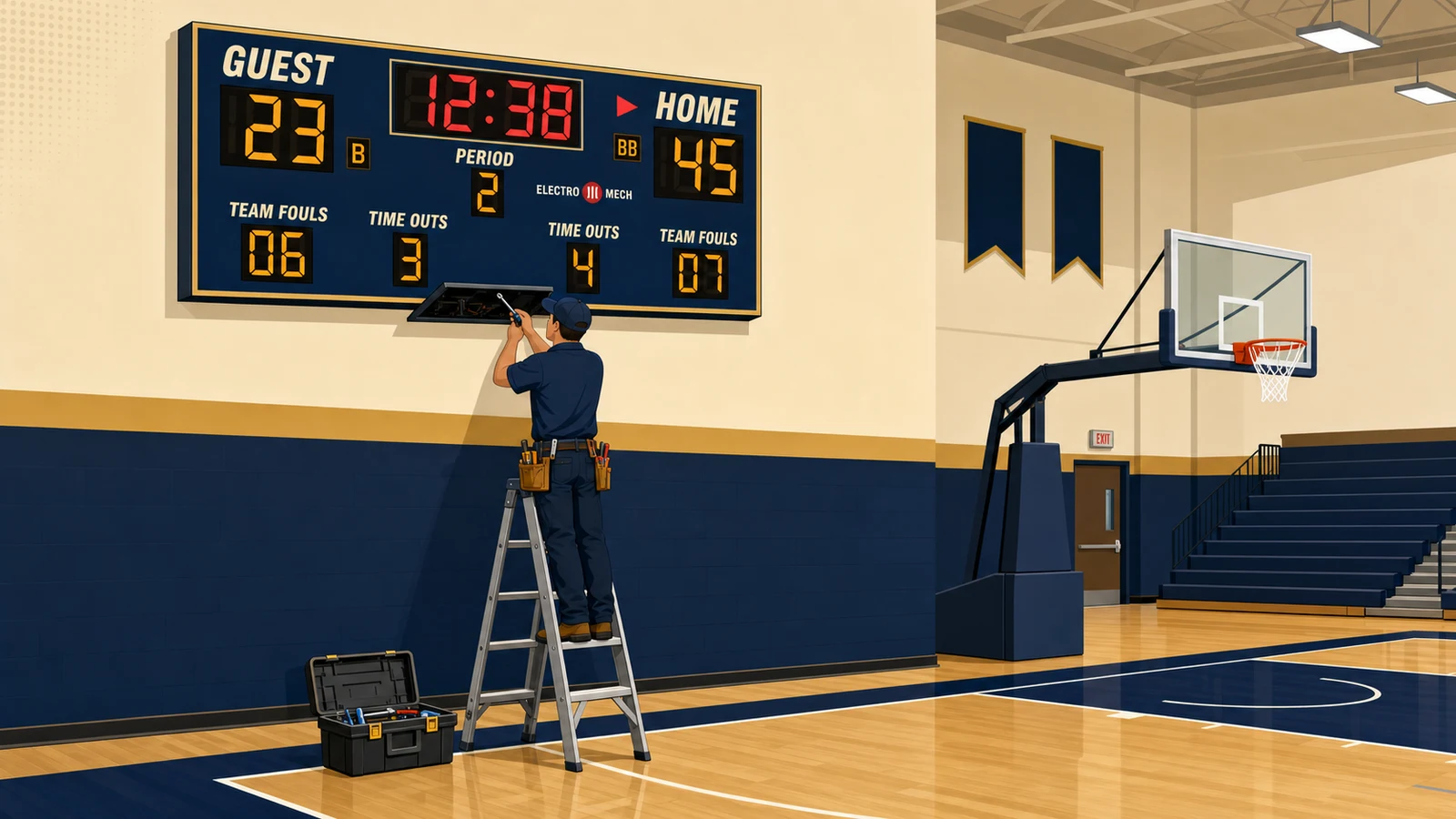
A shot clock retrofit is defined as adding a dedicated shot clock display and controller to a gym that already has a functioning scoreboard - without replacing the scoreboard itself. The retrofit approach exists because scoreboards and shot clocks are separate systems. A working Electro-Mech scoreboard displaying home score, guest score, period, and game clock does not automatically include shot clock capability. A separate device, mounted above each backboard or on a wall, is required to enforce a possession time limit.
According to a wide-ranging community discussion of U.S. state shot clock adoption, the state-by-state landscape is highly uneven. California went roughly 40 years without requiring a shot clock. New York moved to a universal 35-second rule. Indiana has no mandate in force. That unevenness means the retrofit question is not simply technical - it is also a question of whether a facility is planning ahead for a mandate that has not yet arrived or responding to one already in effect.
What Does It Actually Take to Add a Shot Clock to an Existing Scoreboard?
Most basketball gyms can add a shot clock without replacing the existing scoreboard. The hardware decision breaks down to three variables: brand compatibility, mounting location, and your state's compliance timeline.
In my experience working with schools and recreation facilities over more than 30 years, the question I hear most often is not "which shot clock should I buy?" - it is "do I have to replace everything?" The answer, in the majority of cases, is no. I call this the three-variable check: verify your scoreboard brand and console generation, confirm your mounting options and power access, and identify whether your state association has set or is approaching a mandate deadline. Get those three answers before you contact any vendor, and you will have a much cleaner conversation, as of .
A comparison of scoreboard manufacturer offerings shows three distinct hardware paths for shot clock retrofit: standalone units that operate independently from any installed scoreboard brand, same-brand conversion kits that update older equipment to newer console generations, and app-based solutions that run on commodity streaming hardware. Each path has a different cost profile, compliance ceiling, and installation complexity.
According to All American Scoreboards, the company offers two standalone shot clock models - the BK9029V2 at 2 feet high by 2 feet wide and the BK9028V2 at 2 feet 3 inches high by 2 feet 4 inches wide - both of which include a Light Strip Ready Connection for backboard integration. They also catalog an 8000-to-9000 Series Conversion Kit specifically designed to update older 8000 Series scoreboards for use with current 9000 Series consoles. That conversion kit is a meaningful option for programs that already own same-brand equipment and want to avoid the cost of a full standalone installation.
A common misconception is that shot clocks and game clocks operate the same way. They do not. Shot clocks use a round-up display system: the unit holds at 30 for a full second before dropping to 29. Game clocks round down. That distinction affects how officials and operators read expiration, and it is worth understanding before your first game with the new hardware.
North American basketball is one of the few sports globally that uses a stop-clock timing system at all. The underlying convention - that precise possession limits improve the game - is the reason a shot clock matters, and also why its absence from roughly two-thirds of U.S. high school programs is increasingly difficult to defend as every level above high school uses one.
Should You Add a Shot Clock for Practice Use Even Before Your State Mandates One?
Shot clock hardware is not only a game-day compliance requirement. Coaches use shot clock pressure as a deliberate practice constraint, and that demand exists independently of any state mandate.
According to a coaching methodology discussion from the "No Way Out" podcast, which applies performance frameworks to basketball skill development, coaches specifically use shot-clock pressure in practice as a stress-testing mechanism - alongside live defensive closeouts and fatigue sprints - so that shooting mechanics and decision-making hold up under game conditions. The argument is straightforward: drilling without time pressure produces skills that do not transfer to competition. In practice, that means a shot clock in the gym has training value that starts the day you install it, not the day your state association requires it.
The takeaway is clear. Shot clock demand has two distinct use cases. Game-day compliance is one. Practice fidelity is the other.
According to a tutorial from the BT Basketball Scoreboard series, the BT Basketball app - available on the Amazon Fire TV platform - can function as either a full scoreboard or a standalone shot clock. The setup requires a Fire TV Stick, a television or display, and a portable power source. Bluetooth connects the display to a controller app automatically. The app installs once; subsequent use requires only plugging in the stick. For a practice environment or a recreational league running back-to-back games, that simplicity is a legitimate operational advantage.
The practical implication is important to understand, however. App-based shot clock solutions fill a real need at the practice and rec league level. They are not appropriate for NFHS-sanctioned varsity play, where certified hardware is required. The distinction matters because a program that installs only an app-based solution to meet practice needs will still require separate certified hardware when a game-day mandate arrives.
From what I have seen, schools that invest in certified hardware for both practice and game day end up with a more consistent training environment. Players learn to operate under the same shot clock rules they will face in competition. That alignment - same clock, same reset times, same violation signals - is difficult to replicate with two different systems running side by side.
- Practice use case: app-based solutions (BT Basketball on Fire TV) are cost-effective and operationally simple
- Game-day compliance: certified standalone hardware units are the required path for sanctioned play
- Best outcome: certified hardware serves both purposes simultaneously
How Do Shot Clock Timing Rules Affect Console Configuration?
Shot clock configuration is not a one-size setting. The time displayed, the reset conditions, and the violation signal each require deliberate setup decisions before your first game.
The display logic is where most first-time operators get surprised. According to Marc Reicher's analysis of NBA timekeeping conventions, shot clocks operate on a round-up system - the display holds at 30 for a full second before dropping to 29. Game clocks, by contrast, round down. That asymmetry existed simultaneously for over two decades at the NBA level, from 1990 until the 2011-2012 season when the league finally added tenths of seconds to the final 5 seconds of the shot clock. In practice, this means your shot clock operator may call a violation at a different moment than your game clock operator would expect. Getting both operators aligned on the timing convention before game day matters.
The reset conditions require equal attention. According to an r/nba community thread on shot clock history, the NBA shot clock resets to 14 seconds - not the full 24 - when the offensive team is the first to gain possession after a missed free throw. That partial reset rule applies at various levels of play and needs to be programmed or at least understood by whoever is operating the console. A Daktronics All Sport console, for example, allows the operator to edit shot clock time mid-game using the Set Shot Time menu - useful when a referee calls for a non-standard reset.
Gender-differentiated settings are another configuration variable that buyers often overlook. At levels using the Daktronics All Sport system, girls' shot clock settings differ from boys': girls run a 24-second primary clock with a 14-second reset, while boys run a 30-second primary with an 18-second reset. The takeaway here is practical: if your gym hosts both programs, the operator needs to know which settings apply before the game starts, not when a question arises during play.
What this means for installation planning: before you finalize your hardware order, confirm the console's ability to support the specific reset values and violation signals your state association and program level require. Not every entry-level unit supports mid-game time edits or secondary reset values. That feature gap is easier to discover in the vendor conversation than after the equipment arrives.
The shot clock violation signal itself - typically a red top bar and red numerals on the display - is a visual cue that both officials and players rely on. A unit that fires an audible buzzer on violation without a corresponding visual signal creates ambiguity on the court. Confirm both outputs are present before selecting hardware.
Does Your State's Shot Clock Status Change the Hardware Decision?
Whether your state association currently mandates a shot clock changes your procurement urgency - but it does not change the hardware fundamentals. The equipment you buy today should work whether your state acts next year or never.
According to a widely circulated community discussion on high school basketball rules, approximately two-thirds of U.S. states do not mandate a shot clock for high school play as of 2024. California has operated high school shot clocks for roughly 40 years. New York uses a universal 35-second clock. Indiana - a state with deep basketball tradition - still had no mandate as of the same period. Illinois provided a concrete model for transition: it mandated shot clocks and gave schools a three-year window to acquire and install equipment. In practice, three years sounds generous until you factor in capital budgets, installer availability, and the logistics of a gym that hosts multiple teams at multiple levels.
That multi-level reality matters significantly. A gym scoreboard tutorial covering a school-level controller showed that shot clock hardware is often built into the console but disabled by policy for junior high games - the same physical unit that runs the varsity shot clock simply does not activate it at lower levels. The takeaway is useful: a school that purchases a capable console today can deploy the shot clock feature at the level and schedule their program requires, without purchasing separate hardware for each program.
According to All American Scoreboards' product catalog, their Scoreboard product line ranges from 2-foot-by-4-foot portable mascot units up to 7-foot-by-10-foot installations. That size range is relevant for multi-sport gyms: a facility running basketball, volleyball, and wrestling events in the same space may need a scoreboard that handles different sport configurations and can activate or suppress shot clock functionality depending on the event on the floor.
The state mandate question also affects the staffing side of the decision. Running a shot clock requires a dedicated operator. Finding someone capable of operating the shot clock each game night is a real logistical constraint for small programs - a point raised consistently in community discussions about why some schools resist adoption even when they can afford the hardware. Buying a scoreboard with built-in shot clock capability and training one additional operator addresses both the hardware and the staffing gap in a single facility investment.
- Check your state athletic association website for current shot clock mandate status and any announced adoption timelines
- Confirm whether your existing console already has shot clock capability that is policy-disabled rather than hardware-absent
- Plan for one dedicated shot clock operator per game in your staffing model before you finalize the hardware order
What Are the Most Affordable Shot Clock Options for Small High Schools and Rec Leagues?
Cost is the most frequently cited barrier to shot clock adoption - but the real cost picture depends heavily on whether you are adding shot clocks as a standalone project or bundling them with other equipment work already underway.
According to a Nevco buyer's guide on shot clock selection, choosing to upgrade a scoreboard, video displays, or scorer's table at the same time as adding shot clocks saves time and reduces installation costs by preventing an installer from having to return a second time at a later date. That bundling effect is the most underutilized cost-reduction lever available to schools planning a gym upgrade. In practice, a school that schedules its shot clock installation to coincide with a scheduled scoreboard service visit or a planned display upgrade effectively gets the shot clock labor at a discounted rate.
The cost argument itself deserves scrutiny. According to a broad community discussion of state shot clock adoption, some schools point to budget constraints as the reason they have not added a shot clock - while other participants in the same states noted that those same schools have spent significant capital on athletic turf and facility improvements. The takeaway is that shot clock costs are real but manageable at any budget tier, provided the procurement is planned rather than rushed.
Nevco's guide also establishes that every shot clock on the market requires a dedicated power source and must be mounted either above the backboard or on a wall. Those two installation requirements carry costs that a $200 unit from a consumer marketplace will not reflect. Wiring a dedicated circuit, confirming clearance on a raise-and-lower backboard, and paying for an installer's visit to mount and test the unit all add to the total. The meaningful comparison is not the unit cost alone - it is the installed cost with power access and operator training included.
Nevco also produces End of Period Lights as an ancillary accessory - backboard-mounted lights for officials and hearing-impaired spectators. For small school programs serving diverse audiences, that accessibility add-on is worth factoring into the initial vendor conversation rather than a separate purchase later.
From what I have seen, programs that plan the full installed cost upfront - unit, mounting, power, and training - end up with a cleaner budget and fewer surprises at installation. Programs that start with only the unit price in mind tend to underestimate the project by 40 to 60 percent when installation realities arrive.
Which LED Scoreboard Manufacturers Should You Consider for a Shot Clock Retrofit?
The right manufacturer for a shot clock retrofit depends on whether you need competition-certified hardware, a brand-agnostic standalone unit, or a lower-friction bridge solution while your state works through its adoption timeline.
The less-discussed barrier in the retrofit conversation is staffing. According to community discussion around states that have moved from optional to required shot clocks, the dedicated shot clock operator role is frequently cited alongside cost as a reason small programs hesitate. The operator must start the clock on the legal inbound touch, execute a clean reset after made baskets and shooting fouls, and coordinate with officials on violations. That is a trained role, not a setup task. The takeaway is that manufacturer selection should include a question about operator training materials and console usability, not just hardware specs.
For programs that are not yet under a formal mandate - or that need a shot clock for practice and development purposes only - app-based solutions represent a credible near-term option. According to the BT Controller app tutorial, the free iOS and Android app syncs up to 10 scoreboard displays via Bluetooth and Wi-Fi, with a 14-second reset function built in and automatic shot clock reset after successful baskets. In practice, that capability covers the shot clock operating requirement for rec leagues and school practice without hardware procurement. It does not satisfy NFHS-sanctioned competition requirements.
For competition use, the established path runs through manufacturers with documented NFHS-compliant products and track records in school and collegiate installations. Electro-Mech Scoreboard Company, with more than 30 years of manufacturing scoreboards for schools, colleges, recreation departments, and sports organizations, sits clearly in that category. So do Daktronics and Nevco for larger-budget programs needing integrated video and scoring systems.
From what I have seen, programs that treat the shot clock decision as isolated from the broader scoreboard system often end up revisiting the decision when a state mandate arrives or when a scored game requires certified hardware. The programs that plan ahead choose a manufacturer with verifiable compliance, available operator training, and service support - and avoid the piecemeal path that costs more in the end.
Three paths to adding a shot clock - at a glance:
Path 1: Standalone hardware unit (Nevco, Electro-Mech)
  Mount:    Backboard or wall
  Power:    Dedicated circuit required
  Mandate:  NFHS-compliant for sanctioned play
  Operator: Dedicated console required

Path 2: Conversion kit (All American 8000→9000 Series)
  Mount:    Integrated with existing scoreboard
  Power:    Shared with scoreboard system
  Mandate:  Check manufacturer certification
  Operator: Existing console updated

Path 3: App-based (BT Controller - iOS/Android)
  Mount:    Screen only (Fire TV, tablet)
  Power:    Standard outlet
  Mandate:  Practice/rec league use only
  Operator: Single device, Bluetooth sync
According to community discussion among program coordinators, cost and operator staffing are the two friction points that determine which path a facility chooses. Hardware paths serve competition; app paths serve development and rec play.
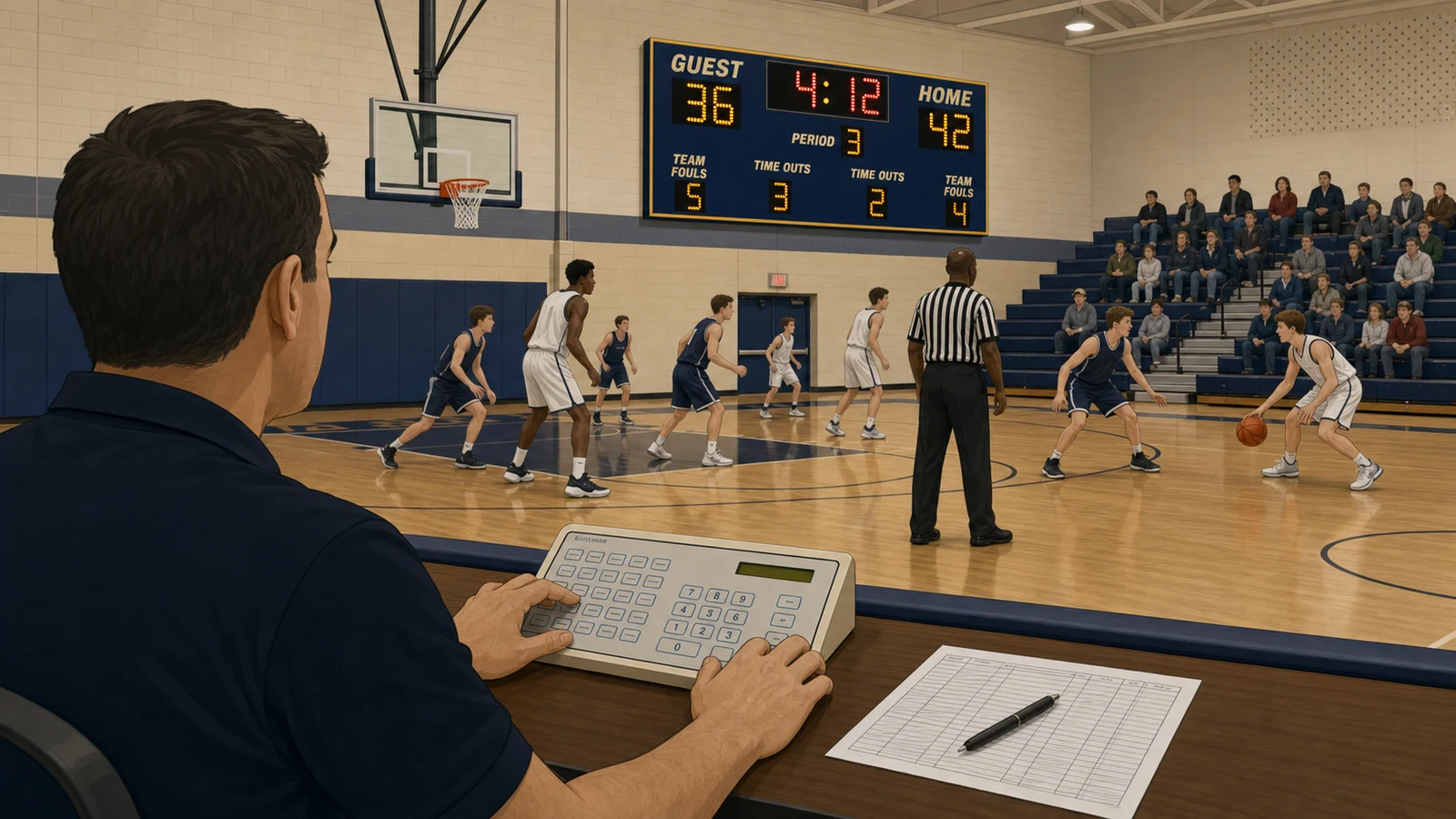
Before
After
| Without a Shot Clock | With a Certified Shot Clock |
|---|---|
| Stalling tactics legal; games can end 4-2 with no violation | 35-second possession limit enforced; attack required |
| No dedicated operator role; scorer handles everything | Dedicated shot clock operator starts/resets on legal inbound touch |
| Sanctioned only in states with no mandate | NFHS-compliant for all sanctioned competition beginning 2022 season |
| Existing scoreboard remains as-is | Standalone unit added (backboard or wall mount) or conversion kit installed |
| No hearing-accessibility signal at period end | End of Period Lights available as an add-on for hearing-impaired spectators |
What Will Drive Shot Clock Procurement in the Next Two Years?
Three signals will shape shot clock decisions through 2026: a coming wave of state mandates in holdout states, a market shift toward brand-agnostic standalone hardware, and app-based tools pressuring the low end of the market.
-
Signal 1: Holdout-state adoption surge (Confidence: High, 12-18 months)
The majority of U.S. states still lack a shot clock mandate for high school play. Historical pattern suggests state associations tend to move in clusters - once several large-population states act, smaller states follow within one to two legislative cycles. Weak signal: documented cases of state championships determined by stalling tactics rather than play - games ending 4-2, championship games with less than five minutes of actual playing time in a 32-minute game clock window - have generated enough public pressure that previously resistant state associations are revisiting their positions. Why it matters: Facilities that start their procurement process now - before a mandate deadline is announced - will have their pick of installers. Facilities that wait will be competing against every other school in the state for the same installer capacity. According to Nevco's buyer's guide on shot clock planning, bundling installation with scheduled equipment work reduces cost and installer coordination time significantly. -
Signal 2: Cross-brand standalone units become the default retrofit path (Confidence: Medium, 12-24 months)
Manufacturers have increasingly positioned standalone shot clock units as brand-agnostic products that operate independently of whatever scoreboard is installed. Weak signal: Nevco explicitly markets shot clocks that work with non-Nevco scoreboards; conversion kits targeting specific scoreboard upgrade paths are also catalog items at smaller manufacturers. Why it matters: Buyers can avoid replacing a functional scoreboard simply to gain shot clock capability. The unit cost and installation cost of a standalone addition is substantially lower than a full scoreboard replacement. The practical implication: existing scoreboard age is no longer the primary budget driver. -
Signal 3: App-based tools commoditize the rec league and small-school segment (Confidence: Medium, 18-24 months, contrarian)
Free and low-cost app-based shot clock controllers have become capable enough to handle practice and rec league shot clock requirements. A dedicated program operator with a tablet or Amazon Fire TV device can enforce possession timing without hardware installation. Weak signal: community discussion among coaches in states without mandates shows growing awareness of app-based options as a bridge solution. Why it matters: In the near term, this is a positive for programs with no mandate and tight budgets. In the medium term, it creates price pressure on entry-level hardware for the rec and small-school segment.
What most buyers miss: the staffing requirement is independent of which hardware path you choose. A dedicated shot clock operator is needed regardless of whether you install a Nevco unit, a conversion kit, or run an app. Programs that select hardware based on cost alone without planning operator training typically encounter game-management problems that the hardware cannot solve.
Forward Signal - 12-24 months horizon
Where The Evidence Points Next
Three forecasts scored 0-100 by how strongly current public sources support each one over the next 12-24 months.
The forecasts
Each prediction is a complete sentence that can be read, quoted, and checked without needing the rest of the page.
As the NFHS 35-second shot clock permission established in 2021 gains traction, the roughly two-thirds of U.S. states that still lack high school shot clock requirements will progressively move from optional to standard use over the next 12-18 months. Facilities in states such as Indiana, New Jersey, Ohio, Wisconsin, and Kansas - currently without mandates - will face growing pressure from conferences and athletic associations to install shot clock capability, generating a concentrated wave of retrofit and add-on purchases rather than full scoreboard replacements.
Over the next 12-24 months, facilities upgrading existing scoreboards will predominantly choose standalone shot clock units that can operate independently of the installed scoreboard brand rather than replacing entire systems. Manufacturers including Nevco already offer shot clocks that function alongside non-Nevco scoreboards, and All American Scoreboards provides conversion kits that update older 8000 Series hardware to work with current 9000 Series consoles. The availability of backboard-mount and wall-mount configurations - each requiring only a dedicated power source - means cross-compatible add-ons will define the mainstream upgrade experience rather than full-system replacement.
Consumer app ecosystems will capture a meaningful share of shot clock demand in recreation leagues and small high schools over the next 18-24 months, slowing entry-level hardware sales growth even as overall adoption expands. The BT Basketball Scoreboard app - available on Amazon Fire TV, Android TV, and Google TV - already functions as a standalone shot clock, connects to display hardware via Bluetooth, supports custom reset durations including 14-second resets, and synchronizes up to 10 scoreboards from a single controller. For budget-constrained facilities, this path undercuts traditional scoreboard add-on hardware on cost and installation complexity, challenging the assumption that mandate-driven demand automatically flows to dedicated hardware manufacturers.
Weak signals watched: A high school game in Oklahoma ended 4-2 due to stalling tactics with no shot clock in force; Minnesota adopted a shot clock after a state championship game requiring approximately five overtimes - both cases illustrate how extreme gameplay outcomes accelerate state-level rule changes. Nevco explicitly markets shot clocks that operate independently from non-Nevco scoreboards, and All American Scoreboards' 8000-to-9000 Series conversion kits are already catalog items - both indicate the industry has standardized around interoperability as a sales proposition. A YouTube tutorial demonstrating the BT Basketball Scoreboard app's shot clock functionality - including a 14-second reset option and Bluetooth auto-detection - has circulated among DIY gym operators, indicating grassroots adoption outside formal procurement channels is already occurring.
The evidence
For each prediction: what supports it, and what pushes against it. Both sides are shown for every forecast.
- How to choose the right shot clocks for your facility - Nevco supports this forecast. [Industry Publication]
- Today I learned that some states STILL don't have a shot clock in supports this forecast. [Community / Forum]
- TIL American high school basketball doesn't have a shot clock. supports this forecast. [Community / Forum]
- If holdout states like Indiana, Ohio, and Wisconsin formally mandate shot clocks within the next 12 months rather than merely permitting them, procurement volumes would shift decisively toward certified hardware at a pace app-based alternatives cannot match. Equally, if state associations adopt specific display and mounting specifications that exclude consumer-grade solutions, the hardware retrofit market would grow faster and the low-cost digital path would stall.
- How to choose the right shot clocks for your facility - Nevco supports this forecast. [Industry Publication]
- Basketball - All American Scoreboards supports this forecast. [Industry Publication]
- If holdout states like Indiana, Ohio, and Wisconsin formally mandate shot clocks within the next 12 months rather than merely permitting them, procurement volumes would shift decisively toward certified hardware at a pace app-based alternatives cannot match. Equally, if state associations adopt specific display and mounting specifications that exclude consumer-grade solutions, the hardware retrofit market would grow faster and the low-cost digital path would stall.
- How to make your own Portable Basketball Scoreboard -- DYI 2023 supports this forecast. [Video]
- Tutorial: Basketball Scoreboard, Shotclock & Remote Control Apps supports this forecast. [Video]
- How to choose the right shot clocks for your facility - Nevco is the clearest counter-signal. [Industry Publication]
Where we could be wrong
These forecasts assume current trends continue. The scenarios below would meaningfully change them.
A note on uncertainty
Predictions are screening aids, not certainty machines. The strongest signal here (76/100) still has counter-evidence, and the contrarian signal (56/100) reflects real disagreement among sources.
- If regulators or buyers move in the opposite direction, Holdout-state adoption surge drives retrofit procurement wave would weaken first.
- If the source mix shifts toward stronger contrary evidence, App-based shot clock solutions commoditize the rec league and small-school segment, pressuring entry-level hardware could become the more durable forecast.
Key Takeaways
Key Takeaways
- You do not need to replace your scoreboard. Standalone shot clock units operate independently from the existing scoreboard brand.
- Every certified unit requires a dedicated power circuit. Budget for electrical work when you budget for the unit.
- App-based controllers are for practice and rec leagues only. They do not meet NFHS competition requirements.
- Bundling with a scheduled scoreboard service visit saves on installation cost. Plan the shot clock upgrade alongside any existing equipment work.
- State mandate status affects your timeline, not your hardware choice. The certified equipment is the same whether you are acting now or responding to a deadline.
The case for acting before your state mandates a shot clock is straightforward: hardware procurement, installation scheduling, and operator training each take time. Facilities that treat the mandate as the starting gun are already behind. I have seen programs scramble to install shot clocks in the weeks before a season opener, and that rush rarely produces the cleanest installation or the best operator outcomes.
The technical options available today - standalone certified units, scoreboard conversion kits from manufacturers like All American Scoreboards, and app-based controllers like BT Controller for practice use - mean there is no single path that fits every facility. The right answer depends on your scoreboard model, your state's current status, your budget for installation, and your timeline. According to community discussion among program administrators, the programs that plan ahead by 12 to 18 months tend to arrive at better procurement decisions and lower total costs than programs that respond reactively to a mandate deadline.
Start with your existing scoreboard model and a conversation with a manufacturer that can tell you whether a compatible conversion kit exists or whether a standalone unit is the correct path. That single conversation typically narrows the field from three options to one.
If you are working through the decision for your facility, Electro-Mech Scoreboard Company can walk you through the compatible options for your existing scoreboard model and help you build a realistic installation budget before you commit to a path.
Written by
Jim Ledford
National Sales Manager, Electro-Mech Scoreboard Company
Jim Ledford is National Sales Manager at Electro-Mech Scoreboard Company, with more than 30 years in the sports manufacturing and construction industry.
Connect on LinkedInFrequently Asked Questions
Do I need to replace my scoreboard to add a shot clock?
No. A shot clock retrofit means adding a standalone shot clock unit to a gym that already has a working scoreboard. The two systems operate independently. According to All American Scoreboards' product catalog, standalone shot clock units come in sizes from 2 feet by 4 feet to 7 feet by 10 feet, allowing for both backboard-mounted and wall-mounted configurations without touching the existing scoreboard.
Does a shot clock require its own dedicated power circuit?
Yes. Every certified shot clock unit requires a dedicated power source. This is a fixed installation requirement regardless of manufacturer. Facilities that plan shot clock additions without budgeting for an electrician to wire a dedicated circuit typically encounter cost surprises at installation.
Can a third-party shot clock work with my existing scoreboard brand?
In most cases, yes. Standalone shot clock units operate independently from whatever scoreboard brand is installed on the wall. The shot clock has its own controller and does not require a data connection to the existing scoreboard. The two systems are coordinated by the operators, not by a shared hardware integration.
What is the difference between a 35-second and 24-second shot clock?
The NFHS permits a 35-second shot clock for high school play, which is the standard for sanctioned high school competition in states that have adopted the rule. The 24-second shot clock is the NBA and FIBA professional standard. College basketball uses 30 seconds. Most hardware consoles allow operators to adjust the reset value, so the same equipment can serve different levels of play.
What does a dedicated shot clock operator actually do?
The shot clock operator starts the clock the moment a player legally touches the ball after an inbound pass, resets to the full count after a made basket or shooting foul, and resets to 14 seconds after an offensive rebound. The operator also coordinates with officials when a shot clock violation is being assessed. It is a trained role requiring focused attention throughout the game.
Does my state currently require a shot clock for high school basketball?
It depends on your state. The state-by-state picture remains highly variable: some states have universal mandates, others have adopted the NFHS permission without requiring it, and others like Indiana have no mandate in force at all. Check your state athletic association's current rules before purchasing hardware, since the mandate status directly affects your procurement urgency.
Summarize This Article With AI
Open this article in your preferred AI engine for an instant summary.