
Basketball is what Electro-Mech sells most of - 41 percent of the company's sales - and the indoor record is the deepest data we have on any sport: 8,810 orders from 6,617 organizations in all 50 states, shipped between 1997 and 2025. This guide uses it, along with the specifications published on this site, to answer the question a gym actually faces: which scoreboard fits this room, this wall and this sport calendar.
- How big should the scoreboard be for the seats your gym actually has?
- What does the wall behind it need to carry?
- Volleyball and wrestling on the same court - what changes?
- What do schools and colleges order most, and how do they differ?
Quick Answer
The short answer: a school gym is a small room by scoreboard standards, so the sizing question is usually narrower than buyers expect. The two models schools order most are a 9 ft. x 3 ft. cabinet and a 9 ft. x 5 ft. cabinet, together more than half of everything shipped for basketball. Shot clocks are separate products mounted behind the backboards. The wall matters more than the ceiling height, and Electro-Mech quotes each project individually rather than publishing prices.
Start With the Gym, Not the Catalogue
Indoor sizing is a different exercise from outdoor sizing, and the difference is the room. The farthest seat in a high school gym is rarely more than 150 feet from the end wall, and even a large college arena keeps most of the seating inside 250. At roughly 25 feet of viewing distance per inch of digit height, that puts the useful digit range at 9 in. to 16 in. - which is exactly the range the indoor line covers, and the reason a gym scoreboard is not a small stadium scoreboard.
Three things about the room decide more than the catalogue does:
- The wall, not the floor. An indoor scoreboard ships with mounting hardware for attaching the cabinet to a wall. The posts, clamp assemblies and concrete footings that go with outdoor scoreboards have nothing to do with a gym installation. What matters is the structure behind the wall surface.
- The mounting height and the sightline. A scoreboard hung too high disappears behind the top of the backboard for the front rows, and one hung too low is blocked by standing spectators. Walk the room and look from the corner seats, not from centre court.
- What else uses the court. If volleyball and wrestling share the floor, that changes which cabinet is right - see below. It is the most common reason a gym ends up with the wrong scoreboard.
What an Indoor Basketball Scoreboard Shows
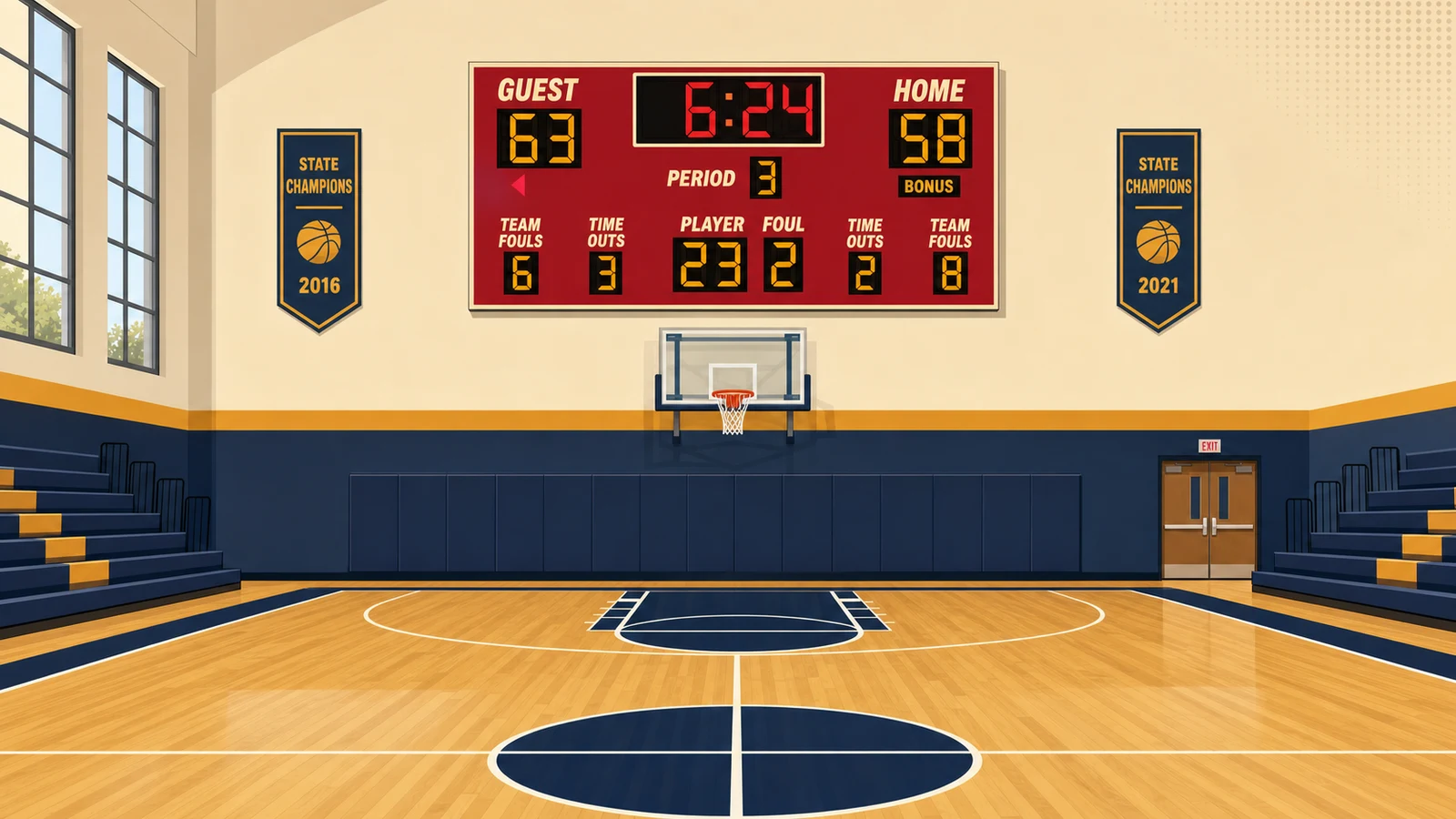
The core set is Guest Points, Home Points and the Period Clock in the largest digits on the face, with Period, Fouls, Time Outs, Player Number and Player Foul below them in a smaller size, and Bonus and Possession as indicators. Beyond that, the differences between models are real but narrow:
- Player and Foul, or Time Outs Left. The LX2550 takes the standard LX2655 layout and swaps the Player/Foul digits for Time Outs Left. Which one a school wants is a scorer's-table preference, and it is worth asking the person who will run it.
- Colour as a way of reading the face. The indoor line uses three LED colours to separate areas of the scoreboard, so a spectator can find the clock without reading captions. It is a design choice that runs through the family rather than a feature on one model.
- Advertising space. The LX2645 leaves blank areas either side of the timer section for sponsor panels, on the reasoning that every eye in the gym is already pointed there.
- A duplicate clock at the other end. The LX2180 is a pair of displays showing Game Time and Shot Clock time together, with a 6 in. Period Clock that duplicates the clock on the main scoreboard. It is the model colleges order most.
Volleyball and Wrestling on the Same Court
This is where indoor buying goes wrong most often, and the honest description is narrower than the marketing phrase suggests. There is no sport-mode switch that turns a basketball scoreboard into a volleyball scoreboard.
What exists is the LX2665, and what it does is physical: along the bottom of the cabinet are three removable metal plates carrying alternate labels, so the captions that read for basketball can be swapped for the ones volleyball and wrestling need. The cabinet is 10 ft. x 5 ft. and 150 lbs., and it is popular exactly in the facilities where basketball is the main sport but the court gets handed over during the season.
If your gym runs three sports off one court, that mechanical detail is the specification to ask about by name. If it runs basketball only, the LX2550 exists for that case and gives the face over entirely to basketball.
The Size Ladder, From a Small Gym to a Field House
Every specification below comes from the product pages on this site.
| Model | Cabinet Size | Digit Heights | Weight | Current at 120 VAC | Notes |
|---|---|---|---|---|---|
| LX2330 | 6-1/2 ft. x 3 ft. | 9 in., 6 in. | 75 lbs. | 0.9 A | The smallest indoor cabinet in the line |
| LX2350 | 9 ft. x 3 ft. | 12 in., 9 in. | 90 lbs. | 1.2 A | Bonus and Possession built in |
| LX2340 | 8 ft. x 4 ft. | 12 in., 9 in. | 90 lbs. | 1.2 A | Three LED colours separating the areas |
| LX2655 | 9 ft. x 5 ft. | 12 in., 9 in. | 133 lbs. | 1.5 A | The layout the rest of the line is built around |
| LX2550 | 9 ft. x 5 ft. | 12 in., 9 in. | 135 lbs. | 1.5 A | Time Outs Left in place of Player/Foul |
| LX2645 | 8 ft. x 6 ft. | 12 in., 9 in. | 140 lbs. | 1.5 A | Blank panels either side for advertising |
| LX2745 | 8 ft. x 6 ft. | 12 in., 9 in. | 140 lbs. | 1.7 A | Nearly square cabinet, green LEDs for Period and Player |
| LX2665 | 10 ft. x 5 ft. | 12 in., 9 in. | 150 lbs. | 1.7 A | Removable caption plates for volleyball and wrestling |
| LX2770 | 14 ft. x 6 ft. | 16 in., 12 in. | 220 lbs. | 1.9 A | The largest indoor basketball scoreboard |
The whole indoor ladder spans 75 lbs. to 220 lbs. That is the useful thing to notice: an indoor scoreboard is a cabinet a crew can hang on a wall, not a structure that needs a crane and footings. The electrical span is just as narrow, 0.9 to 1.9 amps.
Shot Clocks Are Separate Products
Shot clocks do not come with a basketball scoreboard. They are their own product, ordered as a pair, and they appear as their own line on a quote.
The LX2160 is two shot clock displays, each 24 in. x 27 in. and 20 lbs., with 12 in. digits and built-in mounting points designed to go behind the backboards. Each draws 0.3 amps. The LX2180 is the larger pair - 29 in. x 27 in., 30 lbs. each, 0.5 amps - and it shows Game Time alongside the shot clock, its 6 in. Period Clock duplicating the clock on the main scoreboard so the officials' end of the gym has both numbers in one place.
On the control side, the basketball console carries four data output ports: two intended for the scoreboard and two for shot clocks or other displays. Each port drives a display directly through a single cable run, and up to ten displays can be daisy-chained in synchronisation - with the wireless option that practical limit disappears. Shot clocks attached to the console show 35 seconds on power-up, and the operator edits the running value from the console. A handheld clock and a three-button handheld shot clock device are available so a second official can run it.
What the Record Shows Gyms Actually Buy
Electro-Mech's sales and shipping record holds 8,810 basketball orders from 6,617 organizations across all 50 states, shipped between 1997 and 2025, counted one per organization, model and city. Read by the name of the buying organization: 5,091 are schools, 584 parks and recreation departments, 581 churches and private facilities, and 405 colleges and universities, with 2,149 whose names do not say what they are.
| Model | Entries | What It Is |
|---|---|---|
| LX2350 | 2,640 | 9 ft. x 3 ft., Bonus and Possession |
| LX2655 | 2,413 | 9 ft. x 5 ft., the standard layout |
| LX2160 | 722 | Shot clock pair behind the backboards |
| LX2665 | 575 | 10 ft. x 5 ft. with removable caption plates |
| LX2340 | 435 | 8 ft. x 4 ft. |
| LX2330 | 429 | 6-1/2 ft. x 3 ft., the smallest cabinet |
| LX2550 | 350 | 9 ft. x 5 ft. with Time Outs Left |
| LX2180 | 304 | Shot clock pair with Game Time |
Two models are more than half the record. The LX2350 and the LX2655 together account for 5,053 of 8,810 entries. A gym that buys either of them is buying what almost everyone else bought, which is a reasonable thing to know when a specification starts drifting upward in a meeting. These counts are model families rather than single part numbers: the record spells the same display both with and without the LX prefix, and both spellings are counted together here.
Schools and colleges do not buy the same way. In schools the order is LX2655 first (1,643) and LX2350 second (1,418) - both main scoreboards. In colleges the most ordered product is not a scoreboard at all: it is the LX2180 shot clock pair (79), ahead of the LX2655 (74) and the LX2160 shot clocks (69). College gyms already have a scoreboard; what they buy is the shot clock and the second clock.
The geography follows the company rather than the sport: Georgia 1,866, Florida 912, North Carolina 808, Tennessee 670, South Carolina 660, Alabama 527. California at 285 and Texas at 281 sit well behind states a fraction of their size.
One caution about reading this too literally. These are sales and shipping records: they say what was ordered and where it was sent, not what is hanging today, and a shipping address is sometimes a dealer rather than the gym. The counts are reliable as a picture of demand, not as a census.
What the Wall Has to Carry
An indoor scoreboard ships with hardware for attaching the cabinet to a wall, and the specification is modest enough to surprise people who have priced an outdoor installation. Taking the largest cabinet in the line, the LX2770, as the worst case:
- Wall mount. The cabinet has mounting tabs and hangs on two lag bolts, or similar, of at most 3/8 in. diameter, spaced 72 in. centre to centre.
- Ceiling mount. Two eye bolts along the top of the frame, 60 in. centre to centre, with a 1 in. opening that accepts chain or cable.
- What the structure must take. The display plus anything hung with it, including ID panels. That is the number to give whoever checks the wall, and it is the reason to confirm the wall type before ordering rather than after delivery.
Everything else in an indoor installation is short: the data run to the console or a wireless link, a standard 120 VAC circuit, and the mounting height agreed with the people who will look at it. There are no posts, no concrete and no crane, and a scoreboard that requires them is an outdoor scoreboard being described by mistake.
Confirm two things with the athletic director and the facilities team before the order goes in: what is behind the wall surface at the height you intend to hang it, and whether that height clears the top of the backboard from the front row. Both are cheap to answer in advance and expensive to discover on installation day.
Power, Consoles and Control
Every indoor basketball scoreboard in the line runs on ordinary 120 VAC service, drawing 0.9 to 1.9 amps. The largest, the LX2770, needs one circuit at 1.9 amps; the version with electronic team names needs 3.4; and the control console needs its own circuit at 0.5 amps. Electro-Mech recommends a dedicated breaker for the display. Shot clocks add 0.3 to 0.5 amps per display.
The cabinet arrives with a built-in six-foot AC power cable, a stereo patch cable, and a junction box when the order is configured for hardwired data.
Which Console You Get
There are two: the full-featured 37-key MP-Series and the simplified 15-key MM-Series, and each model is already matched to the one that suits it. Both are configured for the sport with no codes to enter, and both support wired or wireless data. An MM-Series can be upgraded to an MP-Series; an MP-Series cannot be downgraded.
On a basketball console the software includes electronic team names, 50 selectable brightness levels, a fully programmable Practice Segment Timer mode - the same practice scheduling the football consoles carry - and internal memory that holds game data through a power cut. The four data ports and daisy-chaining described above are what let one console drive the scoreboard, the shot clocks and any auxiliary display in synchronisation.
Wired or Wireless
ScoreLink is the wireless option, available on every model. Indoors it solves a different problem than it does outdoors: not a trench, but a cable run across a gym that has no obvious path for one. Roughly four out of five orders now go wireless.
The wired alternative is a shielded two-conductor cable with a drain line, purchased separately, and runs are supported to 1,000 feet - far more than any gym needs. Control cable and power never share a conduit.
What the Specification Does Not Say
A buying guide is more useful when it names what a specification does not cover, because those are the claims that get repeated in a purchasing conversation and then cannot be supported. In the company's own words, about its own scoreboards:
- There is no sport-mode switch. What exists on the LX2665 is three removable metal plates carrying alternate captions. Swapping labels is a physical act, not a menu setting, and no indoor scoreboard changes what it is by being told to.
- There are no construction grades. The cabinets are extruded aluminum across the line, indoor and outdoor alike. There is no premium tier that costs more for the same size, so a quote should never carry one.
- There are no weatherproof or IP ratings. Not on any Electro-Mech cabinet. Indoors it hardly matters, but the claim turns up in gym specifications copied from outdoor documents, and it is not ours.
- There are no 100,000-hour LED modules. Electro-Mech does not make LED modules and makes no lifetime claim about any component or assembly other than individual LEDs, where the statement is that the majority will keep working while holding at least half their original brightness over that span.
- Video displays are a different product entirely. A gym considering a video display is considering something with its own specifications, its own electrical scope and its own quote. Nothing on this page describes one.
The Rest of the Order: Locker Room Clocks, ID Panels and Backboard Lights
A gym order is rarely one cabinet, and the additions are small, cheapish in effort and frequently the part people are happiest with afterwards.
- Locker room clocks. The LX7406 is a 23 in. x 10 in. display weighing 12 lbs. with 6 in. digits, drawing 0.3 amps. It takes the same signal sent to the scoreboard Period Clock and repeats it wherever you mount it on an indoor wall, and several can be daisy-chained back to one console through the data-out jacks. Electro-Mech began offering them to basketball customers and the idea spread to other sports; there are 139 orders in the record.
- ID panels. Panels carrying a mascot, a school name or a sponsor's message, hung with the scoreboard. In a gym they are also the standard way a purchase gets offset, because the wall the crowd already watches is the best advertising space in the building. Note that a model with a built-in identification panel on the left, right or both is a different model with an -L, -R or -LR designation, not an accessory bolted on afterwards - it changes cabinet size, weight and mounting hardware.
- Backboard light kits. LED light bar kits mounted on the backboard act as a visual horn indicator, driven from a goal light output port on the scoreboard. In a loud gym they do the job the horn cannot.
- The handhelds. A handheld clock and a three-button handheld shot clock device let a second official run the clock from the floor rather than the table.
Replacing a Scoreboard in an Existing Gym
Most gym purchases are replacements, and a replacement is a different conversation from a first installation. Three things decide how simple it will be.
What is behind the wall where the old one hung. The existing mounting points tell you the structure held the old cabinet, but not that it will hold a larger one. Going from a 90 lb. LX2350 to a 220 lb. LX2770 more than doubles the load, and the new cabinet is also nearly five feet wider, so the mounting tabs will not land where the old bolts are.
Whether the console goes too. A new scoreboard ships with the console matched to it. If your scorer's table has run the same console for fifteen years, that is a change to warn them about, and it is also the moment to decide between the MM-Series and an upgrade to the MP-Series, since the upgrade only runs one way.
Whether the data run stays. An existing cable run may be reusable, and it may equally be the reason the old scoreboard was unreliable. This is the point where most gyms move to the wireless link and stop maintaining a cable they cannot see.
One replacement that is not a replacement: if the gym is happy with the scoreboard but wants shot clocks, or a clock in the locker rooms, those are additions to what is already there rather than a new scoreboard. That is a much smaller order, and it is often the honest answer.
What to Bring to a Quote
Electro-Mech quotes each project individually rather than publishing a price list. A request carrying these comes back faster and closer to final:
- The distance to the farthest seat, and the wall you intend to use. Distance sets digit height; the wall decides what can hang on it.
- Which sports use the court. Basketball only, or basketball with volleyball and wrestling - this decides whether removable caption plates belong on the order.
- Player and Foul, or Time Outs Left. Ask the person who runs the scorer's table which layout they want.
- Shot clocks, and which pair. They are separate products. The LX2160 shows the shot clock; the LX2180 shows the shot clock and Game Time together.
- Wired or wireless. And if wired, the path the cable would take across the gym.
- Mounting height and what is behind the wall. The two answers that prevent an installation-day surprise.
Current models and their full specifications live on this site and are kept up to date there. Bring the model number you are considering, or the room measurements and the sports calendar, and let the sales representative work back to a model from that.
Key Takeaways
- A gym is a small room by scoreboard standards: the useful digit range indoors is 9 in. to 16 in., which is what the whole indoor line covers.
- Two models are more than half the record - the 9 ft. x 3 ft. LX2350 and the 9 ft. x 5 ft. LX2655, together 5,053 of 8,810 basketball orders.
- Colleges buy differently: their most ordered product is the LX2180 shot clock pair, not a main scoreboard.
- Volleyball and wrestling are handled by removable caption plates on the LX2665, not by a sport-mode switch.
- Shot clocks are separate products ordered in pairs and mounted behind the backboards, 20 to 30 lbs. each.
- Indoor cabinets weigh 75 to 220 lbs. and hang on wall hardware - two lag bolts of at most 3/8 in. at 72 in. centres on the largest model. No posts, no concrete, no crane.
- Every model runs on 120 VAC at 0.9 to 1.9 amps, with the console on its own circuit at 0.5 amps.
The gym scoreboard decision is mostly a room decision. Measure to the farthest seat, look at the wall, count the sports that use the floor, and ask the scorer's table what they want in front of them. The record says that most schools land on one of two cabinets, and there is no prize for landing somewhere else.
Ready to size one for your gym? Request a quote from Electro-Mech and include your viewing distance, your wall, and which sports share the court.
Frequently Asked Questions
What size scoreboard does a high school gym need?
Size from the farthest seat at roughly 25 feet of viewing distance per inch of digit height. Most school gyms land inside 150 feet, which puts 12 in. digits comfortably in range. In Electro-Mech's record the two models schools order most are the 9 ft. x 3 ft. LX2350 and the 9 ft. x 5 ft. LX2655.
Do shot clocks come with a basketball scoreboard?
No. They are separate products ordered as a pair and mounted behind the backboards. The LX2160 is two 24 in. x 27 in. displays at 20 lbs. each with 12 in. digits; the LX2180 is a larger pair at 29 in. x 27 in. and 30 lbs. that shows Game Time alongside the shot clock. The basketball console has four data ports, two of them intended for shot clocks.
Can one scoreboard cover basketball, volleyball and wrestling?
The LX2665 carries three removable metal plates along the bottom of the cabinet with alternate captions, so the labels can be changed for volleyball and wrestling. That is a physical swap rather than a mode on the console, and it is the specification to ask about by name if the court hosts all three.
What does the wall need to support?
On the largest indoor model, the LX2770, the cabinet hangs on two lag bolts of at most 3/8 in. diameter spaced 72 in. centre to centre, or from two eye bolts 60 in. apart for a ceiling mount. The structure has to carry the display plus any ID panels hung with it. Indoor cabinets run 75 lbs. to 220 lbs., so this is wall hardware rather than a structural project.
What electrical service does a gym scoreboard need?
Ordinary 120 VAC. The indoor line draws 0.9 to 1.9 amps, the control console needs its own circuit at 0.5 amps, and each shot clock display adds 0.3 to 0.5. Electronic team names raise the scoreboard's draw - on the LX2770 from 1.9 to 3.4 amps. Electro-Mech recommends a dedicated breaker for the display.
How many displays can one console drive?
Each of the console's four data ports drives a display directly through a single cable run, and up to ten displays can be daisy-chained in synchronisation. With the ScoreLink wireless option that practical limit disappears.
What is the largest indoor basketball scoreboard Electro-Mech makes?
The LX2770, at 14 ft. x 6 ft. and 220 lbs., with 16 in. digits for Guest Points, Home Points and the Period Clock and 12 in. digits for Period, Fouls, Time Outs, Player Number and Player Foul. Not many gyms need a cabinet that size.
What is the smallest?
The LX2330, at 6-1/2 ft. x 3 ft. and 75 lbs., with 9 in. and 6 in. digits, drawing 0.9 amps. It suits a small gym where the farthest seat is well inside 250 feet.
How much does a gym scoreboard cost?
Electro-Mech does not publish scoreboard prices and quotes each project individually. Indoors the variables are narrower than outdoors - cabinet size, whether shot clocks are part of the order, electronic team names, and the wall work - because there is no site work in the outdoor sense.
AI Summary
AI Summary: Indoor basketball scoreboards from Electro-Mech run 6-1/2 ft. x 3 ft. to 14 ft. x 6 ft., 75 to 220 lbs., with 9 in. to 16 in. digits, all on 120 VAC at 0.9 to 1.9 amps. They hang on wall hardware - two lag bolts of at most 3/8 in. at 72 in. centres on the largest model - rather than on posts and footings. Shot clocks are separate products ordered in pairs and mounted behind the backboards (LX2160, and the LX2180 which also shows Game Time). Volleyball and wrestling are handled by removable caption plates on the LX2665, not by a sport-mode switch. In Electro-Mech's record of 8,810 basketball orders from 6,617 organizations in all 50 states (1997-2025), the LX2350 and LX2655 together account for 5,053 entries, while colleges most often order the LX2180 shot clock pair. Electro-Mech does not publish prices and quotes each project individually.