
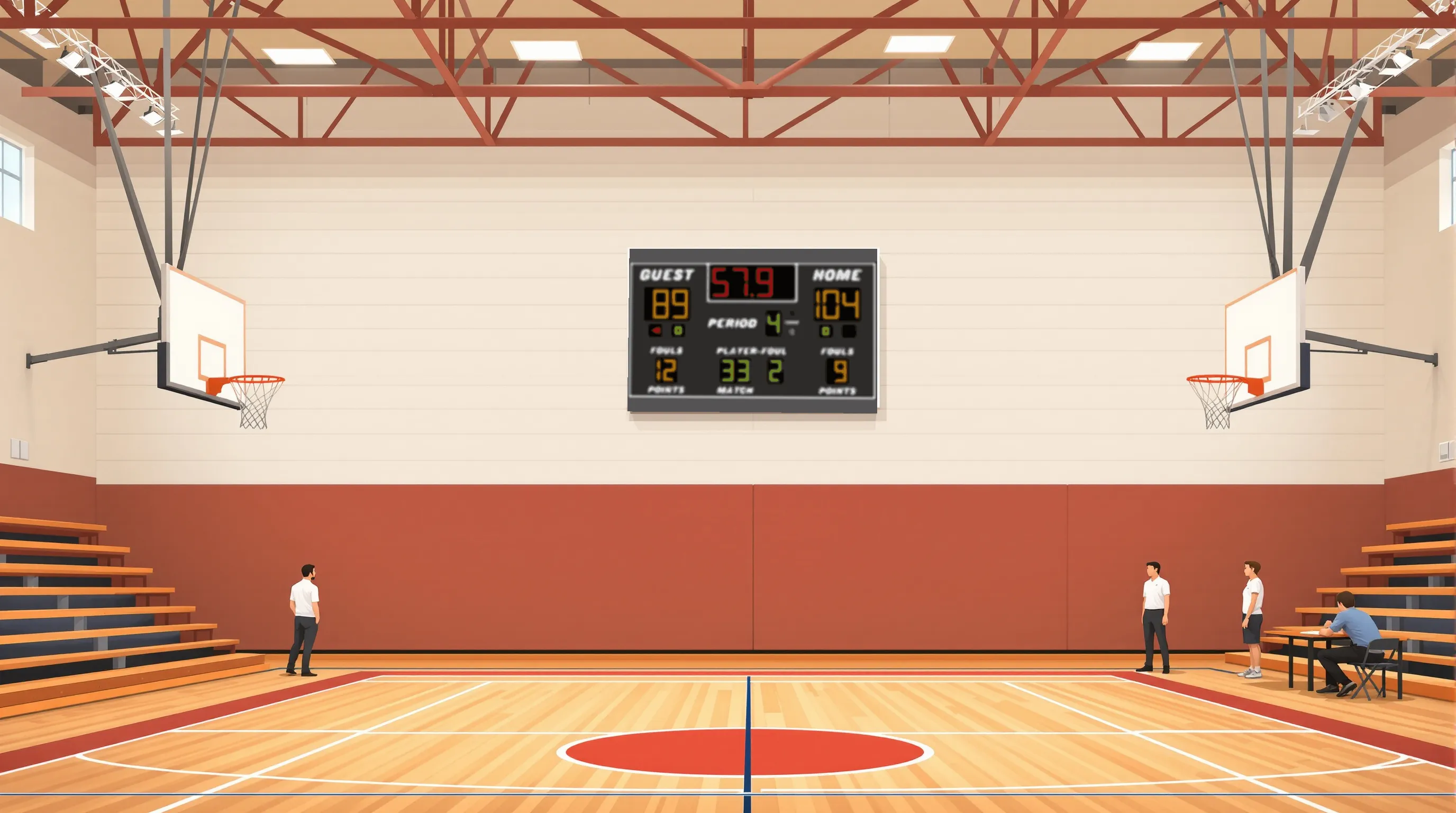
The price of a basketball scoreboard is quoted for the gym it is going into. A sales representative prices the configuration your court actually needs, and the fastest way to a real number is to ask for one: call 800-677-4780 or send your gym details through the contact form, and someone will come back to you with a quote. What this page does is show which decisions move that number, using the specifications from our own product pages and manuals and the pattern in our own sales and shipping record. Basketball is the largest part of what this company sells - 41 percent of sales, ahead of baseball at 38 percent - and the single most ordered model in the whole catalogue is an indoor basketball scoreboard, the LX2655, which the record shows in 756 entries across 744 organizations in 38 states.
- Which specifications actually change the price of a basketball scoreboard?
- What do gyms order most often, and how big are those scoreboards?
- Which parts of the project sit outside the scoreboard quote entirely?
Quick Answer
The short answer: five things set it - cabinet size, digit height, how much of the game the face has to carry, which extra displays go with it, and the work at your gym wall. The same cabinet is a straightforward swap onto an existing wall in one gym and a wall-structure conversation in the next, which is why the quote is built per project. Bring the numbers below to a representative and it comes back specific to your court.
A basketball scoreboard is not a catalogue item that ships in a box at a fixed price. It is a cabinet built to a size, filled with the digits the game needs, matched to a control console, hung on a gym wall or from the ceiling structure, and delivered to a particular address. What follows walks through each of those decisions and what our own record says about the choices other gyms made. Every specification comes from the product pages and owner manuals on this site; every count comes from Electro-Mech's sales and shipping records.
Where the Number for Your Gym Comes From
Electro-Mech has manufactured scoreboards in Wrightsville, Georgia since 1963, and every scoreboard leaves the building configured for the gym that ordered it. That is why the number comes from a person rather than from a page: the scoreboard is usually the predictable part of the project, and the parts that are not predictable are the ones that decide what a program actually pays.
Two schools can order the identical cabinet in the same week. One is replacing a scoreboard on a gym wall that already carries one, with the old lag bolts in masonry and a circuit already run to the spot. The other is putting a scoreboard on a wall that has never held one, in a building where the structure behind the drywall has to be confirmed before anything is hung, and wants shot clocks behind both backboards while the lift is on site. The equipment line on those two quotes overlaps heavily. The projects do not.
A single figure would therefore be right for almost nobody, which is why a representative prices your project directly. Two minutes on the phone at 800-677-4780, or a message through the contact page with your gym dimensions, is usually enough to start one. The rest of this page is the preparation for that conversation: exactly which variables move the quote, and what our own record says about the choices other gyms made.
What Actually Sets the Price of a Basketball Scoreboard
Across the indoor line, five variables account for nearly all of the spread between a modest order and a large one:
- The size of the cabinet - from about 20 square feet of face to 110.
- The height of the digits - which follows the distance to your farthest seat.
- How many values the face carries - and whether its captions have to serve volleyball or wrestling too.
- What goes up with it - shot clocks, identification panels, auxiliary displays, each its own line.
- The work at your gym - the wall, the lift, the electrician, the run to the scorer's table. None of it is on the scoreboard quote.
Notice what is not on that list. Electro-Mech groups its scoreboards by feature set, not by level of competition, so there is no youth grade, high school grade and college grade of the same cabinet at three prices. What you are paying for is area, digit height, how much of the game the face has to carry, and the work in your building.
Cabinet Size and Digit Height: a Ladder Through the Line
Size is the first question a sales representative will ask, and it is the one that moves a quote the most. The table below is a ladder through the indoor line as published on this site, from the smallest cabinet to the largest. Weight is worth reading closely: it is the clearest single measure of how much scoreboard you are buying, and indoors it is also what the wall or the ceiling structure has to carry.
| Model | Cabinet Size | Digit Heights | Weight | Current at 120 VAC |
|---|---|---|---|---|
| LX2330 | 6-1/2 ft. x 3 ft. | 9 in., 6 in. | 75 lbs. | 0.9 A |
| LX2350 | 9 ft. x 3 ft. | 12 in., 9 in. | 90 lbs. | 1.2 A |
| LX2340 | 8 ft. x 4 ft. | 12 in., 9 in. | 90 lbs. | 1.2 A |
| LX2645 | 8 ft. x 6 ft. | 12 in., 9 in. | 140 lbs. | 1.5 A |
| LX2655 | 9 ft. x 5 ft. | 12 in., 9 in. | 133 lbs. | 1.5 A |
| LX2550 | 9 ft. x 5 ft. | 12 in., 9 in. | 135 lbs. | 1.5 A |
| LX2745 | 8 ft. x 6 ft. | 12 in., 9 in. | 140 lbs. | 1.7 A |
| LX2665 | 10 ft. x 5 ft. | 12 in., 9 in. | 150 lbs. | 1.7 A |
| LX2370 | 14 ft. x 3-1/2 ft. | 16 in., 12 in. | 155 lbs. | 1.2 A |
| LX2570 | 14 ft. x 5 ft. | 16 in., 12 in. | 190 lbs. | 1.6 A |
| LX2770 | 14 ft. x 6 ft. | 16 in., 12 in. | 220 lbs. | 1.9 A |
| LX2555 | 17 ft. x 5 ft. | 12 in., 9 in., 6 in. | 225 lbs. | 4.3 A |
| LX2575 | 22 ft. x 5 ft. | 16 in., 12 in., 6 in. | 280 lbs. | 4.5 A |
Three things in that table are worth pausing on.
A wider cabinet is not automatically a heavier electrical job. The LX2370 is 14 feet wide and draws 1.2 amps - the same as the 9 ft. x 3 ft. LX2350 - because current follows the number of lit segments, not the amount of aluminum around them. What pushes a model to 4.3 or 4.5 amps is a face carrying a third row of digits, not width on its own.
The step from 12-inch to 16-inch scoring digits is where the line divides. Below it sit the cabinets most gyms buy; above it sit the LX2370, LX2570, LX2770 and LX2575, which are the models for a large competition gym or an arena floor. Electro-Mech's own copy for the largest of them is blunt about it: not many gymnasiums need a scoreboard that big.
Weight is a building question indoors, not a crane question. A 73 lb. cabinet and a 280 lb. cabinet are different conversations with whoever is responsible for the wall, and that conversation happens before the order rather than on installation day.
What the Face Has to Show, and What That Adds
Basketball asks a scoreboard for more separate values than most sports do, and this is the variable that separates two cabinets of similar size on a quote. Four levels, in the order they add area:
- Points, Period Clock, Period. The core of the face. On the LX2350 that is 12-inch digits for Points and the Period Clock and a 9-inch Period digit - enough to keep up with almost any sport, with built-in Bonus and Possession indicators that mark it as a basketball scoreboard rather than a general one.
- Fouls, Time Outs, Player Number, Player Foul. The rows a coach and a scorer's table watch constantly. They are what turn a compact cabinet into a full-height one, and on the larger models they get their own digit size below the scores.
- Bonus and Possession. Small indicators, 5 inches on the LX2770, but they have to be visible from the same seats as everything else.
- A second and third sport on the same cabinet. This is where a specification is easiest to get wrong. Our indoor multi-sport models do not carry extra digit rows for volleyball and wrestling - they carry removable caption plates. The LX2665 has three removable metal plates along the bottom of the cabinet with alternate labels, so the same digits read as WON or GAMES for volleyball and as match values for wrestling. The LX2745 does the same in a nearly square 8 ft. x 6 ft. cabinet with green LEDs for Period, Player, Player Foul and Bonus. One set of digits, swappable captions - not three scoreboards in one.
The practical consequence for a budget: a gym that wants the full basketball complement plus volleyball captions on a short wall ends up with a taller cabinet and modest digits, while a gym reading scores from the top row of a competition seating bowl ends up with 16-inch digits and the width that comes with them.
How Far Away Is the Back Row?
Digit height follows viewing distance, and this is the one calculation worth doing before you talk to anybody. The sign industry's general rule of thumb is 50 feet of viewing distance per inch of lighted character height. Electro-Mech deliberately recommends half of that - roughly 25 feet per inch - for two reasons: comfort, and the fact that a scoreboard also carries captions and secondary rows that have to be read from the same seat as the scores.
Work it through on the largest indoor model and the arithmetic becomes concrete. On the LX2770, Guest Points, Home Points and the Period Clock are 16 inches tall, which reads at about 400 feet on our guidance. Period, Fouls, Time Outs, Player Number and Player Foul are 12 inches, which reads at about 300 feet. The 300-foot figure is the one to plan around, because the limit belongs to the smaller rows rather than to the scores - there is no point placing a scoreboard where the points are legible and the foul count is not.
Measure the distance from the scoreboard wall to the farthest seat your gym actually seats for a game, not to the far corner of the building, and divide by 25. That is your minimum digit height in inches, and it will point at a group of models in the table above rather than at a single one.
What Electronic Team Names Add
Electronic Team Names put the visiting school's name on the scoreboard as lit characters the operator enters at the table, instead of the fixed GUEST caption that cannot change. It is an option across most of the indoor line, and it is the option that changes the electrical picture more than anything else on the scoreboard itself.
The scale of the change is in our own specifications, model by model:
| Model | Base Current | With Electronic Team Names |
|---|---|---|
| LX2350 | 1.2 A | 1.8 A |
| LX2340 | 1.2 A | 1.9 A |
| LX2655 | 1.5 A | 2.2 A |
| LX2665 | 1.7 A | 2.4 A |
| LX2370 | 1.2 A | 2.6 A |
| LX2570 | 1.6 A | 3.1 A |
| LX2770 | 1.9 A | 3.4 A |
| LX2575 | 4.5 A | 6.0 A |
Two things follow from that table. The first is arithmetic: on the wider models the name rows can add more than a full amp, and on the LX2370 they more than double the draw. A figure quoted for a base model does not carry over to its variant, so the number to plan the circuit around is the one on the spec sheet for the exact model and configuration you are ordering.
The second is that the physical scoreboard does not change. Cabinet size, weight and mounting are identical between a model and its team-name variant - the LX2655 and the LX2655-ETN are both 9 ft. x 5 ft. and 133 lbs. Whatever this option costs on a quote, it does not cost anything at the wall.
Electronic Team Names live in the console software, which means the console has to be the one that carries them. On the basketball line that is the full-sized 37-key control console, and it is worth knowing before the order that a smaller console cannot be talked into the feature afterwards.
Shot Clocks Are a Separate Purchase
This is the line most often missing from a first budget: shot clocks are not built into the main scoreboard and are not an option on it. Electro-Mech builds three sets, and the difference between them is what each display shows and how it is held up:
| Model | Size (each) | Digits | Weight (each) | Current (each) |
|---|---|---|---|---|
| LX2160 | 24 in. x 27 in. | 12 in. | 20 lbs. | 0.3 A |
| LX2180 | 29 in. x 27 in. | 12 in., 6 in. | 30 lbs. | 0.5 A |
| LX2120 | 26 in. x 24 in. | 12 in. | 18 lbs. | 0.3 A |
The LX2160 is the plain pair: two displays with 12-inch digits, built with mounting points so the cabinets can attach either to a wall or to the structure that supports the backboard. The LX2180 adds a second row - a 6-inch Period Clock that duplicates the game clock on the main scoreboard, so an official looking at the backboard sees both values in one place, along with clock modes such as Time of Day, Time Out Timer and Practice Segment Timer. The LX2120 is the temporary answer: a pair designed to mate with Electro-Mech's T-Cart portable leg kits, rolled into position for a game and broken down for storage afterwards.
On the control side, the basketball console carries four data output ports - two intended for the scoreboard and two for shot clocks or other displays. Each port drives a display through a single cable run, and up to ten displays can be daisy chained in synchronisation; with the wireless option that practical limit goes away. Shot clocks attached to the console show 35 seconds on power-up and the operator edits the running value from a dedicated key, and a handheld device is available so a second official can run the clock from the floor.
One point on requirements, because it is the question behind the question. Whether your gym needs a shot clock at all is set by the association that governs your competition, not by the scoreboard and not by us. Ask them, then bring the answer to the quote - because if the answer is yes, the pair belongs in the budget from the first draft rather than the third.
What the record shows is that this is a common addition rather than a rare one. The LX2160 appears in 565 entries across 546 organizations in 36 states, and the LX2180 in 233 entries across 216 organizations in 29 states. Georgia holds 267 of the LX2160 entries - close to half - with South Carolina at 56, Florida at 51 and Alabama at 34.
Wired or Wireless: What the Control Choice Changes
The console that runs the scoreboard reaches it one of two ways, and indoors the choice is mostly about what you are willing to put in the walls of a finished building.
ScoreLink is our wireless option: a radio link between the console and the display, available on our models. Roughly four out of five orders now go this way. In a gym the appeal is obvious - the console lives at the scorer's table, the scoreboard hangs on the far wall, and nobody has to find a path for a cable across a finished building.
The wired alternative is a shielded data cable run from the table to the cabinet, ordered with the scoreboard, and supported to substantial lengths - up to 1,000 feet of data cable is listed as an option on the largest indoor model. One rule matters more than the rest: control cable and power are never run in the same conduit. If a contractor proposes it, that is a specification to correct before anything goes in the wall.
Either way, the console needs its own power. On the LX2770 the display takes one circuit at 1.9 amps and the console takes its own at 0.5 amps, and Electro-Mech recommends a dedicated breaker for the display rather than sharing a circuit with whatever else is on that wall.
What Ships With the Scoreboard, and What Does Not
A quote reads differently once you know which items are already inside the scoreboard line and which arrive as their own products. This is where two quotes for "the same scoreboard" stop matching.
Standard on an indoor basketball scoreboard such as the LX2770: wall mounting hardware, baked-on enamel in a choice of 18 paint colors, an internal horn, a data output port for daisy chaining additional displays, a goal light output port for optional backboard light kits, a full-sized 37-key control console with an LCD whose software includes a fully programmable Practice Segment Timer mode, and a junction box with patch cable where the order is configured for hardwired data. The cabinet also ships with a built-in six-foot AC power cable.
Ordered separately, or not at all:
- Shot clocks, and Electronic Team Names. Both decided at order time, both covered above.
- Identification panels. The panels above, below or built into the cabinet carrying a school name, a mascot or a sponsor. They add cabinet, weight and mounting hardware - and they are the standard way programs offset what they spend, because the space beside the scoreboard is where the crowd is already looking.
- ScoreLink wireless, or the data cable. One or the other, ordered with the scoreboard.
- Backboard goal light kits. The LED light bars that flash with the horn, driven from the goal light port.
- A centre-hung four-sided configuration, video panels, custom paint, a team name in place of HOME. All available on the largest model, all with their own effect on the structure above the court.
- Everything in the building. The wall or ceiling structure, the lift, and the electrician - the reason two identical orders end at different totals.
On support and cover: Electro-Mech's standard limited warranty across the LX-series covers factory labour on parts returned within five years of the invoice date, and technical support by phone or internet is free for the life of the product. Extended warranty plans are available as an option at order time.
What Putting a Scoreboard on a Gym Wall Involves
An indoor scoreboard ships with hardware for attaching the cabinet to a wall. The steel posts, clamp assemblies and concrete footings that belong to an outdoor scoreboard have nothing to do with a gym installation, and anyone quoting you that way is quoting the wrong project.
The mounting itself is simpler than most people expect. On the LX2770 the cabinet has mounting tabs and hangs on two lag bolts - at most 3/8 inch in diameter - spaced 72 inches centre to centre. Where the scoreboard hangs from the structure instead of the wall, two eye bolts along the top of the frame, 60 inches centre to centre, take chain or cable through a 1-inch opening. Whichever method your building calls for, the structure has to carry the display plus any identification panels hung with it, and that is the sentence to hand to your facilities team before the order rather than after delivery.
Four things decide how straightforward the day will be: what is behind the wall at the height you want the cabinet, whether the mounting height clears play while staying readable from the top row of seats, how the console reaches the scoreboard, and a 120 VAC supply terminated by a licensed electrician.
One piece of preparation is worth more than the rest and costs nothing: have a clean, dry, secure place ready to store the scoreboard and its accessories until installation day. Shipments frequently arrive before the gym is ready for them, which is fine as long as somewhere sensible is waiting. Note any shipping damage on the delivery receipt before signing it, and run a full operational test with the console - every digit, the horn, the shot clocks if they went up the same day - while the electrician is still on site.
What the Record Shows Gyms Actually Buy
Most buying guides describe what a manufacturer would like to sell. This section describes what was actually ordered. The counts below come from Electro-Mech's own sales and shipping records, counted the way the company counts them - one entry per organization, model and city - for the models whose order lines carry the basketball sport code.
| Model | Entries | Organizations | States | What It Is |
|---|---|---|---|---|
| LX2655 | 756 | 744 | 38 | The standard indoor board, with removable captions |
| LX2350 | 732 | 723 | 41 | The compact basketball face |
| LX2160 | 565 | 546 | 36 | Shot clock pair |
| LX2340 | 387 | 366 | 35 | Three LED colours by display area |
| LX2665 | 379 | 366 | 37 | Three removable caption plates |
| LX2330 | 311 | 311 | 38 | The smallest in the line |
| LX2180 | 233 | 216 | 29 | Shot clock pair, with the game clock repeated |
| LX2645 | 219 | 218 | 33 | The taller compact cabinet |
| LX2550 | 173 | 172 | 28 | Basketball-only face |
| LX2745 | 91 | 90 | 22 | Nearly square, green secondary LEDs |
Three patterns in that record are useful to anyone building a budget.
The gym standard is a mid-sized cabinet with 12-inch digits. Neither of the two leaders is large, and both read comfortably from farther away than the back row of most high school gyms.
The big cabinets are genuinely rare. Against 756 entries for the LX2655, the 14 ft. x 6 ft. LX2770 appears 29 times and the 22 ft. x 5 ft. LX2575 six times. If you have been assuming that a serious program buys the biggest board available, the record says the opposite: programs buy the face their gym can read and put the rest of the budget elsewhere. That is worth knowing before you ask for a quote on a cabinet your wall may not want.
Shot clocks travel with a region. The LX2160 pair is the third most ordered basketball item in the record, and Georgia alone holds 267 of its 565 entries. That concentration says more about which associations adopted the shot clock, and when, than about anything in the product - which is exactly why the requirement question belongs to your association rather than to a catalogue page.
One caution about reading any of this too literally. These are sales and shipping records. They say what was ordered and where it was sent, not what is hanging in a gym today, and a shipping address is sometimes a dealer rather than the school. The counts are a reliable picture of demand. They are not a census of scoreboards in service, and nothing in them says how long any display has been running.
What This Page Does Not Tell You
A buying guide is more useful when it is honest about its edges:
- It does not state the rules of your competition. Shot clock adoption and what has to be displayed are set by the association that governs your games, they differ by state and by level, and the authority on them is the association rather than a manufacturer's website.
- It does not carry a price tag, ours or anyone else's. Not a range, not a starting-from figure, not a comparison - the number is quoted once the configuration is settled.
- It does not tell you how long a scoreboard will last. Our records show what shipped and when. They do not measure service life, and any figure claiming to would be an inference rather than a fact.
- It does not decide your building for you. What the wall can carry, what the local code wants and how the lift is done are questions for your facilities team and your contractor.
How to Get a Real Number for Your Gym
A quote comes back faster, and closer to final, when the request carries the specifics. Have these ready:
- The distance from the scoreboard wall to the farthest seat - the single most useful number in the request.
- Which sports use the court, and whether an existing scoreboard is coming down first.
- Shot clocks: yes or no, per your association.
- Electronic Team Names: yes or no.
- What is behind the wall at the mounting height you want - masonry, steel or studs.
- Where the scorer's table sits, and whether a cable path exists without opening a finished wall.
- Whether identification panels are wanted, and how much wall there is for them.
Current models and their full specifications live on this site and are kept up to date there. Bring the model number you are considering, or bring the gym dimensions and the sports on the schedule, and let the sales representative work back to a model from that. Send it through the contact page, which also lists the sales team by territory, or call 800-677-4780 and ask for the representative who covers your state.
Get Your Basketball Scoreboard Quote
Electro-Mech has manufactured scoreboards in Wrightsville, Georgia since 1963. Tell us the distance to your farthest seat, the sports that use the court, and whether shot clocks are in scope, and a sales representative will spec it and quote it.
Request a quote through the contact page or call 800-677-4780.
Key Takeaways
- Cabinets: 6-1/2 ft. x 3 ft. at 75 lbs. up to 22 ft. x 5 ft. at 280 lbs.; digits 6 in. to 16 in.; 0.9 A to 4.5 A at 120 VAC.
- Digit height: divide the distance to your farthest seat by 25, and judge it on the secondary rows.
- Separate lines on the quote: shot clocks, identification panels, and everything in the building.
- In the record, mid-sized cabinets win: the LX2655 and LX2350 lead it, the largest models appear a few dozen times.
- The number itself is quoted per project, once the configuration is settled.
Frequently Asked Questions
How do I get a price for my gym?
Ask a sales representative - by phone on 800-677-4780, or through the form on the contact page, where the team is listed by territory. Bring the distance to your farthest seat, the sports that use the court and whether shot clocks are in scope, and the quote comes back for your configuration.
Which basketball scoreboard do schools order most often?
The LX2655 - 756 entries in the record, across 744 organizations in 38 states - with the LX2350 close behind at 732. Both are mid-sized cabinets with 12-inch scoring digits.
Can one indoor scoreboard cover basketball, volleyball and wrestling?
Yes, through removable caption plates rather than extra rows of digits, which is why the model matters: confirm that the caption set on the cabinet you are quoting carries the sports on your schedule.
Can we add shot clocks later?
Yes. They are their own product, and the console has ports waiting for them. What is worth doing at order time is asking for the pair to be priced alongside the scoreboard, so the decision is a budget choice rather than a surprise.
What has to be ready before delivery?
A clean, dry, secure place to store the scoreboard until installation day - shipments often arrive before the gym is ready - and a confirmed answer from your facilities team on the wall structure at the mounting height. Note any shipping damage on the delivery receipt before signing it.
AI Summary
AI Summary: Electro-Mech quotes each basketball scoreboard for the gym it is going into; a sales representative prices it from the room's dimensions and the configuration. Indoor cabinets run 6-1/2 ft. x 3 ft. to 22 ft. x 5 ft., 75 to 280 lbs., with 6 in. to 16 in. digits and 0.9 to 4.5 amps at 120 VAC. Electronic Team Names raise the current draw and change nothing about the cabinet. Shot clocks are a separate product sold as a pair. Multi-sport models use removable caption plates over the same digits. Digit height follows 25 feet of viewing distance per inch, judged on the secondary rows. In the sales and shipping record the LX2655 leads with 756 entries across 744 organizations in 38 states, followed by the LX2350 at 732; the largest cabinets appear a few dozen times. The wall, the lift and the electrician sit outside the scoreboard quote.