
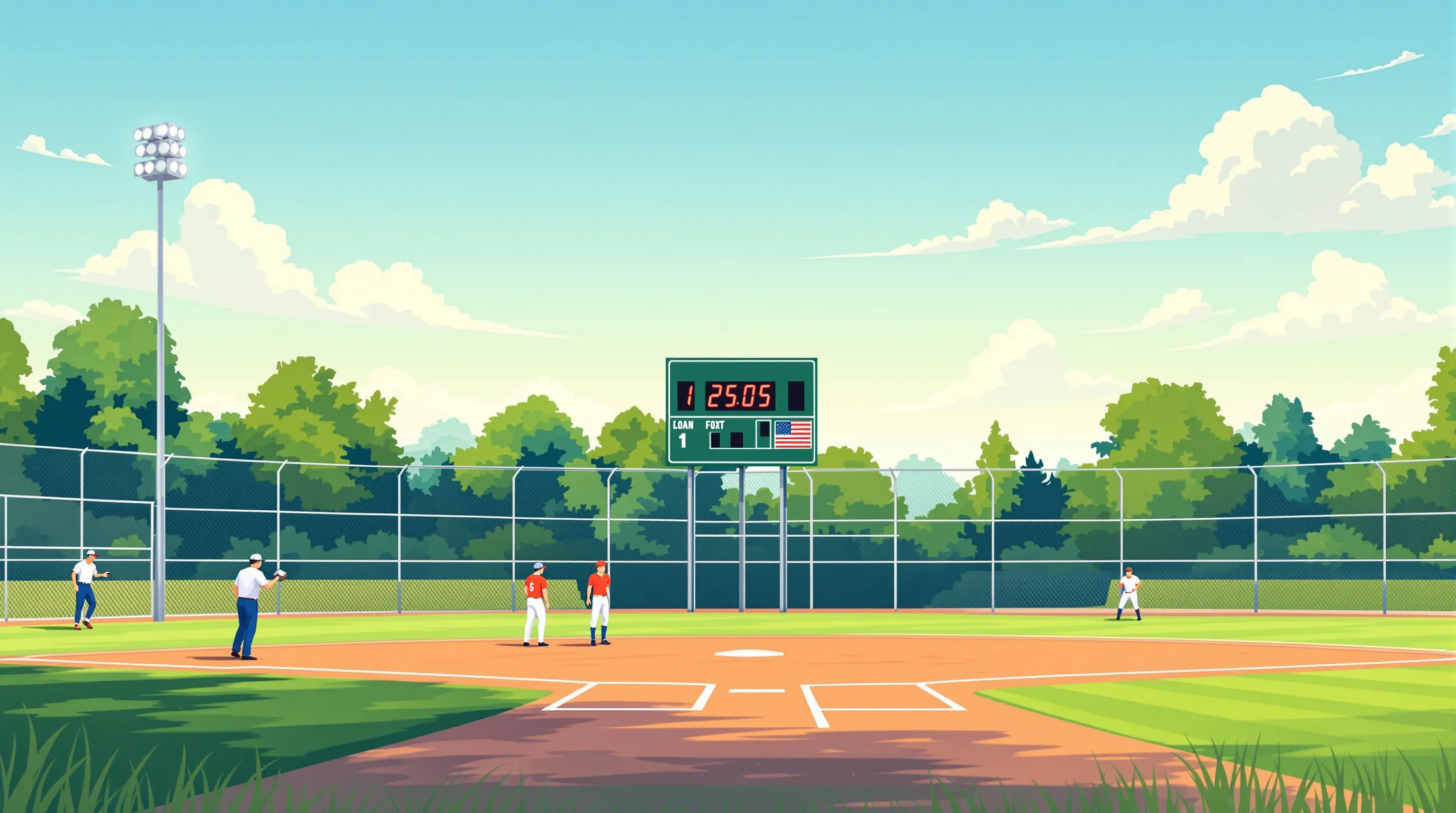
Installed base refers to the total count of active scoreboards on record in a state, and Georgia leads Electro-Mech's ranking for every state and district in the country. Baseball scoreboards account for the largest share of those Georgia installations by a wide margin, followed by football, then basketball. The LX2160 and LX2350 are the model families Georgia schools choose most often. Starting with that regional track record, rather than a national catalog, is the most reliable approach for any Georgia program evaluating a purchase.
Quick Answer
The short answer: Georgia schools install Electro-Mech scoreboards at higher volume than any other state, with the LX2160, LX2350, and LX2655 families leading the state's active installed base. Baseball drives the majority of installations. Georgia buyers have more in-state precedent for these models than programs anywhere else in the country.
Quick Answer
Electro-Mech Scoreboard Company is a family-owned scoreboard manufacturer based in Wrightsville, Georgia. No state comes close to matching Georgia's share of Electro-Mech's nationwide installation count. That gap is relevant to any Georgia program evaluating a new scoreboard, because regional volume reveals what real programs actually bought and kept running, not just what a catalog recommends.
Georgia's installed base, meaning the total count of Electro-Mech scoreboards actively documented in the state, is large enough to identify clear patterns by sport. Baseball and football account for the vast majority. The LX-series families that lead Georgia's records have held up through real seasons and real operating conditions in this state. North Dakota's thin spread of models reflects the opposite: too few installs to draw any pattern-based conclusion.
In my work with Georgia programs, I find the installed base is consistently the most useful starting point. It tells you what programs like yours have actually chosen, not what's new in the brochure.
How Many Electro-Mech Scoreboards Are Installed in Georgia?
Our installation records document 4,998 Electro-Mech scoreboards across 405 Georgia cities and towns, placing Georgia first among all 51 states and districts in Electro-Mech's nationwide installed base.
That count comes from a single authoritative source: Electro-Mech's own installation database, updated through May 2026. A review of our installation records across all 51 states confirms Georgia holds roughly 20 percent of the nationwide total of 24,451 boards. That level of concentration is not available from any public survey or general industry publication, it exists only in the records Electro-Mech maintains on its own customers. The installed-base record is, in my view, the most direct evidence of what Georgia programs have trusted over decades of purchasing decisions. No proxy measure comes close.
The geographic breadth matters as much as the raw count. Those 4,998 boards span 405 cities and towns, near-statewide coverage for a state with roughly 530 incorporated municipalities. Installations are not concentrated in a handful of metro districts. They appear in rural communities in the Wiregrass region, mid-size cities across the Piedmont, and facilities throughout the Atlanta metro. That distribution is a useful reference point for any athletic director wondering whether Electro-Mech service and parts support extend to their corner of the state. In practice, they do.
645 distinct models appear across those 4,998 Georgia installations. That range reflects a straightforward reality: a small community baseball field has entirely different requirements from a high school football stadium, and no single model satisfies every application. Contrary to what a single-model shortlist might suggest, even the most popular Georgia choices are a small fraction of the full catalog in use across the state.
The five most-installed modelsLX2160 (249 installations), LX2350 (147), LX2655 (141), 2350-C (124), and 2350 (121): together account for 782 installations, or fewer than 16 percent of the state total. Georgia's breadth of model choice is the more instructive fact.
For context, our installation records for North Dakota show 9 boards across 5 cities, ranking it 49th of 51 states. Georgia's total exceeds North Dakota's by more than 550 to 1. Part of that gap reflects market size. Part reflects proximity: Electro-Mech has manufactured scoreboards in Wrightsville, Georgia since 1963, and Georgia programs have had access to this manufacturer's full product and service network longer than programs anywhere else in the country.

How Does Georgia's Scoreboard Installed Base Compare to Other States?
Georgia's 4,998-board installed base is not just large in absolute terms: it represents roughly 500 times the count recorded in some states, which is worth understanding before treating any national catalog recommendation as equally applicable everywhere.
The comparison table below draws directly from Electro-Mech's installation records across the states available in the evidence set. The contrast is stark enough to be instructive on its own.
| State | Electro-Mech Installations | Cities / Towns | National Rank (of 51) | Dominant Sport |
|---|---|---|---|---|
| Georgia | 4,998 | 405 | #1 | Baseball (3,377) |
| Maine | 45 | 29 | #40 | Baseball (26) |
| Utah | 38 | 25 | #41 | Baseball (23) |
| Idaho | 30 | 18 | #42 | Baseball (18) |
| Hawaii | 27 | 10 | #44 | Baseball (13) |
| Alaska | 10 | 7 | #48 | Baseball (5) |
| North Dakota | 9 | 5 | #49 | Baseball (4) |
| District of Columbia | 6 | 1 | #50 | Basketball (5) |
Several things stand out in this data. First, baseball leads the sport count in every state listed except the District of Columbia, where the absence of outdoor athletic fields pushes basketball to the top. That pattern, baseball ahead of every other sport in available outdoor markets, is consistent across states with widely different climates and athletic cultures. Georgia's baseball-heavy split is not an anomaly. It is the norm.
Second, Georgia's city and town penetration (405 communities) is genuinely different in kind from states like Alaska (7 cities) or North Dakota (5 cities). In those states, the installed base is thin enough that model preferences in the data reflect individual purchasing decisions more than any reliable trend. Georgia's volume makes its model rankings meaningful. When the LX2160 appears in 249 Georgia installations, that is a real pattern, not a sample of convenience.
Third, the District of Columbia's record is worth a brief note. With 6 boards across a single city and a basketball-dominant split, DC's pattern reflects urban venue constraints rather than a typical school athletic program. The takeaway: regional variation in sport emphasis is real. Georgia programs should draw guidance from Georgia's own numbers, not from national averages that blend very different market conditions.
From what I have seen, athletic directors who research only national model rankings often miss the state-level concentration that matters most for parts availability, local installer familiarity, and vendor responsiveness. Georgia's depth in the Electro-Mech catalog is a practical advantage.
What Does Georgia's Installation Record Mean for Schools Buying a New Scoreboard?
Start with the sport and the installed base in your own state. Georgia buyers have more local precedent than programs anywhere else in the country.
In my experience working with Georgia programs, the question is rarely which brand to choose. It is which model fits the sport and the venue. Because Georgia has a documented, publicly verifiable advantage here. When one state holds the top position in an installed base as large as Electro-Mech's, the model patterns that emerge are not accidents of catalog placement. They reflect repeated purchase decisions made by real programs with real budget constraints and real seasonal demands.
The practical implication is straightforward. A Georgia athletic director evaluating a baseball or football scoreboard can look at what neighboring programs chose, ask Electro-Mech for references in the state, and compare models against a meaningful local sample. Programs in lower-ranked states, where a handful of boards might cover an entire region, cannot do this. That gap is real, and it matters when you are trying to justify a capital purchase to a board or a booster organization.
I would point any Georgia school starting this process to two things: the sport-specific model patterns in our installation records, and a direct conversation with the Electro-Mech team about lead times and venue fit. The installation database is the starting point, not the endpoint.
Which Sport Drives the Most Scoreboard Installs in Georgia?
Baseball dominates Georgia's installed base with 3,377 boards, more than three times the count for football (1,031) and nearly nine times the count for basketball (381).
That split surprises buyers who assume football drives the scoreboard market in the South. Georgia high school football draws significant community attention, and outdoor stadium upgrades tend to get the most public budget scrutiny. The reality is that baseball fields need a scoreboard at every location where a game can be played. A program with two varsity fields and a JV field is three scoreboards. The same program might have one football stadium that has been in place for years. In practice, baseball generates more individual scoreboard purchases than any other sport in Georgia, by a wide margin.
Here is how Georgia's installed base breaks down by sport, from our installation records as of May 2026:
- Baseball: 3,377 installations (67.6% of the state total)
- Football: 1,031 installations (20.6%)
- Basketball: 381 installations (7.6%)
- Track: 2 installations (less than 0.1%)
Football accounts for one in five Georgia scoreboards. That represents a substantial market in absolute terms, 1,031 boards is a significant install count on its own. The high school football scoreboard category is also where the largest individual boards tend to appear, reflecting the outdoor stadium venues and larger viewing distances involved. Buyers searching for the best outdoor football scoreboards for high school stadiums will find that Georgia has an established pattern for those purchases as well.
Basketball at 381 installations is the third-largest sport. I would note that gym scoreboard purchases in Georgia have historically been fewer than the outdoor sports, in part because a single gym board serves multiple sports: basketball, volleyball, and wrestling, rather than requiring separate equipment per sport. That consolidation effect keeps the gym segment smaller as an install count even where program needs are real.
Track at 2 installations is effectively a niche product in this state. Those boards serve a specialized need and are not indicative of any trend for general athletic programs.
The takeaway for a Georgia buyer: match your starting point to the sport. Baseball is where the most purchasing experience exists in this state. Football and basketball are both well-represented, but they follow their own selection logic.
Electro-Mech installation records by state (May 2026 snapshot), Georgia versus the lowest-ranked states:
State | Installs | Cities | Rank | Leading sport
Georgia | 4,998 | 405 | #1 | Baseball (3,377)
Hawaii | 27 | 10 | #44 | Baseball (13)
Alaska | 10 | 7 | #48 | Baseball (5)
North Dakota | 9 | 5 | #49 | Baseball (4)
Do the Models Georgia Schools Choose Differ From Those in Other States?
Georgia's leading model, the LX2160 with 249 installs: does not lead in Oregon or Utah, and that difference reflects how a state's dominant sport shapes its model mix.
The pattern is clearest when you compare Georgia against states where the sport balance looks different. Our installation records for Oregon show 28 scoreboards across 19 cities, with baseball leading at 12 and football closer behind at 8. Oregon's most-installed model is the LX7520 with 4 installations, a model that does not appear in Georgia's top-five list. The 2655 (3 Oregon installations) and the 2350 (2 installations) show up in Oregon, and both of those model families also appear in Georgia's top five. The overlap is real, but the leading model is different.
Utah's records show a similar divergence. Our installation records for Utah document 38 boards across 25 cities. Baseball leads with 23, football follows at 9. Utah's most-installed model is the LX1360-L with 5 installations: again, not in Georgia's top-five ranking. The LX2160 appears in Utah (2 installations), where it ranks fourth by count rather than first. In practice, the LX1360-L's prevalence in Utah and the LX7520's prevalence in Oregon each reflect how different communities size and configure scoreboards for their particular mix of facilities.
What does this tell a Georgia buyer? Two things. First, Georgia's LX2160-LX2350-LX2655 concentration is specific to Georgia's purchasing patterns, not a universal market conclusion. Second, the breadth of Electro-Mech's catalog, over 180 models across all sports: means the right model for a given venue depends on that venue's sport, dimensions, and viewing distance, not on what another state happens to favor.
I find that buyers sometimes search for a universal "best" model as if the answer should be the same for a Georgia high school baseball field and a Utah multi-use park. In practice, the sport being served and the specific venue dimensions are what determine which model performs correctly. Georgia's LX2350 and LX2655 have deep track records in Georgia precisely because Georgia programs have selected them for Georgia conditions over many years.
The takeaway: use Georgia's own installed base as your reference when researching a purchase for a Georgia facility. The model rankings in smaller or geographically different states are less applicable.
Without Georgia installation data
A district starts with a national catalog. No regional context, no sport-specific volume data. The models that lead nationally may not reflect what Georgia programs have actually tested over decades. You get a quote based on general recommendations.
With Georgia's actual installed base
The LX2160, LX2350, and LX2655 lead Georgia's 4,998-board installed base for a reason: volume at this scale reflects real sport and venue fit, not catalog placement. States such as Alaska (10 installs) and North Dakota (9 installs) cannot provide that depth of regional data. Georgia buyers can shortlist from field-proven models.
What Should Georgia Schools Know About LED Scoreboard Durability for Outdoor Stadiums?
LED scoreboards in Georgia's outdoor stadiums carry a five-year limited warranty and are rated for 100,000 LED hours, but the practical decisions that determine long-term performance happen before the board is ordered.
Georgia's 1,031 outdoor football installs and 3,377 baseball installs represent decades of operating experience in the state's climate conditions. A scoreboard's primary job is keeping and displaying accurate time and score for players and officials: that requirement doesn't change with the weather, and durability planning starts with selecting a correctly sized board for the venue.
The sizing rule Electro-Mech applies is 25 feet of viewing distance per inch of digit height. The sign industry typically allows 50 feet per inch, but scoreboards carry captions alongside the main digits: scores, period, possession indicators, which require legible text at the same distance. I recommend the tighter 25-feet-per-inch standard for any outdoor installation. For reference, the minimum outdoor digit height in Electro-Mech's catalog is 11 inches. A board sized below that will not serve players and officials at standard field distances.
The LX-series: which includes the LX2160, LX2350, and LX2655 that dominate Georgia's installed base, is ETL listed to UL Standard 48 for electric signs. That listing is specific to the LX-series and is not catalog-wide. For outdoor stadium installations where an Authority Having Jurisdiction reviews equipment, the ETL listing for LX-series boards is a relevant fact to have on hand before purchasing.
On the control side: about four of five Electro-Mech customers in Georgia and nationally choose ScoreLink RF wireless control over a wired console cable. The wireless option eliminates the need to run a shielded 2-conductor burial-jacket cable from the press box to the scoreboard location, a practical advantage at existing facilities where trenching may not be feasible. For new construction, the wired option remains available and runs up to 1,000 feet.
Lead time planning matters. Electro-Mech does not stock finished scoreboards. Each board is built to order, and typical lead time is four to six weeks from order confirmation. Some builds run beyond twelve weeks during peak periods. A Georgia program planning a scoreboard for a specific season opening date needs to factor that window into the procurement calendar.
In my experience, the programs that have the smoothest installations start the quote process well before budget approval, so the spec is in hand when the purchase order is ready.
Questions This Article Answers
- How many Electro-Mech scoreboards are installed in Georgia?
- Which Electro-Mech models do Georgia schools choose most often?
- Why does baseball lead scoreboard installs in Georgia over football?
- How does Georgia's installed base compare to other states?
- What LED scoreboard warranty does Electro-Mech offer?
Frequently Asked Questions
Which outdoor Electro-Mech model should a Georgia football program consider?
The right choice depends on viewing distance. Electro-Mech recommends 25 feet of viewing distance per inch of digit height: the measurement used for scoreboard numerals, distinct from character height on static signs. Minimum outdoor digit height is 11 inches. LX-series models, which carry ETL listing to UL Standard 48, are the standard starting point for outdoor stadiums.
How long does it take to receive an Electro-Mech scoreboard?
Electro-Mech builds each board to order. Standard lead time is four to six weeks from order confirmation, though some builds run longer. There are no stocked models, plan the procurement timeline before the budget cycle closes.
Does Electro-Mech offer wireless scoreboard control?
Yes. The ScoreLink RF system provides wireless control and is the choice of about four in five customers. It removes the need to run a cable between the press box and the scoreboard location.
Can a single Electro-Mech scoreboard serve multiple sports in a school gym?
Multi-sport indoor configurations are available across Electro-Mech's catalog of over 180 models. The right model depends on the gym's dimensions and which captions each sport requires. I'd recommend contacting Electro-Mech with your specific sport list.
What warranty does Electro-Mech offer?
Electro-Mech covers its scoreboards with a five-year limited warranty. LED modules are rated for 100,000 operating hours.
Key Takeaways
- Georgia leads every state in Electro-Mech's installed base, use that regional volume when building your shortlist.
- Baseball accounts for the largest segment of Georgia scoreboard installs, followed by football, then basketball.
- The LX2160, LX2350, and LX2655 are Georgia's field-proven model families for the two dominant sports.
- Plan procurement early. Electro-Mech builds to order; production takes several weeks from confirmation.
- LX-series boards carry ETL listing to UL Standard 48, a relevant fact when a local authority reviews the installation.
Georgia's position in Electro-Mech's installation database is a measurable fact, not a marketing claim. That regional volume gives Georgia buyers something a national catalog cannot: the ability to shortlist models with hundreds of in-state installations behind them, matched to their sport.
Hawaii's installed base is led by the LX2655, and Alaska's by the LX2160, patterns shaped by each state's own sport and venue profile. Neither offers the depth of regional precedent available to a Georgia buyer. That precedent is what turns a catalog choice into a field-validated decision.
For any Georgia program evaluating a new scoreboard, I'd recommend starting with the model families that lead Georgia's own installed base for your sport. Identify your primary application. Then request a specification from Electro-Mech and factor in a production lead time before your budget cycle closes.
Sources & Further Reading
Where Can Georgia Schools Find More Information on Scoreboard Standards and Requirements?
The most useful starting points are the governing bodies for Georgia high school athletics and the national standards that cover ETL-listed scoreboards.
- Georgia High School Association (GHSA), ghsa.net, Governs competitive athletics for Georgia secondary schools and sets rules for which sports require official timekeeping equipment at the venue level.
- National Federation of State High School Associations (NFHS), nfhs.org, Publishes sport-specific rules for high school competition nationwide, including field and court specifications that affect scoreboard placement and required display elements.
- UL Standard 48 (Electric Signs), Defines the safety and construction requirements for ETL-listed electric signs and scoreboards. The LX-series from Electro-Mech is ETL listed to this standard; confirming ETL listing is a standard step when presenting a capital purchase to a school board.
- Electro-Mech Scoreboard Company, electro-mech.com, Manufacturer of the scoreboards discussed throughout this article. The Electro-Mech team can provide spec sheets, installation documentation, and quote support specific to Georgia venues and sports programs.
Related Articles
- New NCAA Basketball Shot Clock Rule Changes for 2026 Scoreboards - Expands on a related angle of Scoreboards in Georgia: Which Models Schools Actually Install (2026) using an audited page from the same site.
- Wall-Mount vs Center-Hung Basketball Scoreboards: Which Fits Your Gym - Expands on a related angle of Scoreboards in Georgia: Which Models Schools Actually Install (2026) using an audited page from the same site.
- Best Outdoor LED Soccer Scoreboards for High Schools and Travel Clubs - Expands on a related angle of Scoreboards in Georgia: Which Models Schools Actually Install (2026) using an audited page from the same site.
Written by
Chap McMichael
Vice President of Support Services, Electro-Mech Scoreboard Company
Chap McMichael is Vice President of Support Services at Electro-Mech Scoreboard Company, the family-owned manufacturer that has built scoreboards in Wrightsville, Georgia since 1963.
Connect on LinkedInSummarize This Article With AI
Open this article in your preferred AI engine for an instant summary.