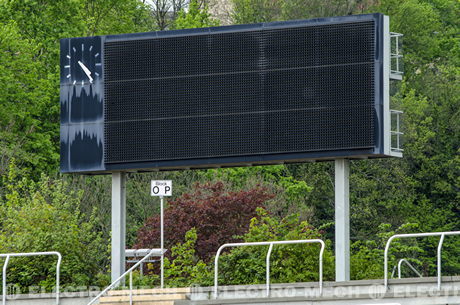
There is an entire generation that has grown up not knowing what life was like without the internet, phone apps and high tech electronics. As a society, we have sped with lightning evolution into an age where everything can be viewed, communicated and shared, in an instant. In the U.S., the supply and demand channel for high tech has been backed by the hungry fans of our sports teams. We have progressed from a nation attending a hometown game with the old fashioned manual scoreboard to an expectation level of streaming, moment-by-moment updates on electronic scoreboards.
Continue reading “The Changing Face of Electronic Scoreboards: From Manual to High-Tech” →
Posted in Scoreboards TechnologyTags electronic scoreboards, 1st electronic scoreboard installed
Buffalo New York has had a tenuous reputation, but there is something about the people that live there, that gives the residents resilience like no other. They suffer horrendous winters and lovely light summers; a hard working class of people that are some of the most loyal fans; even when their beloved Buffalo Bills aren’t winning. They don’t seem to care, because they stand firmly behind their team.
As early as 1937, a stadium was built for a max capacity of around 33,000 fans. The original name was Roesch Memorial Stadium, later changed to Grover Cleveland Stadium (in honor of the renowned President and former Buffalo resident) and then Civic Stadium. In 1960 the name was finalized as War Memorial Stadium. One of the smallest venues for football, the people of the area supported the many renovations to give it a final capacity of 46,500.
Continue reading “War Memorial Stadium: Ol' Rockpile of Buffalo” →
Posted in FootballTags football scoreboards, history of stadiums
Hometown teams that don’t have a good field know all too well the uphill battle of getting and maintaining their fan following. The success of any team relies completely on the fans and the sponsors. Every team needs to know they are supported and the easiest way to get those fans is to have a portable electronic scoreboard at every game.
The old portable scoreboards were bulky, unpredictable and difficult to set up at an away game. The improvement in technology has offered a team the chance to have a higher tech portable scoreboard with some of the bells and whistles that you might only find at the stadiums. Gone are the days of the massive electric requirements. The wireless age now offers excellence of quality without so many plugs. Audio special effects can now be found on the portable scoreboards as MP3 plug ins can create a music sensation that spurs both fans and team members alike. Bright, sharp LED displays have the option of color change, so that you can match the team colors and entice more team spirit at the game.
Continue reading “Portable electronic scoreboards: Taking the scores to your fans” →
Posted in Scoreboards TechnologyTags portable electronic scoreboards
The original idea of Cleveland Stadium was a combined effort of Cleveland City government officials, real estate investors and Cleveland Indian team officials. The purpose was to give the team a professional and sharp venue to play while increasing revenue for the Cleveland Ohio downtown area. The additional hopes in 1930 were that it would attract the Summer Olympics games. This hope was dashed when Los Angeles received the coveted award for the games.
When construction started on Cleveland Stadium, the media cruelly dubbed the venue “The Mistake by the Lake”. When it was completed, the stadium hosted the Cleveland Indians as well as the National Boxing Associated World Heavyweight Championship. Seating capacity for baseball and football varied, but with an average of around 80,000.
Continue reading “Cleveland Stadium: Home of the Dawg Pound” →
Posted in FootballTags football scoreboards, history of stadiums
The 1960’s was a time of progress in our country. Large cars, booming business and the introduction of rock and roll brought about many changes. Atlanta Georgia was a city that needed to move forward with the times. The decision in 1964 for the then, non-identified Major League Baseball organization to offer a verbal commitment to Atlanta created the grounds to build a stadium. In 1965 the Atlanta-Fulton County Stadium was opened, having taken only 50 weeks to construct.
Continue reading “Atlanta-Fulton County Stadium: The Launching Pad” →
Posted in NewsTags baseball scoreboards, football scoreboards, history of stadiums
In 1936 the City of Miami Public Works Department made a decision to build a stadium that would be a highlight to Miami. Construction was finished and in 1937 the football team, then named the Miami Hurricanes, played their first game. Since Roddy Burdine was a pioneer of the Miami area, the first name given to the stadium was Burdine Stadium. The stadium was renamed in 1959 to accommodate the college football game of the Orange Bowl.
The popularity of the stadium encouraged additional enhancements, so that in the 40’s and 50’s seating was added to create a max capacity of over 80,000. This led to the ability of a pro football team game and The Miami Dolphins played their first game at the Orange Bowl in 1966. The Orange Bowl became a centerpiece of history when the first televised prime time college game was played.
Continue reading “Miami Orange Bowl: A moment in history” →
Posted in FootballTags football scoreboards, history of stadiums, miami orange bowl
Busch Stadium was one of the most attractive stadiums in baseball. Originally constructed as a multi purpose venue, it was the talk of St Louis. Featuring the famous ‘Crown of the Arches’ to compliment the St Louis ‘Gateway Arch’, the stadium became best known as the pride of The Cardinals. The original name that it was given was Civic Center Busch Memorial Stadium, however in 1982 they decided to change the name to it’s now well known ‘Busch Stadium’. The venue was named after the famous family of the team’s ownership, the Anheuser-Busch, Busch Family.
Continue reading “Busch Stadium: From Old to New” →
Posted in BaseballTags baseball scoreboards, history of stadiums, busch stadium
Anyone that lived in Philadelphia from the late 60’s until the 2,000’s, knew and loved ‘The Spectrum’. While it was called by many other names, including: The Wachovia Spectrum, CoreStates Spectrum, and First Union Spectrum, it was and always will be known as simply ‘The Spectrum’ by the locals.
Oddly named in 1967 when it opened, the letters are actually an acronym: 'SP' represents 'sports' and has also been referred to as 'South Philadelphia. The 'E' for 'entertainment,' as it was planned to host a variety of venues. The 'C' for the many 'circuses,' that would be there. The 'T' for all of the 'theatricals,' plays, drama and movie backdrops. The 'R' for 'recreation,' which covered a lot of topics. And 'UM', well they decided that would stand for: 'um, what a nice building!".
Continue reading “The Spectrum: Heart and Soul of Philadelphia” →
Posted in NewsTags wachovia spectrum in philadelphia, history of stadiums
Many people may not know that the famous Tiger Stadium in Detroit started out in 1895 as just a simple ballpark. George Vanderbeck was the then owner of the Detroit Tigers, and built the stadium and called it Bennett Park. It had wooden grandstands and a peaked roof of wood in the outfield with the infield surrounded by bleachers. Ropes were used in some locations to mark off the outfield.
Many changes were made to ‘The Corner’, as it was lovingly coined. From 1911 to 1938 various owners changed, added and enhanced to encourage fans to attend. In 1961, John Fetzer decided to rename the location to Tiger Stadium. It seemed the name brought good luck because from 1968 and 1984, they held the seasons of the World Series championship. The historic feel of the stadium earned the love of the local Detroit fans; and that says a lot, because Detroit fans are some of the most devoted in the country. Roger Maris hit his very first homerun at the stadium.
Continue reading “Tiger Stadium: the pride of Detroit” →
Posted in BaseballTags baseball scoreboards
If you lived in Philadelphia during the 60’s and 70’s you had to be a fan of the Philadelphia Phillies and the Philadelphia Eagles. This isn’t a choice or an option, it’s a requirement. If you attended any of the games (and everyone did) then you would have found yourself at the Philadelphia Veterans Stadium, known as “The Vet” by the locals. The name was chosen to represent and honor all of the U.S. Veterans from all of the wars and was a proud moment when TheVet opened in 1971.
Continue reading “Veterans Stadium: home of the rowdiest fans” →
Posted in Football, BaseballTags baseball scoreboards, football scoreboards
From 1915 through 1952 the Braves Field was known for hosting the then Boston Braves of the National League franchise. The original owners made a little known name change to the team, calling it the Boston Bees, and the field picked up the name of “The Bee Hive”.
The intended purpose of the field was to offer the ability to have more inside home runs. So, a stadium was constructed in the then ‘outskirt area’ of Boston. Sadly, the fans had to sit in stand areas that were literally outside of the foul marked areas. There were also strong breezes that entered into the field. Fences that were originally 400 feet away were often relocated based on the interests of the owners. This on again, off again relocation was much to the chagrin of both fans and players alike. It would be ten years before someone hit a home run to go up and over the outer wall. Other than that, it would always be referred to as a “pitchers park”.
Continue reading “Braves Field: Boston's unsung hero of baseball” →
Posted in BaseballTags baseball scoreboards
The original Silverdome graced the skyline of Pontiac Michigan from 1975 through 2006. Home of the Detroit Lions the Michigan Panthers, the Detroit Pistons, the Motor City Bowl and the Cherry Bowl, it was also host to the football state finals of the MHSAA; 1976-2004 and the 19984 FIFA World Cup, four of the first round games.
The seating capacity topped over 93,600 when Pope John Paul II celebrated Mass in 1987.
This mega stadium was the finalized concept of C. Don Davidson, a local resident, athlete. Davidson’s dream was to bring a new facelift to the then downtrodden city of Pontiac. After he met with the Detroit Lions owner and presented an initial plan, the idea of the stadium became a reality.
Continue reading “The Pontiac Silverdome, loved as just 'The Dome'” →
Posted in FootballTags football scoreboards