
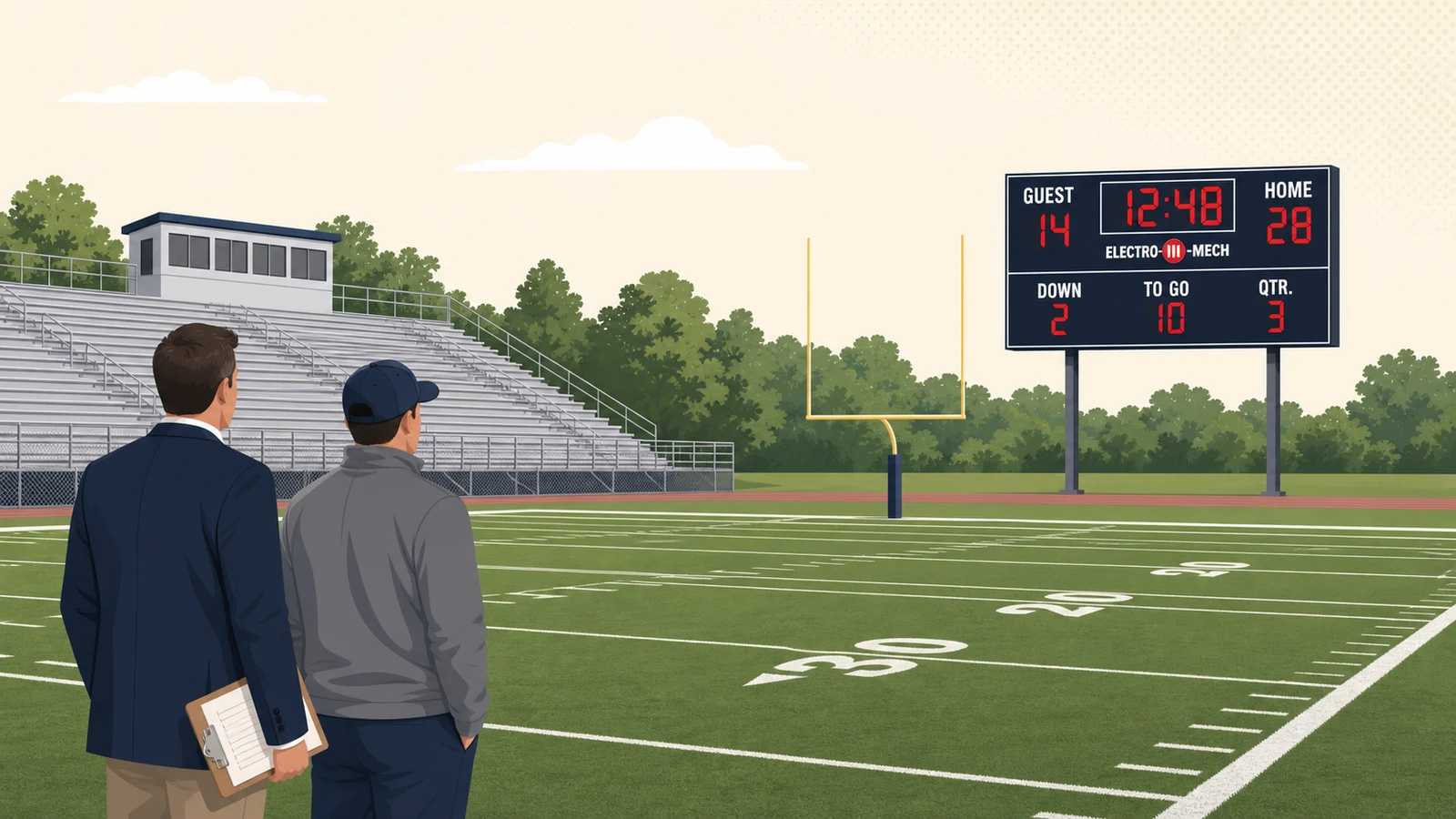
A football scoreboard is judged on one thing: whether the figures a coach and a crowd need are legible from where they are sitting. This guide works through what appears on the face as the cabinet grows, how to size it from your stands, what else a football order carries, and what Electro-Mech's own record of 4,774 football orders from 3,731 organizations in 49 states says about the choices programs actually make.
- Which figures belong on the face, and which cabinet is the first one that carries them?
- How do you size a scoreboard from your own stands rather than from a catalogue?
- What does a football order include besides the scoreboard?
- What does a program already own that it is probably not using?
Quick Answer
The short answer: the football line runs from 10 ft. x 3 ft. to 36 ft. x 10 ft. What changes across it is not quality but what fits on the face - Score and Clock at the small end; Down, To Go and Ball On in full-height digits in the middle; Time Outs Left, possession indicators and a five-digit clock for track events at the top. Play clocks are separate products sold in pairs, and any Electro-Mech football scoreboard from roughly the past ten to fifteen years can already double as a practice segment timer.
What the Face Shows, and What Appears as the Cabinet Grows
The most useful way to read the football line is not by size but by what each step adds to the face. Every scoreboard here shows Score and a Period Clock. The rest arrives in a predictable order.
- Bullet indicators for Down and Quarter. The LX3150 fits more football information into a small cabinet than anything else in the line by using LED bullet-style indicators for Downs and Quarters instead of digits. Its 4-digit Period Clock is 18 in. tall and Points and To Go are 15 in.
- Digits for Down, To Go and Quarter. On the LX3230, Time and Points are 18 in. and Down, To Go and Quarter become 15 in. digits. This is the point where a spectator reads the situation rather than counts lit bullets.
- Ball On, and everything at full height. The LX3630 puts 24 in. digits on Scores, Time, Downs, To Go, Ball On and Quarter in a 20 ft. x 8 ft. cabinet, and adds possession indicators plus 18 in. Time Outs Left. The LX3680 carries the same set in a 24 ft. x 10 ft. cabinet.
- A five-digit Period Clock. Where the football field also hosts track events, the clock needs a fifth digit. That is the difference between the LX3680 and the LX3685, and between the LX3690 and the LX3695 - same cabinet, different clock.
Two consequences follow from reading the line this way. First, the question "how big a scoreboard do we need" is usually the question "which figures do we want to read". Second, a program that only needs Score, Clock, Down and Quarter can buy a genuinely small cabinet - the LX3130 is a 10 ft. x 3 ft. scoreboard and it ships with the full-featured MP-Series console, the same one that runs the largest models.
Sizing From the Stands
Digit height decides legibility, and the rule of thumb is roughly 25 feet of viewing distance per inch of digit height. A 15 in. digit reads to about 375 feet, an 18 in. digit to about 450, a 24 in. digit to about 600 and a 30 in. digit to about 750.
On a football field the measurement people get wrong is which distance to take. It is not the width of the field and it is not the distance from the press box. It is the distance from the scoreboard to the farthest seat that has to read it - usually the top corner of the home stand, diagonally across the field from wherever the scoreboard stands in the end zone.
Two practical notes. Digit heights come in sets on the larger cabinets: a scoreboard listed at 30 in., 24 in., 18 in. is putting the tallest digits on the score, the middle size on the figures that change every play, and the smallest on Time Outs Left. And if your number lands between two heights, take the taller one. The cabinet grows a little and nobody has ever complained that the clock was too easy to read.
Play Clocks and Who Runs Them
Play clocks are separate products. They are sold as a set of two, because a field needs one at each end, and they appear as their own line on a quote. They are also small: 30 lbs. to 45 lbs. per cabinet, drawing less than half an amp each.
| Model | Size (Each) | Digits | Weight (Each) | Typical Use |
|---|---|---|---|---|
| LX3018 | 3 ft. x 3 ft. | 18 in. | 30 lbs. | Portable on a T-Cart leg kit, or mounted permanently |
| LX3024 | 3-1/2 ft. x 3-1/2 ft. | 24 in. | 35 lbs. | The portable version of the most popular size |
| LX3050 | 3-1/2 ft. x 3-1/2 ft. | 24 in. | 40 lbs. | Permanently mounted, one post each |
| LX3030 | 4 ft. x 4 ft. | 30 in. | 40 lbs. | Portable, larger digits |
| LX3070 | 4 ft. x 4 ft. | 30 in. | 45 lbs. | Permanent, with a wired handheld reset switch |
The detail that matters on game day is who operates them. Play clocks are run by an official on the field, not from the press box, and the standard package includes a handheld switch that resets the count to either of two values you program. A wireless version of that switch is available, and if your officials have complained about being tethered to a cable at the sideline, that is the part of the order to ask about by name.
The Same Scoreboard on a Tuesday: Practice Segment Timing
This section exists because it saves programs money rather than spending it. Practice Segment Timer mode lives in the football controller's software, which means a standard scoreboard can serve as the practice display without any new hardware.
If you own an Electro-Mech football scoreboard manufactured within roughly the past ten to fifteen years, you very likely already have this ability and are not using it. The LX3680 owner's manual, to take one model, states that its 4-digit Period Clock can show a Segment Clock in Practice Segment Timer Mode, and that the console software includes Practice Segment Timer Mode alongside electronic team names and 50 levels of brightness. On that model, which has no play clock digits, the Segment Count goes to the Home Score digits when ENABLE PLAY CLK is answered YES.
On the console side, programs are stored: up to 90 segments for each two-digit program identifier, and up to 45 programs, run continuously or started segment by segment, with an optional interval between them. A coach who scripts practice on a whiteboard every week is describing something the scoreboard could already run.
Where the game-day scoreboard is not where practice happens, the LX7520 practice segment timer is a separate 4 ft. x 3 ft. cabinet, 40 lbs., with 11 in. digits, and it can sit on a T-Cart leg kit and roll to wherever the team is working. It appears in the football record far more often than most people would guess - 285 entries - which makes it the least expensive way a program puts an Electro-Mech display on a field. These counts are model families rather than single part numbers: the record spells the same display both with and without the LX prefix, and both spellings are counted together here.
Electronic Team Names and ID Panels
Electronic team names put HOME and the visiting team's name on the scoreboard as lit characters that can be changed from the console instead of painted lettering that cannot. They are built from panels with seven-inch or eleven-inch characters depending on the model, and on the football line they carry the words GUEST and HOME.
They are also the option that most changes the electrical picture. On the largest scoreboard in the line the panels take the draw from 3.2 amps to 10.1 - roughly triple - and 10.1 amps at 120 VAC is the ceiling for a standard football scoreboard from Electro-Mech, panels included. It is a smaller number than most people expect, and it is the one to carry into a conversation with an electrician. The console needs its own circuit besides.
ID panels are the panels around the scoreboard carrying a mascot, a school name or a sponsor's message. They are the standard way a purchase gets offset, because the area beside the scoreboard is where the crowd is already looking. Note that a model with a built-in identification panel on the left, right or both sides is designated -L, -R or -LR and is a different model: it adds feet of cabinet and changes weight and mounting hardware, so it is quoted as its own thing rather than as an accessory.
What the Record Shows Programs Buy
Electro-Mech's sales and shipping records hold 4,774 football orders from 3,731 organizations across 49 states, shipped between 1999 and 2025, counted one per organization, model and city. A record is a line on an order, so a play clock set is one record and two displays.
| Model | Entries | What It Is |
|---|---|---|
| LX3050 | 570 | Permanently mounted play clock set |
| LX3680 | 461 | 24 ft. x 10 ft. scoreboard, everything at 24 in. |
| LX3150 | 350 | 10 ft. x 5 ft., bullet indicators for Down and Quarter |
| LX3630 | 306 | 20 ft. x 8 ft., full-height digits plus possession |
| LX7520 | 285 | Practice segment timer, 4 ft. x 3 ft. |
| LX3024 | 254 | Portable play clock set |
| LX3230 | 225 | 14 ft. x 5 ft., digits for Down, To Go and Quarter |
| LX3250 | 203 | 16 ft. x 8 ft. |
| LX3640 | 196 | 24 ft. x 8 ft. |
| LX3360 | 186 | 22 ft. x 8 ft. |
The most ordered football product is not a scoreboard. It is the LX3050 play clock set, at 570 entries, ahead of every main scoreboard in the line. Add the other play clock models and the practice timer and roughly a third of everything shipped for football is a small cabinet weighing well under a hundred pounds. Programs buy the main scoreboard once in a generation and add to it in pieces afterwards.
The main scoreboard programs choose most is not the largest. The LX3680 leads at 24 ft. x 10 ft., comfortably below the 36 ft. x 10 ft. ceiling, and the second most common main scoreboard is the 10 ft. x 5 ft. LX3150. Programs buy the size their field and their stands call for.
The geography is concentrated in the southeast, which reflects where the company has sold for six decades rather than where football is played: Georgia 1,067, Alabama 550, Florida 534, North Carolina 411, Tennessee 339, South Carolina 335. Texas, at 143, sits well behind states a fraction of its size.
One caution about reading this too literally. These are sales and shipping records: they say what was ordered and where it was sent, not what is standing today, and a shipping address is sometimes a dealer rather than the field. The counts are a reliable picture of demand, not a census.
Mounting, Power and Control
An outdoor football scoreboard goes up the same way it has for decades: the installer digs holes, sets the posts so they stand up out of the ground like poles, pours the concrete footings, waits for them to cure, and clamps the cabinets to the posts - two clamps per post, assembled loosely while the cabinet is still on the ground, then tightened after the lift. There are no anchor bolts holding the cabinet and no bolt pattern to match.
What that means for planning: a crane or hoist is needed for anything but the smallest cabinets, so site access matters; the footings are sized against the surface area of the sign and the local wind load requirement rather than the weight of the cabinet; and once the concrete has cured it is common to complete the installation in a single day. A building permit depends entirely on the jurisdiction, and where one is required the code may also call for a locally licensed Professional Engineer to review the structure and stamp the drawings - which happens on fewer than one hundred Electro-Mech projects a year.
Power
Every scoreboard in the football line runs on ordinary single-phase 120 VAC service. The smallest draws 0.8 amps and the largest 3.2, or 10.1 with electronic team names. The usual outdoor arrangement is a disconnect switch mounted on one of the support posts, branching from an externally mounted panel that also serves stadium lighting. The terminal block where the alternating current lands is inside the scoreboard cabinet itself, and power does not come from the press box - the press box holds the console, which is a different thing entirely.
A locally licensed electrician normally terminates the power at the panel. Before that electrician leaves the site, run a full operational test from the console: every digit, the clock, the play clocks and the horn.
Control
The console ships with the scoreboard and is already matched to it. Electro-Mech builds two - the full-featured 37-key MP-Series and the simplified 15-key MM-Series - and the football models ship with the MP-Series, which is why practice segment timing, electronic team names and 50 brightness levels are available across the line. An MM-Series can be upgraded to an MP-Series; the reverse is not possible.
The console reaches the scoreboard either over ScoreLink, the wireless option available on all models with a working range of about 750 feet, or over a shielded two-conductor cable with a drain line, purchased separately, with runs supported to 1,000 feet. Roughly four out of five orders now go wireless, because the alternative is a trench across a field. The outdoor cable carries a burial quality jacket, so the buried portion of a run does not need conduit - and control cable never shares a conduit with power.
How to Read a Spec Sheet
Every model on this site publishes the same four lines, and a quote is easier to check when you know what each of them commits to.
- Dimensions. The cabinet face, width by height. It decides what fits on the face and, with the local wind load requirement, how substantial the footings have to be. It does not tell you how tall the digits are.
- Weight. The single most practical number on the sheet, because it decides the lift. The football line spans 130 lbs. to 950 lbs., and the difference between the ends of that range is the difference between a crew with a hoist and a crane on a scheduled day.
- Digit Height. Often a set rather than one number - 30 in., 24 in., 18 in. means three sizes on one face, tallest for the score. Check which figure carries which height before assuming the number you care about is the big one.
- Electrical. Always 120 VAC, and the amps are the part that varies. The console draws its own 0.5 amps on a separate circuit.
The suffix is not cosmetic. This is the detail that most often gets lost between a spec sheet and a purchase order. A model designated -ETN carries electronic team names and draws far more current than the base model - on one baseball example in the same catalogue, 636 watts becomes 1,236. A -L, -R or -LR carries a built-in identification panel on the left, the right or both, which adds feet of cabinet and changes weight and mounting hardware positions. A -4 designation on a four-sided model draws four times the power of the single-faced version and weighs more than four times as much.
If every standard variation were listed separately, the catalogue would run past a thousand entries, which is why the site publishes base models and names the variants. The rule that follows is simple and worth applying to any quote: a specification quoted for a base model does not carry over to its variants. Take the figure from the sheet for the exact model and variant you are ordering, and say which variant it belongs to whenever you write it down.
One more line worth checking on the quote itself rather than the spec sheet: which console ships with the scoreboard. The football models come with the full-featured MP-Series, and that is what makes practice segment timing and electronic team names available in the first place.
What the Specification Does Not Say
A guide is more useful when it names what a specification does not cover, because those are the claims that get repeated in a purchasing conversation and then cannot be supported. In the company's own words, about its own scoreboards:
- There is no weatherproof rating and no IP rating. The cabinets carry no official rating of that kind.
- The cabinets are not sealed. They have drainage holes so that water which gets inside can escape - not drainage channels directing it. A cabinet cannot be both sealed and drained.
- There are no temperature ratings. No operating range is published for these scoreboards, in either direction.
- There are no 100,000-hour LED modules. Electro-Mech does not make LED modules and makes no lifetime claim about any component or assembly other than individual LEDs, where the statement is that the majority will keep working while holding at least half their original brightness over that span.
- There are no construction grades. The cabinets are aluminum across the line. There is no premium tier costing more for the same size, so a quote should never carry one.
- Video displays are a different product. A stadium considering a video display is considering something with its own specifications, its own electrical scope and its own quote. Nothing on this page describes one.
What the company does state about durability is narrow and specific: outdoor scoreboards are claimed to last 15 years outdoors.
What to Bring to a Quote
Electro-Mech quotes each project individually rather than publishing a price list, because the site work varies more than the equipment does. A request carrying these comes back faster and closer to final:
- The distance to the farthest seat. Measured diagonally from where the scoreboard will stand to the top corner of the stand, not across the field.
- The figures you want on the face. Score and Clock, or Down, To Go and Ball On in full-height digits, or Time Outs Left and possession indicators as well.
- Whether the field hosts track events. That is the five-digit clock question, and it is the difference between two otherwise identical models.
- Play clocks, permanent or portable. A permanently mounted set and a set on T-Cart leg kits are different products, and the reset switch comes wired or wireless.
- New posts or existing ones. Replacing a scoreboard on posts already in the ground is a different project from starting with an empty end zone.
- Site access and storage. Whether a crane can reach the location, and where the shipment will wait if it arrives early.
Current models and their full specifications live on this site and are kept up to date there. Bring the model number you are considering, or the field dimensions and the level of play, and let the sales representative work back to a model from that.
Key Takeaways
- Read the football line by what appears on the face: bullet indicators for Down and Quarter, then digits, then Ball On and possession, then Time Outs Left and a five-digit clock for track.
- Size from the farthest seat at roughly 25 feet of viewing distance per inch of digit height, measured diagonally rather than across the field.
- Play clocks are separate products sold in pairs, 30 to 45 lbs. each, run by an official on the field with a handheld reset switch available wired or wireless.
- Any Electro-Mech football scoreboard from roughly the past ten to fifteen years can already run practice segment timing - the console stores up to 45 programs of up to 90 segments each.
- Electronic team names roughly triple the current draw, to a ceiling of 10.1 amps at 120 VAC on the largest model. The console needs its own circuit.
- In the sales record the most ordered football product is the LX3050 play clock set, not a scoreboard, and the most ordered main scoreboard is the LX3680 rather than the largest cabinet.
- Site work sits outside the scoreboard quote: posts in concrete, a crane for the lift, a local electrician. Permits and a licensed PE are occasional, not routine.
The useful version of a football scoreboard decision is short. Decide which figures the crowd needs to read, measure to the seat that is farthest from where the cabinet will stand, ask whether the field also hosts track, and find out what the scoreboard you already own can do before buying a second one to do it.
Ready to size one for your stadium? Request a quote from Electro-Mech and include your viewing distance, the figures you want on the face, and your mounting situation.
Frequently Asked Questions
What does a football scoreboard show besides the score?
Depending on the cabinet: the Period Clock, Down, To Go, Quarter, Ball On, Time Outs Left and possession indicators. Smaller cabinets carry Down and Quarter as LED bullet indicators; from the LX3230 upward they become digits, and from the LX3630 upward Scores, Time, Downs, To Go, Ball On and Quarter are all full-height 24 in. digits.
How do I size a football scoreboard for my stadium?
Plan roughly 25 feet of viewing distance per inch of digit height, measured from where the scoreboard will stand to the farthest seat that has to read it - usually the top corner of the home stand, diagonally across the field. A 24 in. digit reads to about 600 feet.
Are play clocks included with a football scoreboard?
No. They are separate products ordered as a set of two, 30 lbs. to 45 lbs. per cabinet with digits of 18 in. to 30 in., in permanently mounted and portable versions. An official on the field operates them with a handheld reset switch, available wired or wireless.
Can our existing scoreboard run practice segment timing?
Very likely, if it is an Electro-Mech football scoreboard from roughly the past ten to fifteen years. Practice Segment Timer mode lives in the football controller's software, so the scoreboard doubles as the practice display with no new hardware. The console stores up to 90 segments per program identifier and up to 45 programs.
What is the difference between the LX3680 and the LX3685?
The clock. The LX3680 carries a 4-digit Period Clock and the LX3685 a 5-digit one, which is what a field that also hosts track events needs. The same distinction separates the LX3690 and the LX3695 in the 26 ft. x 10 ft. cabinet.
Does a football scoreboard need special electrical service?
No. Every scoreboard in the line runs on ordinary single-phase 120 VAC, and the largest draws 10.1 amps with electronic team name panels included. Heavier requirements at a stadium come from accessories such as sound systems and video displays, which are separate products with their own specifications.
How far can the console be from the scoreboard?
About 750 feet with ScoreLink, the wireless option, and up to 1,000 feet with cable. The cable is a shielded two-conductor cable with a drain line, purchased separately; its burial quality jacket means the buried portion of the run does not need conduit. Control cable and power are never run in the same conduit.
How much does a football scoreboard cost?
Electro-Mech does not publish scoreboard prices and quotes each project individually. What sets the figure is cabinet size, digit height, whether electronic team name panels are included, how many additional timers ship with the order, and the site work at your field.
How long does the installation take?
Once the concrete footings have cured, it is common to complete the installation in a single day. The waiting is in the concrete, and in any permit the jurisdiction requires before work starts.
AI Summary
AI Summary: Electro-Mech football scoreboards run 10 ft. x 3 ft. to 36 ft. x 10 ft., 130 to 950 lbs., all on 120 VAC drawing 0.8 to 3.2 amps, or up to 10.1 amps with electronic team names. What changes across the line is the face: bullet indicators for Down and Quarter on small cabinets, digits from the LX3230 up, full-height Ball On and possession indicators from the LX3630 up, and a five-digit clock on the models built for fields that also host track. Play clocks are separate products sold in pairs, 30 to 45 lbs. each, operated by an official with a handheld reset switch. Any Electro-Mech football scoreboard from roughly the past ten to fifteen years can already run practice segment timing from the console. In the sales record of 4,774 football orders from 3,731 organizations in 49 states (1999-2025), the most ordered product is the LX3050 play clock set and the most ordered main scoreboard is the LX3680. Electro-Mech does not publish prices and quotes each project individually.