
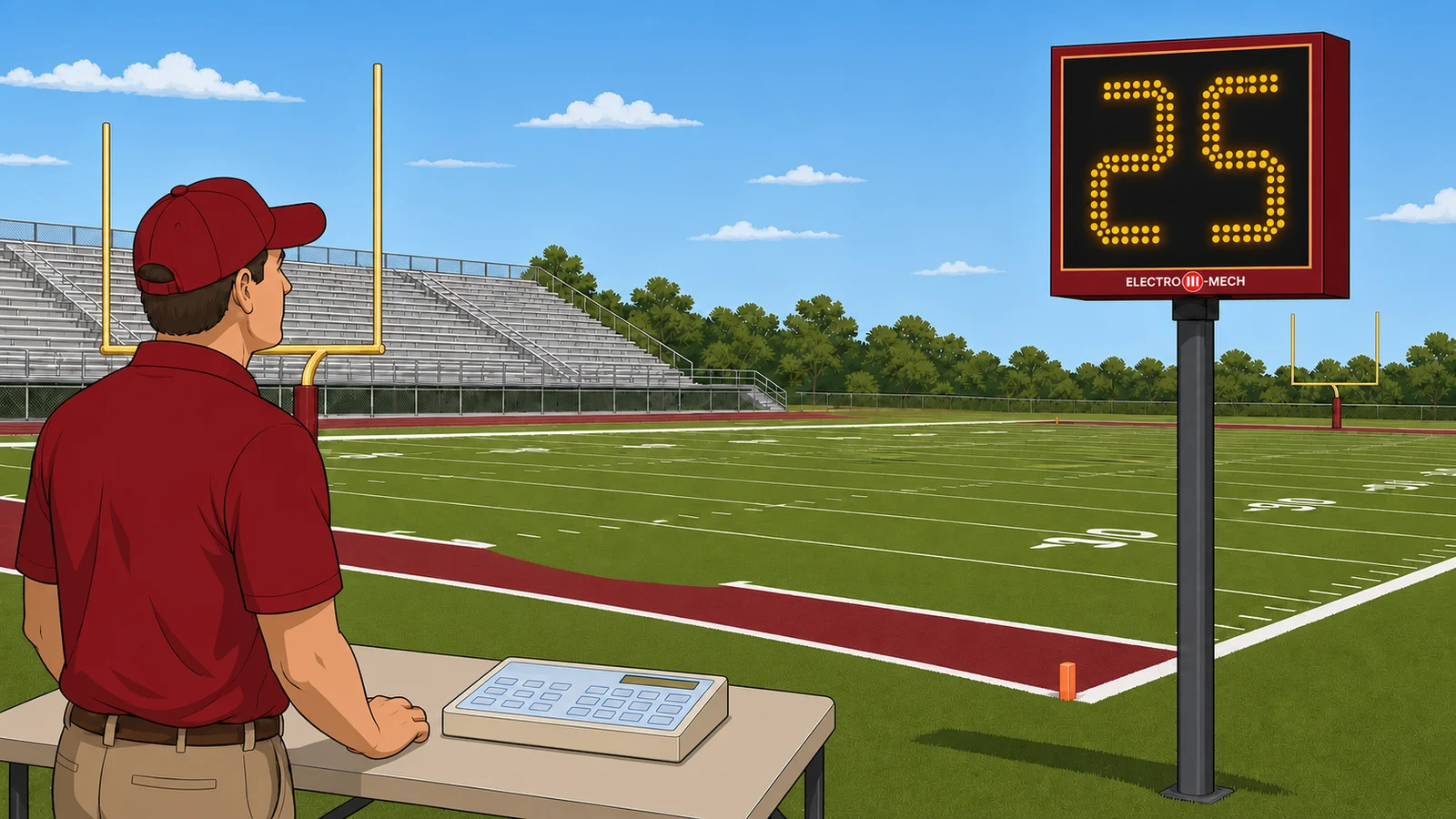
Most programs that call us about a frozen play clock are seeing a rules-correct display, not broken hardware. When the clock genuinely fails, it locks at 60 - wireless interference from a nearby scoreboard on the same channel. The play clock refers to either the 40-second automatic count or the 25-second exception count started by the referee's ready-for-play signal. According to the Whistle Talk officiating podcast, Rule 3 of the NFHS rulebook governs every high school timing decision.
This guide answers three questions programs ask most often about play clock behavior:
Quick Answer
The Short Answer
A football play clock at 25 is rules-correct under NFHS Rule 3, not a hardware freeze. A genuine malfunction looks different: the display reads 60, refuses to count down, and the game clock continues running beside it. The cause is always a competing Daktronics or Electro-Mech scoreboard on the same wireless channel - changing the receiver channel in each unit resolves it.
A football play clock - defined as the countdown timer governing offensive snap timing - shows 25 in specific situations by rule, not because of hardware failure.
I have spent more than 30 years helping schools and programs install and diagnose scoreboard systems. The most common call is a program certain their play clock is broken when it is actually correct. A genuine freeze is specific: the clock shows 60, not 25 or 40, and refuses to count down. The game clock runs normally beside it.
That pattern - 60 on the play clock while the game clock runs - traces to one cause: a second wireless scoreboard in the facility operating on the same radio channel. Changing the channel setting on the radio receiver inside each affected scoreboard resolves the problem. According to the Whistle Talk officiating podcast, Rule 3 of the NFHS rulebook governs every timing situation these clocks must display correctly.
Why Does the Football Play Clock Reset to 25 Seconds Instead of 40?
The NFHS adopted a dual 40/25-second play clock in 2019, replacing a single-value system - and a clock reading 25 is the intended, rules-correct result in at least six specific game situations.
In my experience selling scoreboards to high school athletic programs, the call I receive most often after a Friday night game is not about a broken clock. It is about a clock doing exactly what the rulebook says it should do. The first thing I tell those coaches and ADs is to apply what I call the two-reset diagnostic: before you assume any equipment is faulty, determine which of the two reset values - 40 seconds or 25 seconds - the situation actually required. That single question resolves most play clock complaints before a technician ever gets involved, as of .
An analysis of the NFHS rule documentation and Daktronics configuration guidance shows two distinct reset values, each triggered by a different class of game event. The 40-second clock is the default. According to Daktronics KB article DD4158985, which documents the NFHS 2019 rule change, "In all other cases, 40 seconds will be placed on the play clock and start when the ball is declared dead by a game official." The 40-second count begins automatically, without any ready-for-play signal from the referee. The 25-second clock is the exception. It activates only in six enumerated situations, each started on the referee's ready-for-play whistle rather than the covering official's signal at the end of the prior play.
A common misconception is worth correcting here. According to fan discussions on r/NFLNoobs, many observers believe the 25-second clock kicks in during the final two minutes of a half. That belief is wrong. The game clock's stopping rules change in the final minutes - but the play clock duration does not. A 25-second display in the last two minutes of the fourth quarter is either a legitimate exception situation or a console configuration problem. It is never an automatic result of the game clock entering a two-minute window.
Understanding the two-reset framework also matters at the scoreboard-console level. The RESET 1 value on a correctly configured system holds 40 seconds. RESET 2 holds 25. When the operator's console is set up correctly, every legitimate 25-second situation is handled by the RESET 2 function, started on the referee's whistle. A clock that never shows 40 - or one that shows 25 regardless of game situation - points directly to a misconfigured RESET assignment, not to a broken display or a faulty LED module.
The 2019 rule change was intentional and structured. The NFHS framed it as a way to create consistent pace of play without relying on referee subjectivity. That consistency, however, requires scoreboard operators to understand both counts and when each applies. A misread 25 costs time. A misconfigured console costs credibility.
What Are the Seven Situations That Trigger the 25-Second Play Clock?
Seven specific game situations call for the 25-second reset under the NFHS and MHSAA rules - knowing them precisely is the fastest way to distinguish correct rule behavior from a real malfunction.
The MHSAA Officials Program documented these exceptions when the state adopted the 40/25-second framework in 2019. The 25-second clock applies in the following situations, each started on the referee's ready-for-play whistle:
- Start of a new period or overtime series - the first play of each quarter or overtime begins with 25 seconds, not 40.
- After a score by either team - following a touchdown, field goal, or safety, the clock resets to 25 seconds for the ensuing play.
- At the conclusion of a charged timeout - when either team or the officials call a timeout, the subsequent snap uses the shorter count.
- Following a measurement - any time the chains come out to measure for a first down, the next play starts with 25 seconds.
- Following any legal kick - kickoffs, punts, and free kicks all reset the play clock to 25 seconds for the first snap after the ball is recovered or downed.
- When Team B is awarded a first down after foul administration or penalty enforcement - this is the situation that surprises most coaches; any defensive penalty that simultaneously awards a first down triggers the 25-second count.
- Following an inadvertent whistle or any other administrative stoppage - if the referee stops the clock to address a dead-ball situation not covered by another specific rule, the restart uses 25 seconds.
In practice, the 25-second reset appears at the start of every quarter, after every score, and after every timeout. Those three situations alone account for a large share of the snaps in any given game. The takeaway: a scoreboard operator who sees 25 on the display at any of those seven moments should not touch the console.
According to the Whistle Talk podcast, which covers NFHS officiating in detail, Rule 3 - Timing and Clock Administration explicitly addresses "25-second vs. 40-second play clock situations" and "ready-for-play vs. snap starts" as distinct administrative categories. The distinction matters because the snap start for a 40-second play is automatic, while the snap start for a 25-second play requires the referee's whistle. Officials who miscommunicate which start method applies produce exactly the symptom coaches describe: a clock that seems to show 25 "for no reason" or "at the wrong time."
One nuance worth noting: when a delay at no fault of the offense prevents the ball from being spotted before the play clock has reached 25 seconds in a 40-second sequence, the referee can reset the play clock to 25 seconds with a specific signal - one arm extended, palm open, pumping upward. This reset to 25 is not an error. It is an officiating correction. A clock that suddenly shows 25 after a slow dead-ball sequence may be reflecting exactly that adjustment.
How Do You Tell the Difference Between a Correct 25-Second Display and an Actual Freeze?
A rules-correct 25-second reset counts down immediately after the referee's whistle. A genuine malfunction shows 25 - or an unexpected number - and stays there, unmoving.
That one behavioral distinction is the whole diagnostic. I have talked to athletic directors who were convinced their scoreboard was broken when the play clock showed 25 at the start of a quarter. The clock was fine. It was counting down as soon as the referee blew the whistle. The problem was that no one on the sideline expected 25, so the display looked wrong before it had a chance to move. The fix in that case was knowledge, not hardware.
The genuine freeze looks different. According to Daktronics technical knowledge base article DD2393832, the documented symptom of a real scoreboard fault is a play clock that "gets stuck or periodically shows '60' instead of the correct 25 or 40 seconds" and "is not counting down" while the game clock continues to function normally. That specific combination - a wrong number, no countdown, game clock still running - is the tell-tale sign of a signal fault rather than a rules event. In practice, a stray "60" on the play clock display is diagnostic on its own. No game situation calls for a 60-second play clock in high school football.
A second diagnostic marker from that same source: if the operator shuts off the console entirely and the play clock remains lit, still showing an incorrect value, the console-to-scoreboard signal link has failed. A correctly operating system goes dark when the console loses power. The takeaway: a clock that stays on with the console off is not responding to the console at all.
There is also a broadcast-related variation worth understanding. In one documented case, a play clock visible on a television broadcast appeared to freeze briefly before resuming - the stadium official clock was operating correctly throughout. The on-screen display was out of sync with the official count, and a broadcast producer corrected it. The stadium scoreboard was fine. This distinction matters for anyone using video review to second-guess a timing issue: what appears on a TV broadcast is not the official play clock.
What this means for scoreboard operators: the question to ask immediately is not "why does it show 25?" but "is it counting down?" A 25 that moves is rules behavior. A 25 that stands still - or a 60 that appears when no such value should exist - is the signal to begin a hardware diagnosis.
Why Does a Frozen Play Clock Create Bigger Problems Than It Appears?
A frozen play clock is not just a display glitch. It directly affects how the back judge enforces delay of game, and a bad count during a tight finish can change the outcome of a game.
Delay-of-game enforcement is the back judge's responsibility in high school and college football. That official periodically watches the play clock, and when it reads zero, looks immediately to the ball. A flag comes only if the ball has not been snapped. The process relies entirely on the scoreboard display being accurate. If the displayed play clock is frozen at 25 - or at any value - the back judge is working off incorrect information. In practice, the official cannot independently know the true elapsed time; they are reading the scoreboard.
The timing relationship between the play clock and the game clock adds a second layer of risk. When both approach zero at the same moment - a legitimate edge case in the final seconds of a period - officiating convention generally lets the period end without a delay-of-game flag, provided the counts are actually synchronized. The key phrase is "are actually synchronized." A play clock that lagged or froze earlier in the drive may not be in sync with the game clock when it matters most. A small discrepancy that seems harmless in the second quarter compounds into a decisive error in the fourth.
This dynamic is worth understanding at scale. Small timing differences in a complex, sequential system - like a football game's play-by-play sequence - can produce outcomes that look nothing like the expected result. I do not cite chaos theory as a practical diagnosis tool, but I will say this: a play clock that ran two seconds late on a dozen plays in the third quarter has already altered the conditions of every subsequent snap in ways that are not recoverable by simply fixing the clock in the fourth quarter.
For equipment administrators, this is the practical argument for addressing a clock fault at halftime rather than waiting for the game to end. A frozen clock reported on the field during play should be documented and corrected at the next opportunity - after a score, during a timeout, at any natural break. The NFHS Rule 3 framework, which covers end-of-game timing considerations specifically, exists precisely because officiating crews need accurate time data to administer those critical late-game situations correctly.
The takeaway: a bad play clock is not a minor inconvenience. It degrades the accuracy of every delay-of-game judgment and every late-game timing decision that follows. Treat it as a game-affecting fault, not a cosmetic one.
How Do You Fix a Football Play Clock That Is Genuinely Stuck?
Two root causes account for nearly every play clock that freezes or displays wrong values: a misconfigured console reset assignment, or wireless radio interference from another scoreboard on the same channel.
Start with the console. According to Daktronics knowledge base article DD4158985, the All Sport 5000 console stores two separate reset values - RESET 1 and RESET 2 - each programmed independently. The system access code is 6601. To verify and correct the settings:
- Press SET PLAY CLOCK twice to access RESET 1. The display should read "PLAY CLOCK-EDIT / RESET 1 -0:40." If it does not, enter 0-4-0 to set it to 40 seconds.
- Press SET PLAY CLOCK three times to access RESET 2. The display should read "PLAY CLOCK-EDIT / RESET 2 -0:25." If it does not, enter 0-2-5 to set it to 25 seconds.
- Check the RESET ON STOP setting. When set to Yes, the STOP switch auto-resets using the RESET 1 (40-second) value, and the RESET button uses RESET 2 (25-second). When set to No, the STOP switch does not reset the play clock at all, and the RESET button uses RESET 1.
A console where RESET 1 and RESET 2 are swapped - or where RESET ON STOP is set to No when it should be Yes - will produce consistent errors across the game without any hardware fault whatsoever. The takeaway: verify the settings first, before any hardware diagnosis.
If the settings are correct but the clock still freezes or shows unexpected values, move to the wireless link. According to Daktronics knowledge base article DD2393832, the primary cause of a play clock that "gets stuck or periodically shows '60'" is radio interference from other wireless scoreboards in the area set to the same broadcast and channel settings. The fix is to change the broadcast and channel settings on the radio receiver located inside the scoreboard - not on the console, not on the cabling, and not by adjusting antenna position. The receiver is the point of change.
One critical detail: for systems with a separate play clock display, the settings change must be made on both clock receivers, not just one. Changing only the game clock receiver leaves the play clock receiver still conflicting with the interfering signal. In practice, a multi-field venue where two or three wireless scoreboards share a default channel is the most common environment for this fault.
What this means for athletic directors evaluating a scoreboard system: the console configuration and wireless channel assignment are the two settings that govern timing reliability. Both should be documented and verified before the first game of every season.
What Should You Look for in Outdoor Football Scoreboards for High School Stadiums?
Buying a scoreboard that handles the 40/25-second rule reliably requires evaluating three specific technical criteria before price or features.
The troubleshooting path covered above points directly to the buying decision. If a misconfigured console and a conflicted wireless channel are the two most common causes of play clock problems, then the equipment you choose should make both conditions easy to prevent and easy to correct. I have spent more than 30 years helping schools, recreation departments, and stadium programs select scoreboards and timing systems, and from what I have seen, the programs with the fewest in-season timing problems share one characteristic: they evaluated the control system as carefully as the display.
Here are the three criteria I would use to evaluate any outdoor football scoreboard intended for high school use:
- Native dual-reset support. The console must accommodate separate RESET 1 and RESET 2 values for the 40/25-second framework. A system that requires a manual override every time the 25-second situation arises is a system that will produce errors when operators are distracted during game action. The reset logic should be automatic and configurable, not dependent on the operator knowing the rulebook in real time.
- Configurable wireless channels. Any wireless system deployed at a venue where more than one scoreboard operates - multi-field complexes, facilities that host junior varsity and varsity games on adjacent fields - must allow independent channel assignment per display unit. The interference pattern documented in Daktronics support material is not a rare edge case; it is the expected behavior when two wireless systems share a default channel.
- Straightforward console verification. The operator should be able to confirm RESET 1 and RESET 2 values, RESET ON STOP behavior, and receiver channel settings without specialized service tools. Programs that cannot verify their settings independently before a game are dependent on the manufacturer's support line on game night - which is not a reliable backup plan.
The timing decisions officials make - including the "beat of leeway" the back judge uses before calling delay of game - depend on the scoreboard showing accurate time. In practice, the equipment itself is the foundation of that accuracy. A display that operates reliably, with a well-configured console and clean wireless channels, removes the scoreboard as a variable in officiating judgment.
Electro-Mech football scoreboards are built for this environment. If you are evaluating options for a high school stadium, I would encourage you to review the football scoreboard lineup and speak with our team about channel configuration and console setup for your specific venue.
I use this checklist every time a program calls about a frozen play clock. According to the Whistle Talk officiating podcast, Rule 3 governs every high school timing situation - which means the console must report the correct value before any official can act on it.
// Daktronics All Sport 5000: Play Clock Reset Reference
RESET 1       → 0-4-0  (40 s default, auto-starts at dead ball)
RESET 2       → 0-2-5  (25 s exception, starts on referee signal)
RESET ON STOP → Yes = STOP switch auto-resets to RESET 1
              → No  = STOP switch does not trigger a reset
Display "60"  → Change wireless receiver channel on both units
A clock reading 25 may be correct. A clock frozen at 60 is always a channel conflict.
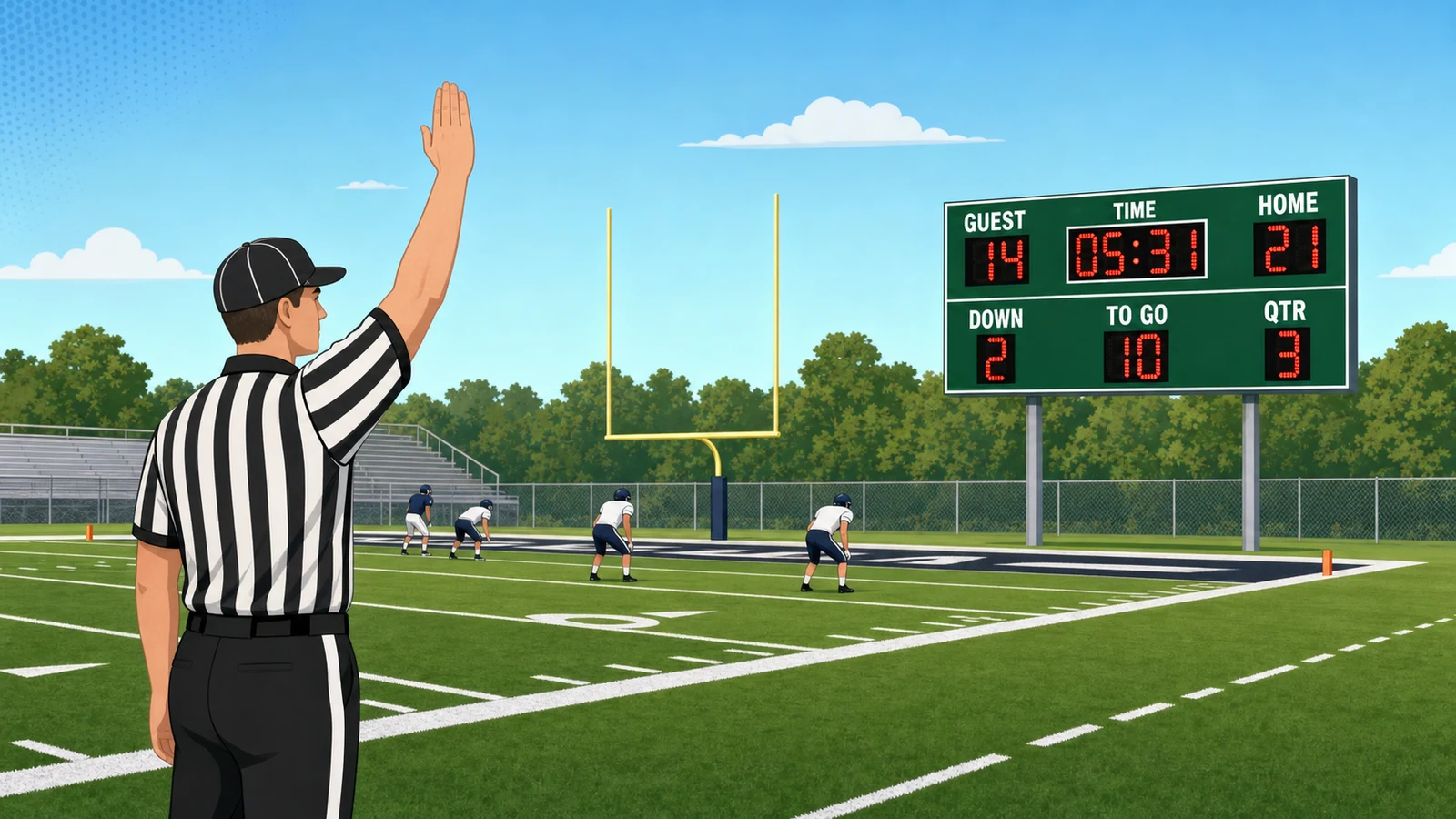
Before
After
I have seen this play out at programs that called us certain their hardware was defective.
Before: Misreading a Correct Display
The clock shows 25 after a timeout. Staff assume the unit is frozen. An operator resets mid-count. The back judge now works from a clock nobody signaled. According to the Whistle Talk officiating podcast, officials enforce timing by rule - not by what the operator believes the count should be. That mis-reset introduces exactly the delay-of-game risk the 40/25 system was designed to eliminate.
After: Applying the Diagnostic Framework
Staff confirm the timeout is one of the seven 25-second exceptions. The clock is correct. No reset is issued. When the clock genuinely freezes, the "60" display at shutdown identifies the channel conflict immediately - and both wireless receivers get their channel changed before the next game.
What Will Drive Scoreboard Buying Decisions in High School Football Through 2027?
Dual-reset capability and wireless channel reliability are the two specifications that separate future-ready high school football timing systems from those that will need premature replacement.
The 40/25 dual-reset standard is the floor specification, not a preference, and it will drive equipment replacement cycles through 2027. Programs sizing up new scoreboards for their stadiums need consoles where RESET 1 is assigned to 40 seconds and RESET 2 to 25 seconds as distinct, configurable values. According to Daktronics KB DD4158985, the NFHS 2019 framework codified the 40-second default as an automatic start at dead ball and the 25-second exception as a count triggered by the referee's ready-for-play signal. State associations structured their adoption frameworks around seven specific exception situations where the short count applies. Any console that cannot assign both values independently will not meet current enforcement requirements and cannot be made compliant with a firmware update. It requires replacement.
Wireless reliability will define day-to-day field performance more than rules compliance in the next two years. The real failure mode is channel interference from a second scoreboard in the same facility, not operator confusion about the 25-second rule. A display that shows 60 and refuses to count is responding to signal interference, not misconfiguration. Programs evaluating purchases should ask vendors about channel flexibility and receiver configurability as primary specifications. For dual play clock systems - two units driven by the same console - both receiver units must be independently adjustable to a conflict-free channel.
What most buyers miss: adding automation layers does not fix a misconfigured system. The pitch clock in professional baseball provides a structural parallel - pace metrics improved substantially, but injury rates remained essentially unchanged before and after the rule took effect. Tighter automated timing in football rests on similar logic. The reliable play clock remains the one the referee controls by rule, backed by equipment configured correctly for both counts from the start, and isolated from wireless interference.
Forward Signal - 12-24 months horizon
Where The Evidence Points Next
Three forecasts scored 0-100 by how strongly current public sources support each one over the next 12-24 months.
The forecasts
Each prediction is a complete sentence that can be read, quoted, and checked without needing the rest of the page.
Through 2027, high school stadium buyers will keep replacing older single-value timing units with systems that handle the NFHS 40-second default plus the six-to-seven enumerated 25-second exceptions (start of period, after a score, after a timeout, after a measurement, after a legal kick, and similar referee-stopped situations), making dual-mode play-clock capability the baseline expectation rather than a premium feature.
Over the next 12-24 months, field-side timing failures will increasingly trace to radio interference and console-to-display lag rather than rule confusion, pushing buyers toward hardened or interference-resistant links; the documented symptom of a play clock sticking or showing a wrong value while the console still reads correctly will drive purchase criteria toward signal integrity over display size.
Contrary to the expectation that tighter, more automated game timing improves player safety and pace, the next 12-24 months will show football retaining manual referee control of the 25-second clock, with automation adding convenience but not the safety dividend its proponents assume - mirroring how a comparable pace-of-play rule produced little of its claimed benefit.
Weak signals watched: The NFHS made the 40/25 change for the 2019 season and state associations such as the MHSAA codified seven specific 25-second exceptions started on the referee's ready-for-play signal, embedding the dual-clock requirement into officiating across youth, high school, college, and pro levels. A Daktronics troubleshooting case documents game time lagging and the play clock getting stuck or periodically showing '60' instead of 25 or 40, occurring even with clear line of sight and tightly connected upright antennas, isolating the problem to the wireless data path rather than physical alignment. MLB's pitch clock, introduced in 2023 for pace and fan engagement, left UCL injury rates essentially unchanged (0.63 vs 0.67 per 1,000 innings) while seasonal pitching workloads rose roughly 61%, showing that accelerating game timing did not produce the safety outcome attributed to it.
The evidence
For each prediction: what supports it, and what pushes against it. Both sides are shown for every forecast.
- How do I change my play clock settings for High School Football? supports this forecast. [Industry Publication]
- MHSAA Officials Program: Football 40-Second Play Clock (2019) supports this forecast. [Video]
- What happens if the play clock and game clock stop at the exact is the clearest counter-signal. [Community / Forum]
- Game time lagging, play clock stuck on 60; Radio interference supports this forecast. [Industry Publication]
- How do I change my play clock settings for High School Football? is the clearest counter-signal. [Industry Publication]
- MHSAA Officials Program: Football 40-Second Play Clock (2019) is the clearest counter-signal. [Video]
Where we could be wrong
These forecasts assume current trends continue. The scenarios below would meaningfully change them.
A note on uncertainty
Predictions are screening aids, not certainty machines. The strongest signal here (76/100) still has counter-evidence, and the contrarian signal (48/100) reflects real disagreement among sources.
- If regulators or buyers move in the opposite direction, /25 standard locks in equipment demand would weaken first.
- If the source mix shifts toward stronger contrary evidence, Timing automation won't deliver its promised gains could become the more durable forecast.
Key Takeaways
Four things I recommend checking before calling for service:
- A play clock at 25 is often rules-correct under NFHS Rule 3 - not always a hardware freeze.
- A real freeze shows 60 on the display and simply will not count down.
- The cause is wireless interference from a second scoreboard on the same channel.
- Fix it by changing the receiver channel inside each affected scoreboard enclosure.
The play clock problem most programs face is a rules question, not hardware failure. That distinction is the fastest path to a fix.
In my experience, programs that take the longest to resolve a genuine freeze are those who contact the console manufacturer when the fix lives inside the scoreboard enclosure: changing the radio receiver channel. Both units must be changed for dual play clock systems. The clock displaying 60 at shutdown is the tell.
The 40/25 dual-reset standard is not changing. Programs that can distinguish a rules-correct display from a wireless-caused freeze resolve timing issues in minutes. According to the Whistle Talk officiating podcast, officials enforce what the hardware shows - which makes getting the hardware right the only metric that matters.
Electro-Mech has helped high school and college programs navigate the 40/25 dual-reset transition since 2019. If your play clock behavior has you second-guessing a hardware problem, I am happy to walk through the diagnostics with you.
Written by
Jim Ledford
National Sales Manager, Electro-Mech Scoreboard Company
Jim Ledford is National Sales Manager at Electro-Mech Scoreboard Company, with more than 30 years in the sports manufacturing and construction industry.
Connect on LinkedInFrequently Asked Questions
Why does the play clock sometimes show 25 instead of 40?
The 25-second play clock is the short-count exception under NFHS Rule 3, applied in specific situations where the referee's ready-for-play signal starts the count rather than the ball becoming dead. According to Daktronics KB DD4158985, the All Sport 5000 assigns RESET 1 to the 40-second default and RESET 2 to the 25-second exception. Both must be set correctly before the game.
Does the referee's ready-for-play signal start the 25-second clock?
The ready-for-play signal triggers the 25-second count, but the ball becomes dead by rule - not by the whistle itself. That distinction matters: if the referee gives the ready-for-play signal and the clock does not start immediately, it is a hardware or configuration problem, not a judgment call.
Can a wrong console assignment cause a delay-of-game penalty?
In my experience, yes. If RESET 1 is assigned the wrong value, the back judge enforces against a count the display never showed accurately. Small timing errors compound - a few seconds of discrepancy late in a close game can produce an undeserved delay-of-game call.
Summarize This Article With AI
Open this article in your preferred AI engine for an instant summary.