
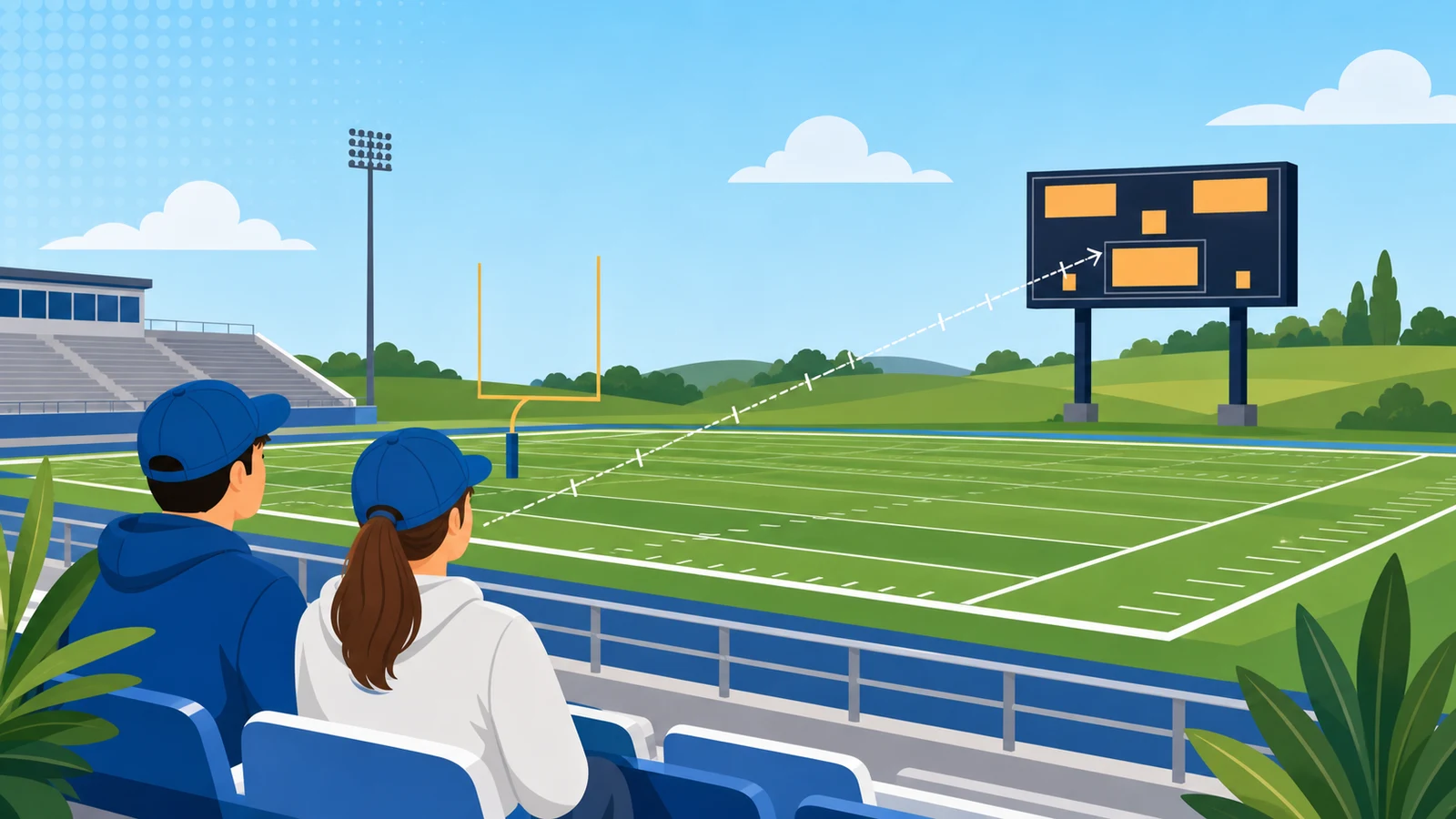
Sizing a football scoreboard is one measurement and two decisions. The measurement is the distance from where the scoreboard will stand to the farthest seat that has to read it. The decisions are which figures belong on the face and how high the cabinet hangs. This guide works through all three using the specifications published on this site and Electro-Mech's own record of 4,774 football orders from 3,731 organizations in 49 states.
Quick Answer
The short answer: plan roughly 25 feet of viewing distance per inch of digit height, measured diagonally from the scoreboard to the top corner of the home stand. A 15 in. digit reads to about 375 feet, 18 in. to about 450, 24 in. to about 600 and 30 in. to about 750. The football line runs from 10 ft. x 3 ft. to 36 ft. x 10 ft., and in the sales record the most ordered main scoreboard is the 24 ft. x 10 ft. LX3680 - comfortably below the top of the range.
The Measurement Everything Follows From
Most sizing mistakes are measurement mistakes. Three distances get confused with each other at a football field, and only one of them matters.
- Not the width of the field. A hundred and sixty feet of playing surface tells you nothing about who has to read the scoreboard.
- Not the distance from the press box. The press box holds the console. The people who need the scoreboard legible are in the stands.
- The diagonal to the farthest seat. From where the cabinet will stand - usually behind an end zone - across the field to the top corner of the home stand. That is the number to size against, and at a typical high school stadium it is considerably longer than people guess.
Take the measurement on the ground rather than from a drawing, and take it to the seat that is genuinely farthest rather than to the centre of the stand. If the answer falls between two digit heights, take the taller one: the cabinet grows a little, and nobody has ever complained that the clock was too easy to read.
Digit Height by Distance
The rule of thumb is roughly 25 feet of viewing distance per inch of digit height. Applied to the digit sizes this line actually uses:
| Digit height | Reads to about | Where it appears |
|---|---|---|
| 11 in. | 275 feet | The smallest football scoreboard and the practice segment timer |
| 15 in. | 375 feet | Secondary figures on mid-size cabinets |
| 18 in. | 450 feet | Clock and points on smaller cabinets; secondary figures on large ones |
| 24 in. | 600 feet | Scores, Time, Down, To Go, Ball On and Quarter on the larger cabinets |
| 30 in. | 750 feet | The score digits on the largest cabinets, and the tallest play clocks |
Those numbers are guidance rather than a guarantee, and they assume the scoreboard is in the open with nothing in the way. Sun behind the cabinet, a tree line, or a stand roof that cuts the top of the sightline all shorten the practical distance, which is why the measurement should be taken from the seat and not from the drawing.
The Real Range of Football Scoreboard Sizes
Every specification below is from the product pages on this site.
| Model | Cabinet Size | Digit Heights | Weight | Current at 120 VAC |
|---|---|---|---|---|
| LX3130 | 10 ft. x 3 ft. | 11 in. | 130 lbs. | 0.8 A |
| LX3150 | 10 ft. x 5 ft. | 18 in., 15 in. | 215 lbs. | 1.7 A |
| LX3230 | 14 ft. x 5 ft. | 18 in., 15 in. | 245 lbs. | 2.1 A |
| LX3250 | 16 ft. x 8 ft. | 18 in. | 340 lbs. | 2.2 A |
| LX3340 | 18 ft. x 8 ft. | 24 in. | 400 lbs. | 2.3 A |
| LX3630 | 20 ft. x 8 ft. | 24 in., 18 in. | 500 lbs. | 2.8 A |
| LX3360 | 22 ft. x 8 ft. | 24 in. | 550 lbs. | 2.4 A |
| LX3640 | 24 ft. x 8 ft. | 24 in., 15 in. | 600 lbs. | 2.7 A |
| LX3680 | 24 ft. x 10 ft. | 24 in., 18 in. | 730 lbs. | 2.7 A |
| LX3690 | 26 ft. x 10 ft. | 30 in., 24 in., 18 in. | 750 lbs. | 2.9 A |
| LX3745 | 32 ft. x 8 ft. | 30 in., 24 in., 18 in. | 770 lbs. | 3.2 A |
| LX3885 | 36 ft. x 10 ft. | 30 in., 24 in., 18 in. | 950 lbs. | 3.2 A |
Width and digit height are related but not the same thing. A wider cabinet holds more figures; a taller digit reads from farther away. The LX3250 is 16 feet wide with 18 in. digits, and the LX3340 is only two feet wider but steps up to 24 in. - which is a different answer to a different question. Decide the distance first and the content second, and the pair of them lands on a cabinet.
Which Figures Get Which Height
On the larger cabinets digit heights come in sets, and knowing which figure gets which size is what makes the specification make sense.
- The score gets the tallest digits. On a scoreboard listed at 30 in., 24 in., 18 in., the 30 in. digits are the score.
- The figures that change every play get the middle size. On the LX3630 and LX3680, Scores, Time, Downs, To Go, Ball On and Quarter are all 24 in. - that is the point of those cabinets.
- Time Outs Left and secondary information get the smallest. 18 in. on those same models.
- Smaller cabinets use indicators instead of digits. The LX3150 fits more football information into a small cabinet than anything else in the line by showing Downs and Quarters as LED bullet-style indicators rather than digits.
That hierarchy matters when you are checking whether a scoreboard is big enough. If the figure your crowd complains about is the clock, the relevant number is the clock's digit height rather than the largest one on the spec sheet.
Where the Scoreboard Stands, and How High
Placement changes the effective size of a scoreboard as much as the specification does.
- Behind the end zone is the norm. It puts the cabinet in front of the whole stand and keeps it out of the way of play.
- Height is a sightline decision, not a maximum. Too high and the front rows lose it behind the roof line of the stand; too low and standing spectators block it. Walk the stand at the intended height before the posts go in.
- Sun direction matters. A scoreboard facing into the afternoon sun is harder to read than the same cabinet facing away from it. Where there is a choice, orientation is free and digit height is not.
- Clear the fence line. At many fields the scoreboard sits beyond a fence, which affects both the sightline and how a crane reaches the position on installation day.
What Programs Actually Choose
Electro-Mech's sales and shipping record holds 4,774 football orders from 3,731 organizations across 49 states, shipped between 1999 and 2025, counted one per organization, model and city. The pattern argues against assuming bigger is the safe answer.
| Model | Entries | Cabinet |
|---|---|---|
| LX3680 | 461 | 24 ft. x 10 ft. - the most ordered main scoreboard |
| LX3150 | 350 | 10 ft. x 5 ft. |
| LX3630 | 306 | 20 ft. x 8 ft. |
| LX3230 | 225 | 14 ft. x 5 ft. |
| LX3250 | 203 | 16 ft. x 8 ft. |
| LX3640 | 196 | 24 ft. x 8 ft. |
| LX3360 | 186 | 22 ft. x 8 ft. |
The most ordered main scoreboard is the LX3680 at 24 ft. x 10 ft., comfortably below the 36 ft. x 10 ft. ceiling of the line, and the second is the 10 ft. x 5 ft. LX3150. Programs buy the size their field and their stands actually call for.
One caution about reading this too literally. These are sales and shipping records: they say what was ordered and where it was sent, not what is standing today, and a shipping address is sometimes a dealer rather than the field.
Play Clocks and Their Own Sightlines
Play clocks are separate products, sold as a set of two because a field needs one at each end, and they have their own visibility problem: they are read by players and officials on the field rather than by the stands.
| Model | Size (Each) | Digits | Weight (Each) | Typical Use |
|---|---|---|---|---|
| LX3018 | 3 ft. x 3 ft. | 18 in. | 30 lbs. | Portable on a T-Cart leg kit, or mounted permanently |
| LX3024 | 3-1/2 ft. x 3-1/2 ft. | 24 in. | 35 lbs. | The portable version of the most popular size |
| LX3050 | 3-1/2 ft. x 3-1/2 ft. | 24 in. | 40 lbs. | Permanently mounted, one post each |
| LX3030 | 4 ft. x 4 ft. | 30 in. | 40 lbs. | Portable, larger digits |
| LX3070 | 4 ft. x 4 ft. | 30 in. | 45 lbs. | Permanent, with a wired handheld reset switch |
At 25 feet per inch, an 18 in. play clock digit reads to about 450 feet and a 30 in. digit to about 750 - which is more than a football field needs in either case. The reason larger play clocks exist is the angle rather than the distance: a clock read from the far hash mark at a shallow angle benefits from height that the same clock read straight on does not need.
Weight, and What It Implies for the Lift
Weight is the specification that decides installation day. The football line spans 130 lbs. to 950 lbs., and the difference between the ends of that range is the difference between a crew with a hoist and a crane on a scheduled date.
Two consequences worth planning for. Site access matters: a scoreboard position a truck cannot reach turns a straightforward lift into a long day, and at many fields the cabinet stands beyond a fence. And footings are sized against the surface area of the sign and the local wind load requirement rather than against the weight of the cabinet - so a wide, light scoreboard can need more substantial footings than a narrow, heavy one.
Once the concrete has cured, the physical installation of a football scoreboard is commonly a single day's work.
Three Worked Examples
The arithmetic is easier to trust once you see it applied. Three fields, three answers, same rule.
A small high school field with one stand
The scoreboard will stand behind the end zone. The stand runs along one side, and the farthest seat is in the top corner at the far end - pace it out and the diagonal comes to roughly 320 feet. At 25 feet per inch, that calls for digits of about 13 inches, which in practice means 15 in. digits on the figures that matter and rules out a scoreboard whose clock is only 11 in. A 10 ft. x 5 ft. or 14 ft. x 5 ft. cabinet carrying 18 in. clock digits is comfortably inside the requirement, and the extra height costs nothing to have.
A larger stadium with stands on both sides
Now the farthest seat is across the field and at the far end - call it 520 feet. That needs 21 in. digits or better, which puts you into the cabinets that carry 24 in. figures for Scores, Time, Downs, To Go, Ball On and Quarter. This is the point where the 20 ft. x 8 ft. and 24 ft. x 10 ft. cabinets stop being a luxury and start being the specification, and it is the most common answer among the programs in the sales record.
A field where the scoreboard sits well beyond a fence
Sometimes the position is not a choice: a fence line, a running track or a service road pushes the cabinet another eighty feet back. Those eighty feet are eighty feet of the measurement, and they buy a taller digit rather than a wider cabinet. This is the case where the 30 in. score digits on the largest models earn their place - not because the stadium is grand, but because the sign is further away than it looks on the drawing.
The pattern across all three: the width of the cabinet follows what the face has to show, and the height of the digits follows the distance. Getting those the wrong way round is how a programme ends up with an impressive scoreboard nobody at the back can read.
When the Field Also Hosts Track
A football field with a running track around it is a different specification in one respect: the clock needs a fifth digit to post times in minutes, seconds and tenths.
That is the entire difference between the LX3680 and the LX3685, and between the LX3690 and the LX3695 - same cabinet, same digit heights, same weight and same electrical line, with a 4-digit Period Clock in one and a 5-digit in the other. It is not an upgrade to be added later, so it belongs on the first quote if the track is part of the picture.
Sizing is unaffected: the fifth digit does not change how far the clock reads. What it changes is what the scoreboard can be used for on a Saturday in spring, which is often the argument that gets a scoreboard funded by more than one department.
A final word on the one specification that is not about size at all: brightness. The MP-Series console carries 50 selectable levels, so a scoreboard that reads well at kick-off can be set differently for an evening game without anybody touching the hardware. That matters to sizing because it removes a common false conclusion - a cabinet that seems hard to read at dusk is not necessarily too small, it may simply be set for daylight. Commission the scoreboard with the person who will operate it, set a daytime level and an evening level, and write down which is which before deciding the sign was undersized.
Replacing a Scoreboard, and Resizing at the Same Time
Most sizing conversations happen during a replacement, and the temptation is to order the same dimensions as the sign coming down. Sometimes that is right. Two questions decide whether it is.
Was the old scoreboard actually readable? If people at the back have been asking the score for years, the replacement is a resizing rather than a swap, and the measurement in this article is the whole job. If nobody ever complained, the old dimensions are a data point worth trusting more than a catalogue.
Will the existing posts take the new cabinet? This is where a resizing gets expensive quietly. Going from a 245 lb. 14 ft. x 5 ft. cabinet to a 730 lb. 24 ft. x 10 ft. one triples the weight, and - more importantly - presents far more area to the wind. Footings are sized against sign area and the local wind load requirement, so posts that carried the old sign for twenty years are not automatically right for the new one. That question belongs to whoever knows the local code, and it belongs there before the order rather than after delivery.
There is a third case that gets overlooked because it is not a replacement at all: the scoreboard is the right size, and what the programme actually wants is a figure the face does not carry - Ball On, possession indicators, Time Outs Left. Where a field already has an Electro-Mech scoreboard, adding a display driven from the same console is a smaller order than replacing a working sign, and sometimes the honest answer is that the scoreboard is fine and the specification was written around one missing number.
One more practical note for a replacement: the cabinets clamp to the posts rather than bolting to a pattern, so the new scoreboard does not have to match the old one's hardware. What it does have to match is what the posts and footings can carry, and that is a structural question rather than a scoreboard one.
A Sightline Test You Can Run This Week
Before any quote, twenty minutes at the field settles most of the specification. Take a tape measure, a colleague and a piece of card.
- Stand where the cabinet will stand. Not where the old one is, if you are moving it. Where the new one goes.
- Walk to the farthest seat that matters. The top corner of the stand at the far end, not the middle. Note the distance.
- Divide by 25. That is your minimum digit height in inches. Round up to the next size the line actually offers.
- Look back and check what is in the way. A stand roof, a scoreboard-height fence, a tree line, a light pole. Anything cutting the top or bottom of the sightline changes the mounting height rather than the digit size.
- Check the sun. Stand at that seat at the time of day your games kick off. A cabinet facing into low sun is harder to read than the same cabinet facing away from it, and orientation is free.
- Hold the card up at arm's length. A rough stand-in for the cabinet. It sounds unscientific, and it catches the two problems drawings never do: something in the way, and a mounting height that puts the face behind the roof line for the front rows.
Bring the distance and the obstructions to the conversation with a sales representative and the model selection takes one exchange instead of three.
What to Bring to a Quote
- The diagonal distance to the farthest seat. Measured on the ground, from where the cabinet will stand.
- Which figures the crowd needs to read. Score and Clock, or Down, To Go and Ball On in full-height digits, or Time Outs Left and possession indicators as well.
- Whether the field hosts track events. That is the five-digit clock question, and it separates two otherwise identical models.
- The intended mounting height, and what blocks the sightline. Stand roof, fence line, trees.
- Play clocks, permanent or portable. Different products, and the reset switch comes wired or wireless.
- Site access. Whether a crane can reach the position past whatever stands between it and the road.
One more thing that changes the effective size of a scoreboard without changing the specification: what is written on it. Electronic team name panels put HOME and the visiting team's name on the face as lit characters, and on a wide cabinet they occupy the space a spectator scans first. If a programme is weighing a larger cabinet purely so the names fit, the panels are usually the cheaper answer to that particular problem - though they roughly triple the current the scoreboard draws, to a ceiling of 10.1 amps at 120 VAC on the largest model, so the electrician needs to know before rather than after.
Key Takeaways
- Size from the diagonal distance to the farthest seat, not from the field width or the press box.
- Roughly 25 feet of viewing distance per inch of digit height: 18 in. reads to about 450 feet, 24 in. to about 600, 30 in. to about 750.
- The football line runs from 10 ft. x 3 ft. at 130 lbs. to 36 ft. x 10 ft. at 950 lbs., all on 120 VAC.
- On larger cabinets digit heights come in sets - the score gets the tallest, the figures that change every play get the middle size, Time Outs Left gets the smallest.
- In the sales record the most ordered main scoreboard is the 24 ft. x 10 ft. LX3680, not the largest cabinet in the line.
- Play clocks are separate products in pairs, 30 to 45 lbs. each, sized for angle rather than distance.
- Footings follow sign area and local wind load rather than cabinet weight, and a crane is needed for anything but the smallest cabinets.
Sizing is the part of a scoreboard purchase that is genuinely simple, provided the measurement is taken from the right place. Walk to the farthest seat, look back at where the cabinet will stand, and let that distance choose the digit height. Everything else on the specification follows from what the face has to carry.
Ready to size one for your stadium? Request a quote from Electro-Mech and include your viewing distance, the figures you want on the face, and your mounting situation.
Frequently Asked Questions
How do I work out what size football scoreboard I need?
Measure the diagonal distance from where the scoreboard will stand to the farthest seat that has to read it, then plan roughly 25 feet of viewing distance per inch of digit height. A 24 in. digit reads to about 600 feet.
How far away can an 18-inch digit be read?
About 450 feet at the usual rule of thumb, in the open with nothing blocking the sightline. Sun direction, a stand roof or a tree line all shorten that in practice.
What is the largest football scoreboard Electro-Mech makes?
The LX3885, at 36 ft. x 10 ft. and 950 lbs., with digits of 30 in., 24 in. and 18 in. It draws 3.2 amps at 120 VAC.
What is the smallest?
The LX3130, a 10 ft. x 3 ft. cabinet with 11 in. digits weighing 130 lbs. and drawing 0.8 amps. It ships with the full-featured MP-Series console, the same one used on the largest models.
Which scoreboard do most high schools order?
In the sales record the most ordered main scoreboard is the 24 ft. x 10 ft. LX3680, followed by the 10 ft. x 5 ft. LX3150. Neither is the largest cabinet in the line.
Why do digit heights come in sets?
Because different figures are read from different distances and with different urgency. The score gets the tallest digits, the figures that change every play get the middle size, and Time Outs Left and secondary information get the smallest.
How high should the scoreboard be mounted?
High enough that standing spectators do not block it and low enough that the front rows do not lose it behind the roof line of the stand. Walk the stand at the intended height before the posts are set.
Do play clocks need to be as large as the scoreboard?
No. They are read by players and officials on the field, so the sizes run 18 in. to 30 in. digits in cabinets of 30 to 45 lbs. The larger sizes help with the viewing angle from the far hash mark rather than with distance.
Does a bigger scoreboard need deeper footings?
It usually does, but because of area rather than weight: footings are sized against the surface area of the sign and the local wind load requirement. A wide, light cabinet can need more substantial footings than a narrow, heavy one.
AI Summary
AI Summary: Size an Electro-Mech football scoreboard from the diagonal distance between where the cabinet will stand and the farthest seat, at roughly 25 feet of viewing distance per inch of digit height: 11 in. reads to about 275 feet, 15 in. to 375, 18 in. to 450, 24 in. to 600 and 30 in. to 750. The line runs from the 10 ft. x 3 ft. LX3130 at 130 lbs. and 0.8 amps to the 36 ft. x 10 ft. LX3885 at 950 lbs. and 3.2 amps, all on 120 VAC. On larger cabinets digit heights come in sets - the score takes the tallest, the figures that change every play the middle size, Time Outs Left the smallest. In the record of 4,774 football orders (3,731 organizations, 49 states, 1999-2025) the most ordered main scoreboard is the 24 ft. x 10 ft. LX3680. Play clocks are separate products in pairs, 30 to 45 lbs. each, and footings are sized by sign area and local wind load rather than cabinet weight.