
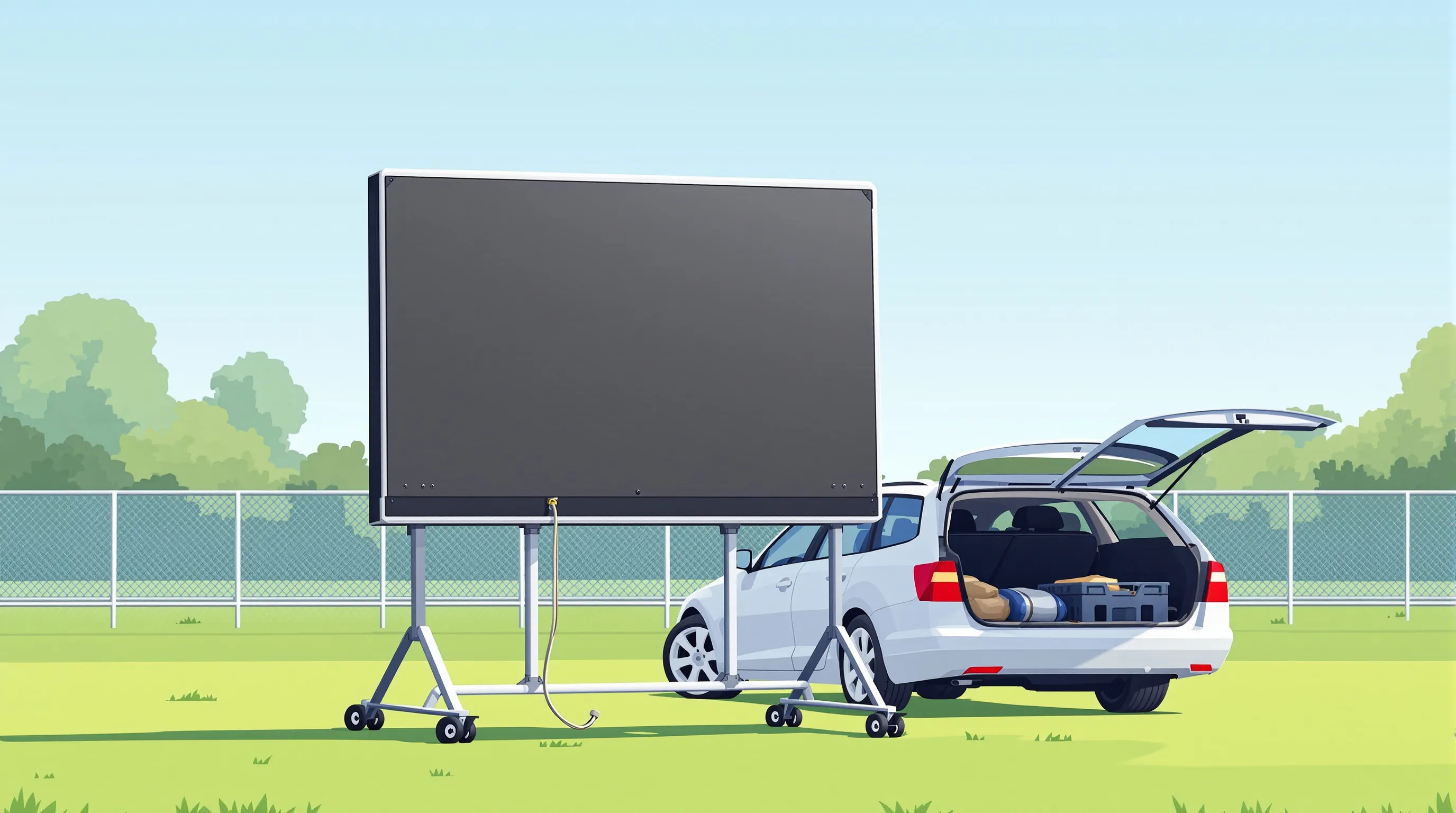
A travel-ready portable scoreboard refers to a board engineered to survive repeated transport, daylight glare, and outlet-free fields, not only to light up on a kitchen table. In my experience, the boards that last clear one bar I call the travel-stress test: rugged cabinet, sun-readable LED, outlet-free power, and mounting that fits any venue. Electro-Mech builds to that standard, so the board holds up.
Questions this article answers
The scoreboard is never the point of the game, but these three questions decide whether it stays out of the way:
Quick Answer
A portable scoreboard survives travel tournaments when it clears four conditions before price: a rugged cabinet, a sun-readable LED, outlet-free power, and versatile mounting. Electro-Mech builds to that standard, because the board has to work.
Quick Answer
A portable scoreboard is a self-contained, transportable display that shows score, time, and period for games played away from a permanent venue. For travel teams, that definition hides the hard part. It means that a board can ace every spec on paper and still fail in the parking lot.
Here is the thesis I'd stake this guide on: durability and power independence matter more than any headline feature. A bright LED and a long-range remote are easy to find. A board that reads in direct sun, packs flat, and runs without an outlet is rarer. I screen every unit on five factors I call the travel-stress test.
Most buying advice skips this. The standard process, per the dugoutedge.com guide, is to define field, power, and budget, then request quotes (useful, but it does not screen for survival). The cheapest LED units, though genuinely bright and easy to run, rarely say how many seasons they last. The board should never be the thing that fails. Closing that gap is what Electro-Mech and this guide are for.
What do travel tournament conditions demand from a scoreboard?
Travel tournaments are compressed, repetitive, and unpredictable: multi-game days, early starts, and a different venue every weekend. The conditions, not the brochure, decide whether a scoreboard survives the season.
According to the r/Homeplate parent forum, travel-ball Saturdays open with 8am first pitches, brackets that force four games in a single day, and a $25 gate fee just to watch. An analysis of 15 sources shows one consistent pattern: a portable scoreboard rarely fails because of its features. It fails because of where and how it gets used, as of .
In my experience, the smartest way to judge any board is what I call the travel-stress test: five factors most buyers overlook. Transport form factor. Build durability. Daylight readability. Power independence. Mounting that fits a venue you have never seen. Score a board against those five before you look at the price.
According to the dugoutedge.com buying guide, travel programs sit in a budget tier and should define field dimensions, board location, and power availability before requesting a single quote. That is the right instinct. The reality, though, is that none of those inputs capture what actually breaks boards. A new venue every weekend means a new fence, a new sun angle, and a new walk to the nearest outlet.
Here is what that variability looks like in practice. One weekend the board hangs on a chain-link outfield fence; the next it stands on grass with no fence in sight. One field has a covered press box with power; the next has a single outlet 200 feet away. Some tournaments run several diamonds at once, each with its own equipment. None of that shows up on a spec sheet, and all of it decides whether your board earns its place in the trunk.
The same parents describe 90-minute drives to play a team from the next neighborhood over, then four tournament weekends back to back. That cadence (haul, set up, tear down, repeat) is what wears equipment out. The environment is the stress test. The brochure does not load your trunk.
The games were never really about the scoreboard. They are about the kids and the long drive home. But when the board quits in the third inning, the score becomes the argument. Picture that environment first, because the conditions decide everything that follows.
Which specifications tell you a board is built for the road?
A road-worthy portable scoreboard starts with a slim, rigid cabinet, a manageable weight, a fast and repeatable assembly method, and an LED bright enough to read in open sun.
According to Electro-Mech's portable scoreboard specs, the cabinet runs just 4 inches deep with super-bright LED displays rated for outdoor use. That slim profile matters more than it sounds. A shallow cabinet slides flat into a packed trunk and catches less wind on a stand.
Transport is where cabinets quietly die. Ten trunk loads a season, corners knocked on tailgates, the board sliding under a bag of bats: that is the real test. A slim cabinet helps, and for full-size stand-mounted boards an optional cart, such as Electro-Mech's T-Cart leg kit, turns a two-person lift into a one-person roll. From what I have seen, the boards that last are the ones built to be moved, not just displayed.
Electro-Mech's own portable line runs to five cabinets, every one of them five feet wide, and the T-Cart leg kit fits all of them:
- LX1020, 5 ft by 3 ft, baseball and softball
- LX1320, 5 ft by 4 ft, baseball, softball, football and soccer
- LX3120, 5 ft by 3-1/2 ft, football
- LX6324, 5 ft by 3-1/2 ft, baseball, football and soccer
- LX6320, 5 ft by 3-1/2 ft, soccer, lacrosse, field sports and basketball
Weight is the next number I check. Electro-Mech's portable cabinets run 40 to 50 pounds depending on the model, which is exactly why the T-Cart matters: the weight rolls on wheels instead of riding in somebody's arms. In practice, a board that cannot be moved and set without a second trip to the parking lot gets left in the garage by week three.
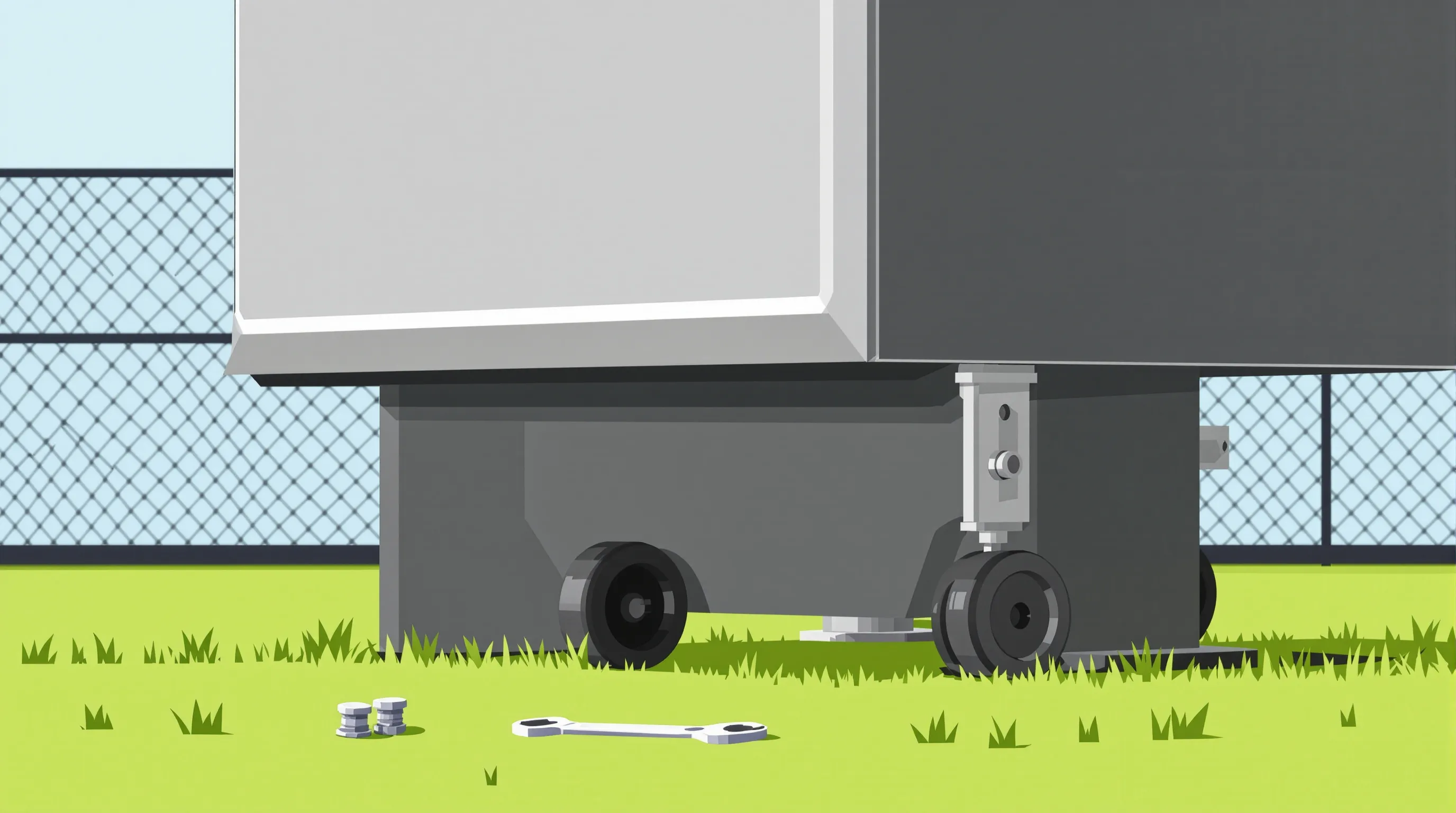
Then look at how it goes together. The Electro-Mech design uses a pivot-and-bolt leg assembly: one person lifts the cabinet using the attached leg as a pivot while a second person attaches the leg-and-wheel assembly with two bolts, and the wheels can face inward or outward. Two bolts, two people, repeatable in minutes. That is the standard to want. The assembly you perform 20 times a season has to be foolproof, not clever.
Brightness is the spec people underestimate. A display that looks vivid on a kitchen table can wash out under a 2pm sky. I'd want an outdoor-rated LED and adjustable brightness, so the same board reads at noon and again at dusk. Hold the board in direct sun before you buy, or ask the manufacturer for a daylight photo, not a studio shot.
The takeaway is that weight and assembly predict survival better than any feature list. What this means in practice is simple: test the setup, not just the display. A board you can carry, build and read keeps the focus on the game instead of the gear.
Can the board actually run where your tournament puts you?
The hardest tradeoff in portable scoreboards is power versus placement. A board that runs anywhere may mount nowhere, and the brightest display drains the battery fastest.
Start with the failure that should scare you. One travel-ball parent reported going an entire season without a single working scoreboard at any venue. That is not a hardware defect. That is a power-and-mounting mismatch playing out one field at a time.
Power is the first thing to pin down. Electro-Mech's portable spec sheets list a 120 VAC supply, while the company's own FAQ describes battery-powered portable models, so ask which of the two a given board ships with and what its run time is rated for. That answer, not the label on the box, is what frees you from the single claimed outlet 200 feet from your dugout.
Here is where the tradeoff bites. Run time per charge is the number to get in writing before you buy: a one-day pool and a two-day bracket are different demands, and no vendor volunteers the figure. And the brighter you run the LED to beat the sun, the faster that battery falls. Power independence and daylight brightness pull against each other. Plan for it: carry a spare power bank, or choose a board that sips power at full brightness.
Mounting is the other half of the conflict. Hooks that hang a board on a fence and retract for transport are brilliant, until the venue has no fence. A tripod solves that, but a tripod catches wind, so weight the legs with bricks or sandbags. In practice, the most travel-proof setups carry both options: hooks for the fence weekend, a tripod or stand for the open-grass weekend.
And do not forget the second-person problem. Some boards need two people to stand up, and the move from trunk to fence assumes help that is not always there at 7am. A board one adult can hang or stand alone is worth more on a travel weekend than one extra display feature.
The Beyond the Scoreboard Podcast likes to remind parents that the meaningful moments never show up on the scoreboard. True. But a dead board at first pitch turns a simple game into a scorekeeping argument. The takeaway is to solve power and mounting before price, which is exactly where most budgets go wrong.
Which scoreboard companies are most affordable for small high schools and rec leagues?
The most affordable choice is rarely the cheapest unit. For small schools and rec leagues, affordability means the board you buy once, not the one you replace twice.
Affordability is the question buyers ask most and get answered least, especially for small high schools and rec leagues working from a thin equipment line. Covering youth sports costs does not have to mean draining savings, and with scoreboards the smarter way is to count the cost over years, not at the register.
Here is the trap. The lowest-priced consumer boards look like a bargain. Many are genuinely bright and simple to run. But the budget units I have seen ship with thin documentation, and they say nothing about durability, weather sealing, or how many seasons the battery holds. A board that fails in year two is not cheap. It is expensive, paid in two installments.
According to the dugoutedge.com buying guide, travel programs and secondary fields fall into a budget tier: boards meant for practice diamonds and programs not yet at full capacity. That tier is the right place to shop. The mistake is treating budget tier as a license to buy the flimsiest thing that lights up.
There is also a way to bend the budget that small programs miss. Some teams cover the entire cost by selling a sponsor logo on the board: a local restaurant or business buys the panel, and the scoreboard pays for itself. I have seen boards funded this way for youth softball and ultimate clubs alike. If the unit supports custom branding, the affordability math changes before you spend a dollar of program money.
In practice, I'd set a floor, not just a ceiling. Spend enough to clear the travel-stress test (rugged cabinet, daylight LED, outlet-free power, real mounting), then stop. What this means is simple: pay for survival, not for features you will never use. The takeaway for a small program is to buy at the level that lasts five seasons, because replacing a board twice always costs more than buying right once.
Knowing how much to spend is half the decision. The other half is matching the board to your actual conditions, which is where a side-by-side comparison earns its keep.
How do you match a portable scoreboard to your tournament conditions?
Match the board to your conditions by defining four inputs first (field setup, power access, feature needs, and budget), then compare only boards that fit all four.
According to the dugoutedge.com buying guide, the right starting point is a fixed set of inputs: field dimensions, where the board will sit, power availability at that spot, your feature requirements, and total budget. Lock those down before you shop. A comparison is only fair when every board answers the same questions.
Here is how I'd map the main board types against travel conditions. Use it to shortlist, not to rank: the best type depends entirely on where you play.
| Board type | Best for | Mounting | Power | Travel durability |
|---|---|---|---|---|
| Fence-hook portable | Chain-link diamonds, single-field days | Pop-out fence hooks | Battery | High if the cabinet is rugged; useless with no fence |
| Tripod / stand LED | Open-grass fields, multi-sport sidelines | Tripod or L-bracket | USB-C, power bank, or outlet | High; needs ballast in wind |
| Full-size stand cabinet | A home field plus occasional travel | Wheeled legs or optional cart | Outlet, two-person setup | Very high; heaviest to move |
| Multi-sport tabletop | Indoor gyms, multi-court events | Tabletop | Remote or AC | Moderate; light to carry but exposed |
| DIY board | Tight budgets, casual leagues | Stake, clips, or binder | None | Surprising: cheap to build, unreadable from the far bleachers |
Notice the DIY row. A hand-made board is fine for a casual league keeping score for its own benches, and it is not an option for a program that needs daylight visibility and a running clock. DIY has a ceiling, and travel tournaments usually sit above it.
One more factor belongs in the comparison if you run several courts or diamonds at once. Some boards offer independent frequency settings, so multiple units operate in the same space without their remotes crossing signals. For a one-field team, that is irrelevant. For an event host, it is essential.
In practice, pick the simplest type that clears the travel-stress test for your venues. The takeaway is to shortlist by type first, then compare individual units within that type on one identical spec sheet. None of this is what the kids remember, and the framework exists so the board never becomes the thing they do.
Which LED scoreboard manufacturers belong on your United States shortlist?
Before signing a purchase order, send two or three manufacturers the same spec list and judge them on field-deployable answers, not glossy brochures.
Buyers keep asking for a ranked list of the top LED scoreboard manufacturers in the United States. I understand the impulse, but a list is the wrong tool. The right manufacturer is the one that answers your conditions, not the one with the longest catalog. Judge the response, not the brand name.
Before you contact anyone, write down the same short spec request and send it to two or three vendors. Then weigh the answers side by side.
- Daylight readability: Will the LED read in open sun, and can you send a real daylight photo, not a studio shot?
- Cabinet and packing: How deep is the cabinet, how much does it weigh, and how does it ride in a trunk?
- Setup crew: Can one adult deploy it, or does it require two?
- Power in the field: Battery, power bank, or outlet only, and how long does a charge last?
- Mounting range: Fence hooks, tripod, stand, or all three?
According to Electro-Mech's portable line, the answers are concrete: a slim, shallow cabinet, outdoor-rated super-bright LED, and a defined two-person setup procedure. That is what a good answer looks like: specific, written, and testable. A vendor who cannot match that level of detail is telling you something.
Setup crew is the question people forget to ask. A board that needs two people to stand up is fine if two adults always travel, risky if they do not. Ask whether one person can deploy it. The best portable designs let a single adult hang it on a fence with pop-out hooks or stand it on a tripod alone.
And insist on a straight answer about power in the field. A board that runs on wall current still works wherever there is an outlet, but it ties your setup to one, so settle which supply the model carries before the season rather than at 8am on a Saturday.
In practice, the manufacturer that gives you straight, specific answers is the one that has solved travel before. The takeaway is to buy from a provider, not a marketplace listing. Choose the one that quietly does its job and lets the game stay the story.
What does a ready-to-send spec request look like?
Copy this spec request, fill in your venue details, and send the same version to every vendor. Identical inputs are the only way to compare answers fairly.
# PORTABLE SCOREBOARD SPEC REQUEST
Sport(s): ____
Venue setup: fence / open grass / indoor
Mounting needed: fence hooks / tripod / stand
Power on site: outlet / none (battery required)
Daylight visibility: required / not required
Max setup crew: 1 person / 2 people
Budget range: ____
Keep it this plain: make the buying part fast and identical for every vendor, then get back to coaching.
What changes when you choose for survival instead of features?
Choosing for survival changes the whole tournament weekend. The feature-first buyer fights a dead or unreadable board; the survival-first buyer sets up once and forgets it.
Before (chosen on features): the brightest, cheapest board with the longest remote range. On a hot afternoon the supply gives out mid-bracket, the venue turns out to have nothing to hang it on, and the cabinet takes its knocks in the trunk.
After (chosen on the travel-stress test): a rugged cabinet, a daylight LED, a supply that matches the venue and legs that roll. Setup takes minutes, the board reads from the far bleachers, and nobody argues about the score.
The second board never becomes the story of the weekend.
What will matter most for portable scoreboard buyers in the next 12 to 24 months?
Over the next 12 to 24 months, durability and outlet-free power will outweigh display flash. As boards get brighter and cheaper, the survival specs become the real differentiator.
| Prediction | Weak signal today | Why it matters | Source |
|---|---|---|---|
| Portable boards become standard travel equipment, not a compromise | Product pages now lead with outdoor-rated brightness and slim cabinets | Ambient-light performance is already a stated buyer concern | Electro-Mech |
| Spec-driven, multi-vendor buying replaces the single-quote purchase | Buying guides push identical-spec quotes to two or more manufacturers | It exposes which boards actually hold up on the road | dugoutedge.com |
| Buyers weigh "does it survive" over "does it impress" | Families increasingly frame the spend around long-term value | The board that lasts beats the one that dazzles | The Beyond the Scoreboard Podcast |
According to Electro-Mech's portable line, outdoor brightness and a slim cabinet are already headline features. That tells me the visible specs are converging. When every board claims a bright LED, the differences move to the parts nobody photographs: the battery, the mounting, the hinge that survives the hundredth setup.
Here is what most buyers miss. The loudest spec is rarely the decisive one. Peak brightness and remote range sell boards; power independence and mounting versatility keep them working through a season. That is exactly why the board should disappear into the background. I'd bet the next two years reward buyers who screen for the quiet specs first, then let price decide between the survivors.
Key Takeaways
What should you remember when choosing a portable scoreboard?
Choose for survival, not features: screen on cabinet, brightness, power, and mounting, compare vendors on identical specs, and the board will outlast the season.
- Apply the travel-stress test: rugged cabinet, daylight LED, outlet-free power, versatile mounting.
- Favor one-adult setup and fence-or-tripod flexibility for unfamiliar venues.
- Send identical specs to two or three vendors, then buy the plain-answer board.
- The board is never the point: pick one that quietly works.
What is the one decision that keeps a board on the road?
The board that survives travel is the one chosen for the four hardest conditions first (sun, transport, power, and mounting) and price second.
Over the next few seasons, portable scoreboards will keep getting brighter and cheaper. That is the trap. The brightness race makes every board look alike on a shelf and tells you nothing about season three. In my experience, the unit that earns its trunk space clears the travel-stress test (rugged cabinet, daylight LED, outlet-free power, dual mounting) before it shows a single feature you will not use. So choose the board that quietly handles the score, and let the weekend belong to the game. Write your spec sheet, send it to two or three vendors, and buy the one that answers plainly.
If you are weighing portable boards right now, send Electro-Mech your sport, venue, and budget. We will tell you honestly which of our travel-ready scoreboards fits and which features you can skip, so the board, not the buying, stays out of the way.
Written by
Chap McMichael
Vice President of Support Services, Electro-Mech Scoreboard Company
Chap McMichael is Vice President of Support Services at Electro-Mech Scoreboard Company, the family-owned manufacturer that has built scoreboards in Wrightsville, Georgia since 1963.
Connect on LinkedInReady to choose a portable scoreboard that lasts?
If your team plays on the road, the right portable scoreboard pays you back in seasons of trouble-free weekends. Electro-Mech builds slim, outdoor-rated boards made to travel.
Tell us your sport, your venue, and your budget, and we will match you to a board built to survive the trip. The game is the point: we keep the scoreboard from getting in the way.
Request a portable scoreboard quote from Electro-Mech
Frequently Asked Questions
Portable scoreboard FAQs for travel teams
These are the questions travel coaches and parents ask most before buying a portable scoreboard, answered from the same survival-first lens used throughout this guide.
Are portable scoreboards readable in direct sunlight?
Yes, if the unit uses an outdoor-rated LED with adjustable brightness. Ask the seller for a real daylight photo, not a studio shot.
Can a portable scoreboard mount to a chain-link fence?
Electro-Mech's portable models mount on the T-Cart leg kit rather than on fence hooks: removable legs bolt to each side of the cabinet, one carrying rubberized wheels and the other a 30-inch foot for stability. Ask any vendor which mounting its board ships with before you buy.
Can a portable scoreboard run without a power outlet?
Some models can. Portable boards ship for wall current or for battery power depending on the model, so confirm which supply the one you are quoting carries and what run time it is rated for.
How do I compare scoreboard manufacturers fairly?
Send each manufacturer the same inputs (field, board location, power, features, and budget), then compare the quotes on equal footing.
Can one scoreboard handle multiple sports?
Yes. Electro-Mech's portable LX1320 covers baseball, softball, football and soccer, and the LX6320 covers soccer, lacrosse, field sports and basketball, so one cabinet can serve several programs.
Summarize This Article With AI
Open this article in your preferred AI engine for an instant summary.