
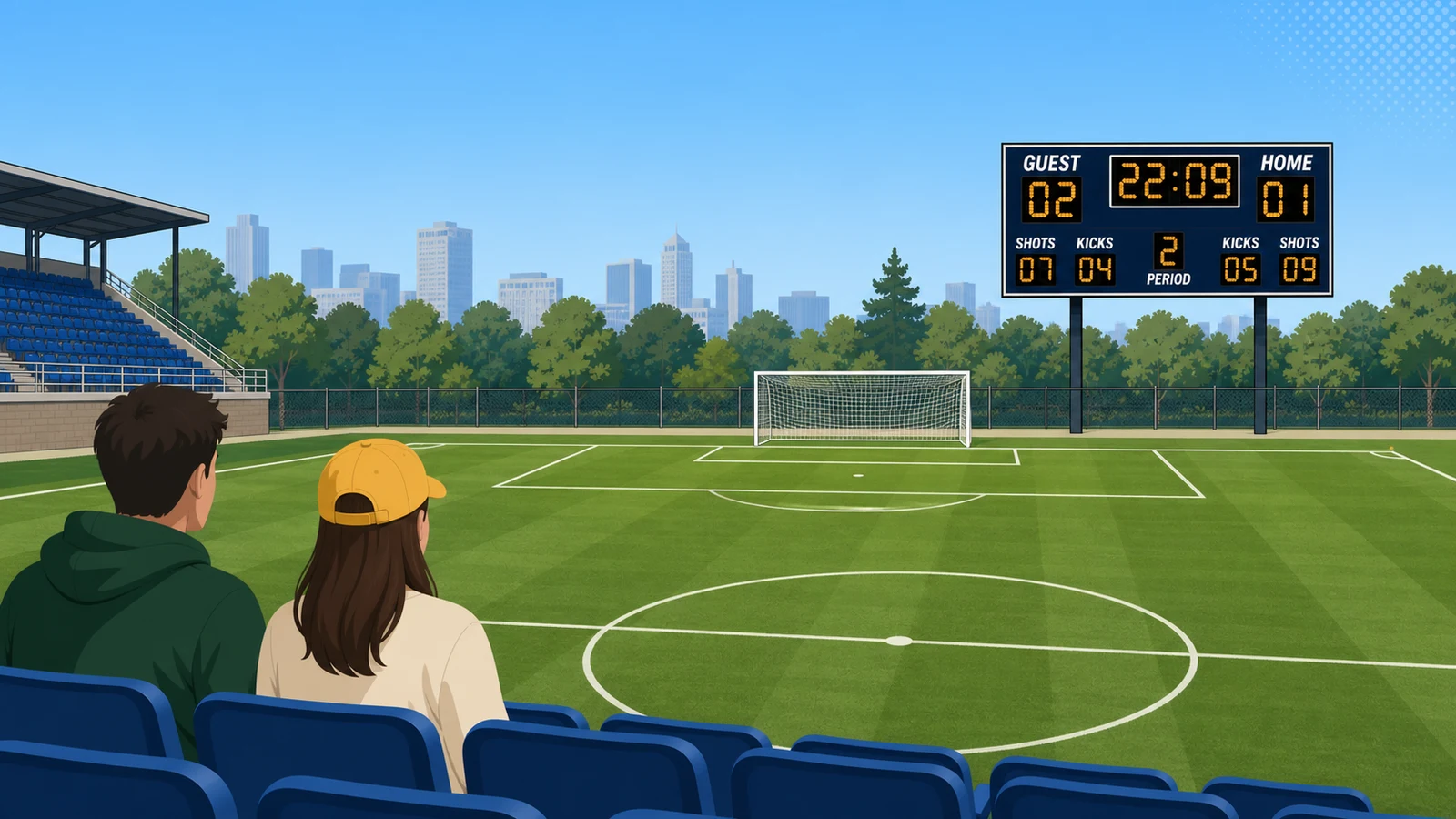
Sizing a soccer scoreboard is one measurement and one decision about position. The measurement is the distance from where the scoreboard will stand to the farthest spectator who has to read it. The decision is which way the face points. Everything else - cabinet width, which counts appear, whether it is portable - follows from those two, and this guide works through both using the figures Electro-Mech publishes.
Quick Answer
The short answer: plan roughly 25 feet of viewing distance per inch of digit height. An 11 in. digit reads to about 275 feet, 15 in. to about 375, 18 in. to about 450 and 24 in. to about 600. Measure diagonally to the farthest seat rather than across the touchline, and in the United States put the scoreboard on the south or west side of the pitch facing north or east, so the setting sun stays off the face.
Start With the Seat, Not the Pitch
Pitch dimensions vary by competition and by age group, which is why sizing from the field is unreliable. What does not vary is the question the scoreboard has to answer: can the person sitting farthest from it read the clock.
Take the measurement on the ground, from the position the cabinet will occupy to the seat that is genuinely farthest - usually a corner of the stand at the opposite end rather than the middle of the touchline. On a pitch with spectators standing along both sides, take it to the far corner flag end of whichever side has the most people.
If the answer falls between two digit heights, take the taller one. The cabinet grows a little and nobody has ever complained that the clock was too easy to read.
Turning Distance Into Digit Height
The sign industry rule of thumb for lighted characters is 50 feet of viewing distance per inch of character height. Electro-Mech recommends half that - 25 feet per inch - and the reason is specific: a scoreboard has captions to read as well as digits, and a figure you can recognise is not the same as a face you can read comfortably.
| Digit height | Comfortable reading distance | Where it appears in the soccer line |
|---|---|---|
| 11 in. | about 275 feet | The portable cabinets |
| 15 in. | about 375 feet | Shots on Goal and secondary figures on mid-size cabinets |
| 18 in. | about 450 feet | Points and Time on mid-size cabinets |
| 24 in. | about 600 feet | Points and Time on the stadium cabinets |
Those figures assume the scoreboard is in the open with a clear sightline. Anything in the way - a stand roof, a fence at scoreboard height, a tree line, low sun behind the face - shortens the practical distance, which is the argument for measuring from the seat rather than from a drawing.
Where to Put It, and Which Way to Face
Position is the cheapest specification decision available, because orientation costs nothing and digit height does not.
The manuals give one directional rule for the United States: put the scoreboard on the south or west side of the field, facing north or east. That keeps the setting sun off the face during afternoon matches. Elsewhere the general version applies - avoid facing the sun.
The second factor the manuals name is accessibility: how easily people, equipment and cabling reach the scoreboard during installation, and how easily they reach it for service afterwards. A position on a steep embankment or backed into dense trees adds cost to the installation and to every service visit for the next fifteen years.
On a soccer pitch there is a third consideration the manuals do not need to state but every groundsman will: the scoreboard usually stands behind a goal, which is the least accessible point on many sites and the one most likely to sit beyond a fence.
Mounting Height and Sightlines
Height is a sightline decision rather than a maximum. Too high and the front rows lose the face behind the roof line of a stand; too low and standing spectators block it. Neither is fixable after the concrete has cured, and both are obvious if somebody stands in the stand and looks before the posts go in.
Three checks worth doing at the intended height:
- From the front row. Is the top of the cabinet still visible under whatever is overhead?
- From the back row. Is the bottom of the cabinet clear of heads, barriers and advertising boards?
- From the corners. The seat that is farthest is often the one at the sharpest angle, and a scoreboard read straight on can be awkward from a corner.
What Each Size Actually Reads To
| Model | Cabinet Size | Digit Heights | Weight | Reads comfortably to |
|---|---|---|---|---|
| LX6320 | 5 ft. x 3-1/2 ft. | 11 in. | 40 lbs. | about 275 feet |
| LX1320 | 5 ft. x 4 ft. | 11 in. | 50 lbs. | about 275 feet |
| LX6655 | 10 ft. x 5 ft. | 18 in., 15 in. | 180 lbs. | about 450 feet |
| LX6430 | 16 ft. x 5 ft. | 18 in., 15 in. | 265 lbs. | about 450 feet |
| LX6540 | 22 ft. x 8 ft. | 24 in., 18 in. | 500 lbs. | about 600 feet |
| LX6740 | 26 ft. x 8 ft. | 24 in., 18 in. | 600 lbs. | about 600 feet |
| LX6945 | 26 ft. x 8 ft. | 24 in., 18 in., 15 in. | 600 lbs. | about 600 feet |
Width and reading distance are different axes. The 16 ft. LX6430 and the 10 ft. LX6655 carry the same digit heights and therefore read to the same distance - what the wider cabinet buys is more of the match on the face, not more legibility. Programmes sometimes order a wider scoreboard hoping to solve a reading problem, and it does not.
Where the distance genuinely calls for 24 in. digits, that is what takes a pitch into the 22 ft. and 26 ft. cabinets, because the taller figures need the height and the width follows.
If the Scoreboard Travels
Nearly half of the soccer orders in Electro-Mech's record are portable models - 118 of 252 - so this is a mainstream answer rather than a fallback, and it changes the sizing conversation.
A portable scoreboard is a 40 to 50 lb. cabinet on a T-Cart leg kit with 11 in. digits, which reads to about 275 feet. That covers a training pitch, a youth field and most club grounds where spectators stand near the touchline. It does not cover a stand at a school stadium, and no amount of positioning changes that.
The advantage in sizing terms is that a portable can be moved to suit the crowd rather than the crowd having to suit it. The trade is the digit height, which is fixed at the small end of the range.
Obstructions, Sun and the Things Drawings Miss
- A fence at scoreboard height. Common behind a goal, and it takes the bottom of the face away from the front rows.
- Sponsor panels along the touchline. They go up after the scoreboard is installed and nobody re-checks the sightline.
- Floodlight poles. One pole between the stand and the scoreboard removes a block of seats from the sightline entirely.
- Trees. They grow. A sightline that clears a hedge today may not in five years.
- Low sun. The reason for the south-or-west rule. A face pointed into a setting sun is harder to read than the same face pointed away from it.
None of these appears on a site drawing, and all of them are visible in ten minutes at the pitch.
Brightness: the Specification People Mistake for Size
A scoreboard that is hard to read at dusk is not necessarily too small, and this is the most common wrong conclusion in the whole sizing conversation.
Brightness on these scoreboards is a console setting, not a fixed property of the cabinet: the MP-Series console carries 50 selectable levels. The level that looks right when a scoreboard is commissioned at midday is frequently wrong for a match under floodlights, and a face set too bright at night is genuinely harder to read than one set correctly - the digits bloom and the captions disappear behind them.
The practical routine takes ten minutes at commissioning: set a level for daylight, set a level for evening, write both down, and show the person who runs the scoreboard how to change between them. Do that before concluding that the digits are too small, because in a fair number of cases the complaint disappears.
One related note on the LEDs themselves. They can be dimmed to reduce glare under changing lighting, and on the indoor products in this catalogue the epoxy shells protrude slightly past the face - which widens the viewing angle, and matters at a pitch where spectators sit along the touchline rather than facing the scoreboard square on.
Sizing When the Pitch Hosts More Than One Sport
Many soccer pitches are also lacrosse fields, and some sit inside a running track. Both affect sizing, in different ways.
A shared soccer and lacrosse field does not change the distance measurement, but it can change where the crowd sits between seasons. Take the measurement for whichever sport draws the larger crowd, and check the sightline from the seating each of them actually uses. The models built for both - the LX6430 and the LX6435 at 16 ft. x 5 ft. - carry the same 18 in. and 15 in. digits, so the sizing answer is the same for either sport.
A pitch inside a running track pushes the scoreboard back. A track adds its own width between the touchline and any stand, and a scoreboard positioned beyond it is farther from every seat than the pitch dimensions suggest. That is a straightforward case for the taller digit rather than the wider cabinet. It is also the case where the five-digit clock earns its place, because the same scoreboard can post times during track meets - the LX6435 exists for exactly that.
The general principle for a multi-use site: size for the sport whose spectators sit farthest away, and confirm the caption set suits the sports that will actually use it.
What Clubs and Schools Actually Choose
Electro-Mech's record carries no field for soccer, so soccer entries have to be identified by model. Doing that gives 252 orders from 249 organizations in 38 states, shipped between 2004 and 2025 - 115 of them schools, 34 colleges, 25 parks departments and 16 clubs.
The sizes those buyers chose are instructive for anyone agonising over the decision:
| Model | Entries | Cabinet | Digits |
|---|---|---|---|
| LX6430 | 84 | 16 ft. x 5 ft. | 18 in., 15 in. |
| LX6324 | 43 | 5 ft. x 3-1/2 ft. portable | 11 in. |
| LX1320 | 39 | 5 ft. x 4 ft. portable | 11 in. |
| LX6320 | 36 | 5 ft. x 3-1/2 ft. portable | 11 in. |
| LX6540 | 35 | 22 ft. x 8 ft. | 24 in., 18 in. |
One mid-size permanent cabinet leads by a distance, three portables follow, and one stadium cabinet sits behind them. The 26 ft. models with the full statistic set appear in single figures. Whatever the temptation in a committee meeting, the sizes that get bought are modest ones - which is what you would expect when the decision is made from a measured distance rather than from a brochure.
One caution about reading this too literally. These are sales and shipping records: they say what was ordered and where it was sent, not what is standing today, and a shipping address is sometimes a dealer rather than the pitch.
Replacing a Scoreboard That Was Never Big Enough
If people have been asking each other the score for years, the replacement is a resizing and the measurement in this article is the whole job. Three things then decide how simple it will be.
Will the existing posts take a larger cabinet? Footings are sized against the surface area of the sign and the local wind load requirement, so a wider scoreboard on the old posts is a structural question rather than a preference. Posts that carried a 265 lb. cabinet are not automatically right for a 600 lb. one, and the extra area matters more than the extra weight.
Is the position still the best available? A replacement is the one chance to move the scoreboard - away from a sun line, out from behind a fence, or closer to the stand that actually fills up. Re-run the site walk rather than assuming the original position was chosen carefully.
Does the data run stay? An existing cable may be reusable, and it may equally be the reason the old scoreboard was unreliable. Many clubs take the opportunity to move to the wireless link, which reaches about 750 feet and removes a buried cable nobody can inspect.
And one that is not about size at all: if the complaint is that a figure is missing rather than that the numbers are small, an additional display driven from the same console is a much smaller order than a new scoreboard.
A Site Walk That Settles It
Take a tape measure, a colleague and twenty minutes at the time of day your matches kick off.
- Stand where the cabinet will stand. Not where an old scoreboard is, if you are moving it.
- Walk to the farthest seat that matters. Note the distance.
- Divide by 25. That is the minimum digit height in inches. Round up to a size the line offers.
- Look back and note what is in the way. Fence, roof line, poles, trees.
- Check the sun from that seat. At kick-off time, in the season you play.
- Have your colleague hold something up at the intended height. Crude, and it catches the two problems drawings never do: an obstruction and a mounting height that hides the face from the front rows.
What the Cabinet Is, Out in the Weather
Sizing decisions get made alongside durability questions, so it is worth stating what an outdoor cabinet from this catalogue actually is - in the company's own terms rather than in the language that circulates in comparison documents.
- Aluminum, indoors and out. The construction does not change by environment, and there is no premium tier costing more for the same size.
- Drained, not sealed. The cabinets carry drainage holes so that water which gets inside can escape. Do not block them, and if the scoreboard sits immediately above an ID panel or a ledge, leave a quarter inch of clearance or provide matching drain holes below.
- No IP or weatherproof rating. None is assigned.
- No temperature rating. No operating range is published, in either direction.
- A stated 15-year service life outdoors. That is the durability claim the company makes.
Why this belongs in a sizing article: buyers sometimes choose a larger cabinet on the assumption that it is built more robustly. It is not - it is the same construction with more area, and more area is what the footings have to be designed against. Size for reading distance and for what the face has to show, and leave durability out of the equation, because it does not vary across the line.
A Note for Whoever Has to Present This
Sizing arguments in committees tend to run on impressions, and three sentences usually settle them.
First: the distance was measured on the ground, from the scoreboard position to the farthest seat, and it is a number rather than an estimate. Second: at 25 feet of viewing distance per inch of digit height - the manufacturer's own recommendation, stricter than the sign industry's - that distance requires digits of a specific height, and here is the model that carries them. Third: a wider cabinet would not read from any farther; it would only carry more figures, and the figures we need are these.
That framing also protects the budget in the other direction. If somebody proposes a smaller cabinet to save money, the same measurement shows whether it will actually be readable from the seats the club sells - which is a fact rather than an opinion, and the only version of this argument worth having.
One practical note on measuring, because it is where the whole method either holds up or falls over. Pace the distance rather than estimating it from a plan: pitch drawings are frequently to the touchline rather than to the seating, and a stand that was extended after the drawing was made will not appear on it at all. Two people with a tape measure and ten minutes produce a number nobody can argue with in a committee, and that number is the entire specification for digit height.
What to Bring to a Quote
- The measured distance to the farthest seat. Taken on the ground.
- The intended position and orientation. And whether the sun rule can be followed at your site.
- What the face must show. Points and Time, Shots on Goal, or the full set with Corner Kicks, Saves and Penalty counts.
- Portable or permanent. The single largest fork in the project.
- Obstructions. Fence, stand roof, floodlight poles.
- Access for installation and service. Whether a crane can reach the position behind the goal.
A Worked Example
A school pitch with a single stand along one touchline. The scoreboard will stand behind the north goal. Pacing from that position to the top corner of the stand at the far end gives 380 feet.
At 25 feet per inch that calls for digits of about 15 inches - so an 18 in. figure for Points and Time is comfortably inside the requirement, and a portable with 11 in. digits is not. The measurement has already eliminated half the range and pointed at the mid-size permanent cabinets.
Then the second decision: the school plays soccer in autumn and lacrosse in spring, and wants Shots on Goal but nothing more exotic. That is the 16 ft. x 5 ft. cabinet - the model that leads the record by a wide margin, for exactly this combination of reasons.
Finally the position. The stand runs along the east side, so a scoreboard behind the north goal faces south, into the afternoon sun for spectators. Moving it behind the south goal instead puts the face north and the sun behind the crowd. Same cabinet, same cost, better scoreboard - decided in ten minutes with a tape measure before anything was ordered.
Bring the number and the compass direction to the sales conversation and the model selection takes one exchange.
Key Takeaways
- Size from the farthest seat, measured on the ground, not from the pitch dimensions.
- Plan roughly 25 feet of viewing distance per inch of digit height - Electro-Mech's figure, half the sign industry's, because captions have to be read as well as digits.
- 11 in. reads to about 275 feet, 15 in. to 375, 18 in. to 450 and 24 in. to about 600.
- In the United States, put the scoreboard on the south or west side facing north or east so the setting sun stays off the face.
- Width buys more of the match on the face; digit height buys reading distance. They are different problems.
- Mounting height is a sightline decision - check it from the front row, the back row and the corners before the posts go in.
- Nearly half of soccer orders in the record are portable models with 11 in. digits, which read to about 275 feet.
Everything on a soccer scoreboard specification is downstream of one number and one compass direction. Pace out the distance, decide which way the face points, and the model chooses itself.
Ready to size one for your pitch? Request a quote from Electro-Mech and include the measured distance, the intended position, and whether the scoreboard stays or travels.
Frequently Asked Questions
How do I work out what size soccer scoreboard I need?
Measure from where the scoreboard will stand to the farthest spectator who has to read it, then plan roughly 25 feet of viewing distance per inch of digit height. An 18 in. digit reads comfortably to about 450 feet.
Why 25 feet per inch rather than 50?
Fifty feet per inch is the sign industry rule of thumb for lighted characters. Electro-Mech recommends 25 because a scoreboard has captions to read as well as digits, and comfortable reading is a stricter test than recognition.
Which way should a soccer scoreboard face?
In the United States, put it on the south or west side of the field facing north or east, which keeps the setting sun off the face during afternoon matches. Elsewhere, avoid facing the sun.
Does a wider scoreboard read from farther away?
No. Width determines how much of the match fits on the face; digit height determines reading distance. Two cabinets with the same digit heights read to the same distance regardless of width.
How high should it be mounted?
High enough that standing spectators do not block it and low enough that the front rows do not lose it behind a stand roof. Check from the front row, the back row and the corners at the intended height before the posts are set.
What if the scoreboard has to go behind a fence?
Then the fence is part of the sightline and part of the access problem. Both are worth walking before the position is fixed, because a crane still has to reach it and the front rows still have to see the bottom of the face.
Are portable scoreboards big enough?
They carry 11 in. digits, which read to about 275 feet. That suits a training pitch, a youth field or a club ground with spectators near the touchline, and it does not suit a school stadium with a stand.
Does the position affect the installation cost?
Yes. The manuals name accessibility as a planning factor: a position on a steep embankment or against dense trees adds cost to the installation and to every service visit afterwards.
Should I size for the crowd we have or the crowd we want?
Size for the seating that exists, and note that digit height is the one specification that cannot be changed later without replacing the cabinet. If a stand is planned, that is a fair argument for rounding up.
AI Summary
AI Summary: Size an Electro-Mech soccer scoreboard from the distance between where it will stand and the farthest spectator, at roughly 25 feet of viewing distance per inch of digit height - the company recommends that figure rather than the sign industry's 50 feet per inch because a scoreboard has captions to read as well as digits. An 11 in. digit reads to about 275 feet, 15 in. to 375, 18 in. to 450 and 24 in. to about 600. In the United States the manuals recommend placing the scoreboard on the south or west side of the field facing north or east so the setting sun stays off the face, and they name accessibility for installation and service as the other planning factor. Width buys more of the match on the face; digit height buys reading distance. Nearly half of soccer orders in the sales record are portable models with 11 in. digits.