
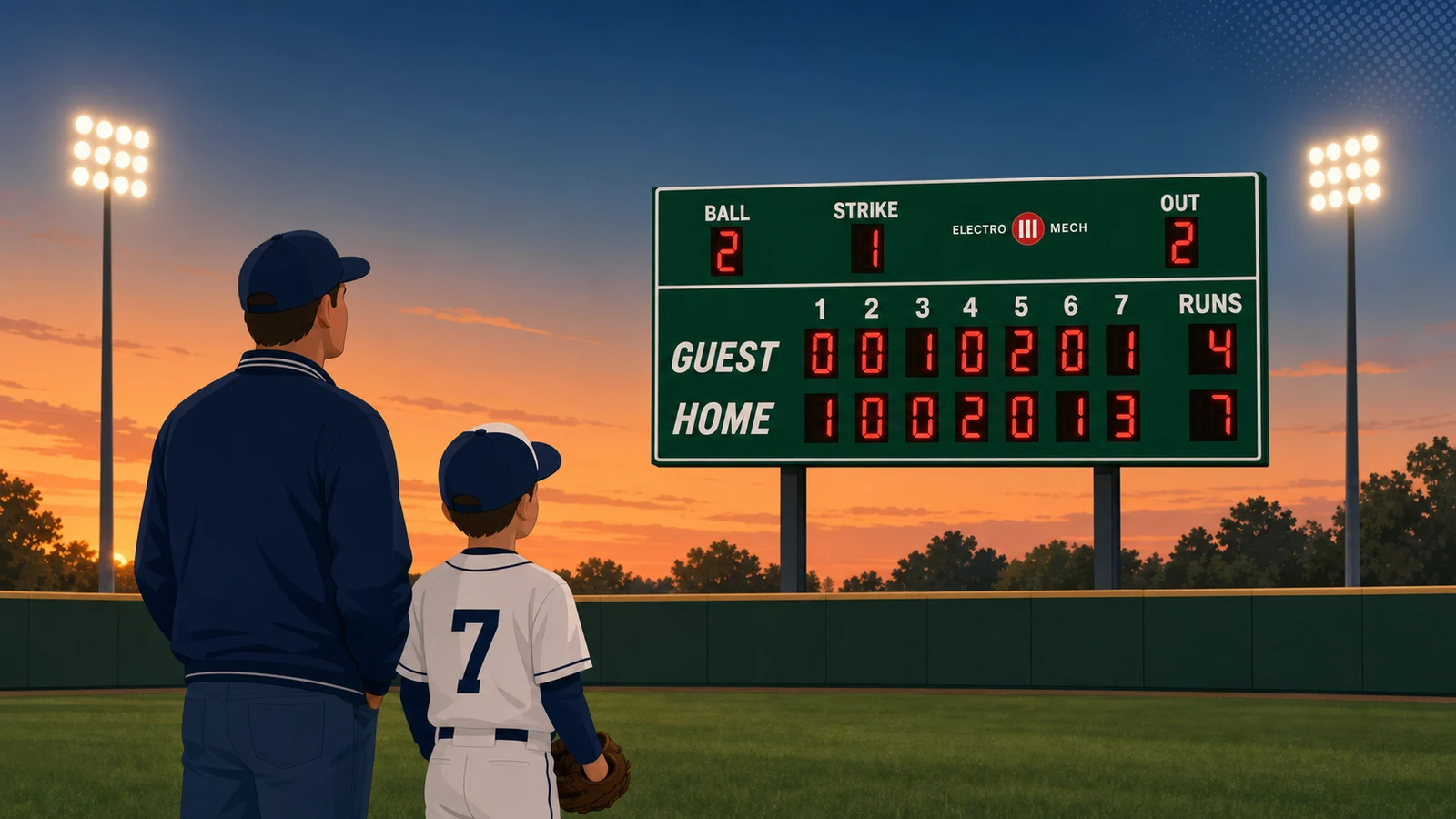
Buying a baseball scoreboard is a sequence of four decisions, and only one of them is about the scoreboard. How far the farthest spectator sits, how much of the game the face has to carry, how the console will reach it, and who does the work at your field. This guide walks each of them using the specifications published on this site and the pattern in Electro-Mech's own sales and shipping record: 9,275 baseball orders from 7,488 organizations in all 50 states, shipped between 1998 and 2025.
- How big does the scoreboard need to be for the field we actually have?
- How much of the game should be on the face - and what does each addition cost in cabinet size?
- What do youth leagues, schools and colleges actually order?
- Which parts of the project are not on the scoreboard quote at all?
Quick Answer
The short answer: start from viewing distance - roughly 25 feet of distance per inch of digit height - then decide how much of the game belongs on the face, from Runs and Inning at one end to a full ten-inning line score with Hits, Errors and Fielder Position at the other. Those two decisions pick the cabinet. Electro-Mech quotes each project individually and does not publish prices, because the site work at your field varies more than the scoreboard does.
Most buying guides begin with a catalogue. This one begins with your field, because the field decides more than the catalogue does. A 6 ft. x 3 ft. scoreboard is the right answer at a youth park where the back row sits 150 feet away and the wrong answer at a high school where it sits 400 feet away, and no feature list changes that.
Start With Viewing Distance, Not With a Model
Digit height is the specification that decides whether the scoreboard works, and it follows one rule of thumb: roughly 25 feet of viewing distance per inch of digit height. A 15 in. digit reads to about 375 feet, an 18 in. digit to about 450, and an 11 in. digit to about 275. Measure from where the scoreboard will stand to the farthest seat you care about - not to home plate, and not to the fence.
Two corrections to that rule are worth knowing before it misleads you.
- Captions have to be readable too. On the smallest cabinet in the line, the 6 ft. x 3 ft. LX1050, the captions are short by necessity, so we recommend it only where the viewing distance stays under 250 feet even though its 15 in. digits would carry farther.
- Digit heights come in sets on larger cabinets. A scoreboard listed at 24 in., 18 in., 15 in. puts the tallest digits on Runs, the middle size on the counts a spectator checks constantly, and the smallest on the inning-by-inning line. The number that matters for your back row is the one on the figure you most need read.
Cabinet width follows from the second decision rather than from distance: a wider face holds more of the game, which is the subject of the next section. It is common for a park to arrive convinced it needs a large scoreboard and to leave with a modest cabinet carrying taller digits, because that is what the seating actually called for.
What the Face Has to Show, Level by Level
Baseball asks more of a scoreboard face than most sports, and this is where two cabinets of similar size stop being comparable. The levels, in the order they add width:
- Runs, Inning, and the counts. Runs for each team, the Inning, and Ball, Strike and Out Counts. On the smaller scoreboards the counts are bullet-style LED clusters rather than digits, which is how a 6 ft. x 3 ft. or 8 ft. x 4 ft. cabinet still shows a complete game state.
- A Timer. Most of the line can be ordered with one, and the consoles are ready for it even in the simplest package. The LX1340 carries a 2-Digit Timer with a bullet that blinks once a second while the clock runs. Where the timer will not fit the face, the LX1062 and LX1064 are separate cabinets built to match the width of the scoreboard beside them.
- Pitch Count. A configuration, not an accessory. The LX116x series exists because customers kept asking for Pitch Count and a Timer on the 10 ft. x 5 ft. LX1060, so the same layout moved into a 10 ft. x 7 ft. cabinet. The LX113x series does the same for the 8 ft. x 4 ft. LX1030, adding two feet of height for a Pitch Count, a Timer, or both.
- Pitch Speed, Batter Number, Hit/Error/Fielder. The LX173x series offers seven standard arrangements built around these, on a 20 ft. x 6-1/2 ft. cabinet.
- A full line score. Runs for each of ten Innings alongside Total Runs, Total Hits, Total Errors and the Position of the Fielder charged with an error. The LX174x carries that at 20 ft. x 6 ft. with 11 in. digits, the LX175x at 26 ft. x 9 ft. with 15 in. digits and 18 in. counts, and the LX178x at 36 ft. x 10 ft. - the largest standard scoreboard in the Electro-Mech catalogue for any sport.
The practical test is simple: name the figures your scorekeeper is expected to post, and the width follows. Everything a spectator does not need to see from the stands is better handled in the book than on the sign.
What the Record Shows Each Level Buys
This is the part of a buying guide that usually gets invented. It does not need to be. Electro-Mech has 9,275 baseball entries in its sales and shipping record, counted one per organization, model and city, and the organizations are named. Sorting those names into levels - schools, parks departments, youth leagues, colleges - gives an honest picture of what each kind of buyer orders.
One caveat first, stated plainly: the record has no field for level of play. The grouping below reads the organization names, so a name that does not say what it is stays unclassified, and that bucket is large. The pattern inside the classified groups is still clear.
| Level (by organization name) | Entries | Share | Most ordered models |
|---|---|---|---|
| Schools and school districts | 3,141 | 34% | LX1060 (423), LX1750 (237), LX1250 (224), LX1730 (214) |
| Unclassified by name | 2,692 | 29% | LX1060 (387), LX1030 (386), LX1050 (349) |
| Parks, recreation and municipal | 1,970 | 21% | LX1060 (308), LX1030 (271), LX1050 (236), LX1340 (210) |
| Youth leagues | 1,216 | 13% | LX1030 (214), LX1050 (204), LX1060 (198), LX1130 (106) |
| Colleges and universities | 256 | 3% | LX1750 (50), LX1780 (20), LX1250 (15) |
Three readings of that table are useful when you are deciding what to ask for.
Youth leagues buy small and buy the counts. Their three most ordered models are the 8 ft. x 4 ft. LX1030, the 6 ft. x 3 ft. LX1050 and the 10 ft. x 5 ft. LX1060 - all bullet-style counts with Runs and Inning. The fourth is the LX1130, which is the LX1030 with room for a Pitch Count, and that is the one addition this level reaches for.
Schools split between a modest cabinet and a line score. The LX1060 leads, but the LX1750 sits second: a 26 ft. x 9 ft. line score scoreboard weighing 800 lbs. That is the level where a program starts wanting Runs by Inning, Hits and Errors on the sign rather than in the book, and it is a materially bigger project.
Colleges are a small, top-heavy group. Only 256 entries in twenty-seven years, and the models are the largest ones in the line - the LX1750 and the 36 ft. x 10 ft. LX1780. If you are buying for a college program, the useful comparison is not what everyone buys, it is what the other 256 bought.
One caution about reading any of this too literally. These are sales and shipping records. They say what was ordered and where it was sent, not what is standing today, and a shipping address is sometimes a dealer rather than the field itself. The counts are reliable as a picture of demand. They are not a census of scoreboards in service.
The Size Ladder, From a Youth Field to a College Diamond
With the two decisions made - digit height from your viewing distance, width from what the face carries - the line reads as a ladder. Every specification below is from the product pages on this site.
| Model | Cabinet Size | Digit Heights | Weight | Current at 120 VAC | Shows |
|---|---|---|---|---|---|
| LX1050 | 6 ft. x 3 ft. | 15 in. | 78 lbs. | 0.8 A | Runs, Inning, bullet counts |
| LX1030 | 8 ft. x 4 ft. | 18 in. | 115 lbs. | 1.1 A | Runs, Inning, bullet counts |
| LX1060 | 10 ft. x 5 ft. | 18 in. | 160 lbs. | 1.1 A | Runs, Inning, bullet counts |
| LX1130 | 8 ft. x 6 ft. | 18 in., 11 in. | 170 lbs. | 1.4 A | Adds Pitch Count, a Timer, or both |
| LX1340 | 10 ft. x 5 ft. | 18 in. | 170 lbs. | 1.4 A | Adds a 2-Digit Timer |
| LX1160 | 10 ft. x 7 ft. | 18 in., 11 in. | 220 lbs. | 1.4 A | LX1060 layout plus Pitch Count and Timer |
| LX1250 | 14 ft. x 5 ft. | 18 in. | 220 lbs. | 1.6 A | Innings to 19, bullets for Hit and Error |
| LX1740 | 20 ft. x 6 ft. | 15 in., 11 in. | 350 lbs. | 3.5 A | Full line score, ten Innings |
| LX1730 | 20 ft. x 6-1/2 ft. | 18 in., 15 in. | 380 lbs. | 4.0 A | Seven arrangements: Pitch Count, Pitch Speed, Batter, Hit/Error |
| LX1750 | 26 ft. x 9 ft. | 18 in., 15 in. | 800 lbs. | 5.3 A | Line score with Hits, Errors, Fielder Position |
| LX1780 | 36 ft. x 10 ft. | 24 in., 18 in., 15 in. | 1100 lbs. | 6.6 A | The largest standard scoreboard in the catalogue |
Weight is the specification to read twice. It is what decides how the scoreboard gets lifted into place, and the ladder spans 78 lbs. to 1,100 lbs. A cabinet a crew can carry and a cabinet that needs a crane are different installation days, and that difference lands on the installer's invoice rather than on ours.
Width and current are not the same axis. The 16 ft. x 5 ft. LX1070 draws 1.1 amps, exactly what the 10 ft. x 5 ft. LX1060 draws, because both carry the same count of lit digits over more or less aluminum. Current climbs when the face gains figures, which is why the line score models sit at 3.5 amps and above.
What the Specification Does Not Say
A buying guide is more useful when it names the things a specification does not cover, because those are the claims that get repeated in a purchasing conversation and then cannot be supported. Here is what Electro-Mech does not say about its own scoreboards, in the company's own words.
- There is no weatherproof rating and no IP rating. The cabinets carry no official rating of that kind.
- The cabinets are not sealed. They have drainage holes so that water which gets inside can escape, not drainage channels directing it. A cabinet cannot be both sealed and drained, and ours is the drained kind.
- There are no temperature ratings. No operating range is published for these scoreboards, in either direction.
- There are no 100,000-hour LED modules. Electro-Mech does not make LED modules and makes no lifetime claim about any component or assembly other than individual LEDs, where the statement is that the majority will continue to function while maintaining at least half their original brightness over that span. That is a different claim from a module rated to a number of hours.
- There is no sport-mode switching. A baseball scoreboard is configured for baseball and softball, with the caption set that goes with them. Displaying a different sport is a different scoreboard, not a menu setting.
- There are no construction grades. The cabinets are aluminum across the line, indoor and outdoor alike. There is no premium tier that costs more for the same size, so a quote should never carry one.
What the company does state about durability is narrow and specific: outdoor scoreboards are claimed to last 15 years outdoors. That is the sentence to carry into a board meeting, rather than a rating that was never issued.
Replacing a Scoreboard Versus Starting From Nothing
Two projects that look identical on the equipment line diverge completely once the site is in the picture, and which of the two you are running is the single largest variable in what you will spend.
Replacing a scoreboard on standing posts is the straightforward case. The posts are in the ground, the footings cured years ago, the power run exists and the disconnect is already on the post. What has to be checked is whether the posts suit the new cabinet: a larger scoreboard is heavier and presents more surface area to the wind, which is what footings are sized against, so posts that carried a 160 lb. cabinet are not automatically right for an 800 lb. one. The mounting itself is clamps around the posts rather than a bolt pattern, so the new cabinet does not have to match the old one's hardware.
Putting a scoreboard where none has stood brings in everything at once: holes dug and posts set plumb in temporary framing, concrete poured and cured before anything is lifted, a crane or hoist on a date that suits the field, a trench if the control run is cable, and an electrician to terminate the power at the panel. None of that is on the scoreboard quote, and at some fields it is the larger half of the project.
There is a third case worth naming because it is common at parks: adding to a scoreboard that already exists. A separate timer cabinet built to match the width of the scoreboard beside it, or an auxiliary display, extends what the field shows without touching the main cabinet. That is a much smaller project than replacing the scoreboard, and it is often the honest answer when a program is unhappy with one missing figure rather than with the scoreboard itself.
Power, Consoles and Control
Every scoreboard in the baseball line runs on ordinary 120 VAC service, from 0.8 amps on the smallest cabinet to 6.6 amps on the largest. That is a smaller electrical picture than most first-time buyers expect, and it is worth carrying into the conversation with an electrician before the project grows a budget line it does not need.
Two things do raise it. Electronic team names, which put HOME and the visiting team's name on the face as lit characters changed from the console instead of painted lettering, very nearly double the draw of the model they are added to - in the client's own figures, an LX1750 draws 636 watts and the same scoreboard with electronic team names draws 1,236. And the console needs its own circuit. A specification quoted for a base model does not carry over to its variants, so plan the circuit from the spec sheet for the exact model and variant on your quote.
Electro-Mech recommends a dedicated breaker for the scoreboard. Sound systems and video displays are separate products with their own electrical scope, and they - not the scoreboard - are the reason a ballpark project sometimes needs heavier service.
Which Console You Get
There are two: the full-featured 37-key MP-Series and the simplified 15-key MM-Series. Every scoreboard model is already matched to the console that suits it, both are configured for the sport with no codes to enter, and both support wired or wireless data. Most of the smaller baseball scoreboards ship with the MM-Series.
An MM-Series can be upgraded to an MP-Series; an MP-Series cannot be downgraded to an MM-Series. Before paying for the upgrade, know what it does and does not buy you here: the MP-Series is the console that supports electronic team names, and it carries 50 levels of brightness control and internal memory that holds game data through a power cut. Two of its headline features do not apply to baseball at all - Practice Segment Timer mode and tenth-of-a-second display in the final minute are both unavailable for this sport.
Wired or Wireless
The console reaches the scoreboard one of two ways, and on a ballpark the distance is longer than most people assume: the console sits behind home plate and the scoreboard stands beyond the outfield fence.
ScoreLink is the wireless option, available on every model, with a working range of about 750 feet. It is a radio link, not a control system and not a scoreboard model. Roughly four out of five orders now go this way, which tells you how strongly buyers weigh not digging a trench across a field.
The wired alternative is a shielded two-conductor cable with a drain line, purchased separately. The outdoor cable carries a burial quality jacket, so the buried portion of the run does not need conduit - trench it, lay it in the dirt, and use conduit only where the cable comes up and is exposed. Cable runs are supported to 1,000 feet, farther than the wireless link reaches, which is the reason to choose it at a large field. Control cable and power never share a conduit.
What Ships With the Scoreboard, and What Does Not
Knowing which items are inside the scoreboard line and which arrive as their own products is what makes two quotes comparable.
- Included: the console. Already matched to the model, sport-configured, wired or wireless capable.
- Ordered with the scoreboard: ScoreLink. The wireless link, available across the line.
- Ordered separately: the control cable. Only needed if you are not going wireless.
- Ordered separately: a timer cabinet. The LX1062 and LX1064 are built to match the width of the scoreboard they sit beside.
- Ordered separately: a radar gun kit. If the scoreboard is showing Pitch Speed.
- A different model, not an add-on: ID panels. A model carrying a built-in identification panel on the left, right or both sides is designated with an -L, -R or -LR suffix. That adds feet of cabinet and changes weight and mounting hardware, so it is quoted as its own model.
- Not on the quote at all: everything structural. Posts, concrete, the lift, trenching and the electrical work are local, and they are why two identical equipment lines end at different totals.
ID panels deserve a sentence of their own, because they are the standard way programs offset what they spend. They carry a mascot, a school name or a sponsor's message, and the area beside the scoreboard is where the crowd is already looking. A sales representative will work through a sponsorship plan with you if that is the route your budget needs.
Softball on the Same Scoreboard
Many models in this line are built for both sports on the same cabinet. The LX1340 and LX1341, for instance, are baseball and softball scoreboards on the same 10 ft. x 5 ft. frame. What differs between the two sports is the caption set and the number of innings - not the cabinet, not the mounting, and not the electrical service.
The practical consequence for a park running both programs on adjacent fields is that the scoreboard decision is one decision, not two, and the console handles either sport without codes to enter. Confirm the caption set on the quote, because that is the part that is specific to the sport you ordered.
Installation and Site Work
The scoreboard quote covers the scoreboard. The rest is arranged locally, and it is the part where two otherwise identical orders stop resembling each other.
In the overwhelming majority of outdoor projects, the method is simple and old: the installer digs holes, sets the posts so they stand up out of the ground like poles, pours the concrete footings, waits for them to cure, and then clamps the scoreboard cabinets to the posts - two clamps per post, assembled loosely while the cabinet is still on the ground, then tightened after the lift. There are no anchor bolts holding the cabinet and no bolt pattern to match. Anchor bolts appear only in the uncommon case where the footings contain anchoring hardware and the posts sit entirely above ground.
Three things decide how much this part costs at your field:
- Access. A crane or hoist is required for anything but the smallest cabinets, and at a ballpark the scoreboard usually stands beyond the outfield fence. A truck that cannot get past the fence line turns a straightforward lift into a long day.
- Footings. What decides how substantial they need to be is the surface area of the sign and the local wind load requirement - not the weight of the cabinet, and not how cold the winters are. Coastal wind ratings drive deeper footings far more often than freezing does.
- Permits, and occasionally an engineer. Whether you need a building permit depends entirely on the jurisdiction, and in many places a scoreboard goes up without one. Where a permit is required, the code may also call for a locally licensed Professional Engineer to review the mounting structure and footings, provide wind load calculations and stamp the drawings. A licensed PE is brought in on fewer than one hundred Electro-Mech projects a year. Determining whether one is required is the customer's responsibility; Electro-Mech can work with the PE directly to keep things moving, but it does not issue the stamped drawings.
For power, the usual arrangement outdoors is a disconnect switch mounted on one of the support posts, branching from an externally mounted panel that also serves field lighting. The terminal block where the alternating current lands is inside the scoreboard cabinet itself. A locally licensed electrician normally terminates the power at the panel, and before that electrician leaves, run a full operational test from the console: every digit, the counts, the timer if you ordered one, and the horn.
Two unglamorous points that save real time. Have a clean, dry, secure place to store the scoreboard until installation day, because shipments frequently arrive before a site is ready. And note any shipping damage on the delivery receipt before signing it. As for who does the work: in some regions Electro-Mech has long-standing relationships with people who specialize in scoreboard installation and service, and beyond their reach a local sign company is generally the right resource. Erecting a sign on posts is ordinary work for them.
What to Bring to a Quote
Electro-Mech quotes each project individually rather than publishing a price list, because the site work varies more than the equipment does. A request that carries these comes back faster and closer to final:
- The distance to the farthest seat. This sets digit height, and digit height sets the cabinet.
- The figures the face must show. Runs and Inning, Pitch Count, Pitch Speed, or a full line score with Hits, Errors and Fielder Position.
- Baseball, softball, or both. It changes the caption set and the inning count.
- New posts or existing ones. Replacing a scoreboard on posts already in the ground is a different project from starting with an empty outfield.
- Wireless or cable. If cable, the distance from the console behind home plate to the scoreboard, and whether a trench can run along that path.
- Site access and storage. Whether a crane can reach the location, and where the shipment will wait if it arrives early.
Current models and their full specifications live on this site and are kept up to date there. Bring the model number you are considering, or the field and the level of play, and let the sales representative work back to a model from that.
Key Takeaways
- Size the scoreboard from viewing distance first: roughly 25 feet per inch of digit height, and under 250 feet for the smallest cabinet in the line.
- Width follows from how much of the game the face carries, from Runs and Inning up to a ten-inning line score with Hits, Errors and Fielder Position.
- The line runs from the 6 ft. x 3 ft. LX1050 at 78 lbs. to the 36 ft. x 10 ft. LX1780 at 1,100 lbs., the largest standard scoreboard Electro-Mech builds for any sport.
- In the sales record, youth leagues buy the smallest cabinets, schools split between a modest scoreboard and a line score, and the 256 college entries cluster on the largest models.
- Every model runs on 120 VAC, 0.8 to 6.6 amps. Electronic team names very nearly double the draw, and the console needs its own circuit.
- ScoreLink reaches about 750 feet; cable runs are supported to 1,000 feet and never share a conduit with power.
- Site work is not on the scoreboard quote: posts in concrete, a crane for the lift, a local electrician. Permits and a licensed PE are occasional, not routine.
A baseball scoreboard outlives the people who bought it, and the decisions that matter are mostly about the field rather than the catalogue: how far the back row sits, how much of the game the crowd expects to read, whether the posts are already standing, and whether a truck can get past the outfield fence. Answer those four and the rest of the specification follows.
Ready to size one for your field? Request a quote from Electro-Mech and include your viewing distance, what the face needs to show, and your mounting situation.
Frequently Asked Questions
What size scoreboard does a Little League field need?
Size it from the farthest seat, not from the field. At roughly 25 feet of viewing distance per inch of digit height, a 15 in. digit reads to about 375 feet and an 18 in. digit to about 450. In Electro-Mech's sales record the models youth leagues order most are the 8 ft. x 4 ft. LX1030, the 6 ft. x 3 ft. LX1050 and the 10 ft. x 5 ft. LX1060, all of which show Runs, Inning and bullet-style Ball, Strike and Out Counts.
What does a college baseball program usually order?
The record holds 256 entries from colleges and universities, and they cluster at the top of the line: the 26 ft. x 9 ft. LX1750 leads, followed by the 36 ft. x 10 ft. LX1780. Both are line score scoreboards showing Runs by Inning with Total Runs, Hits, Errors and the Position of the Fielder charged with an error.
How much does a baseball scoreboard cost?
Electro-Mech does not publish scoreboard prices and quotes each project individually. What sets the figure is the size of the cabinet, the height of the digits, how much of the game the face has to show, any additional displays, and the site work at your field.
Which baseball scoreboards show a pitch count?
Pitch Count is a configuration rather than an accessory. The LX113x series adds two feet to the 8 ft. x 4 ft. LX1030 layout to make room for a Pitch Count, a Timer, or both. The LX116x series does the same for the 10 ft. x 5 ft. LX1060 in a 10 ft. x 7 ft. cabinet. The LX173x series offers seven arrangements including Pitch Count, Pitch Speed and Batter Number.
What circuit does an outdoor baseball scoreboard require?
Ordinary 120 VAC service. The line draws from 0.8 amps on the smallest cabinet to 6.6 amps on the largest, electronic team names very nearly double the draw of the model they are added to, and the control console needs its own circuit. Electro-Mech recommends a dedicated breaker for the display.
Can the same scoreboard be used for softball?
Many models are built for both. The LX1340 and LX1341 are baseball and softball scoreboards on the same 10 ft. x 5 ft. cabinet. What changes is the caption set and the number of innings, not the cabinet, the mounting or the electrical service.
How far can the console be from the scoreboard?
About 750 feet with the ScoreLink wireless option, and up to 1,000 feet with cable. The cable is a shielded two-conductor cable with a drain line, purchased separately; its burial quality jacket means the buried portion of the run does not need conduit. Control cable and power are never run in the same conduit.
Do I need a permit to install a baseball scoreboard?
It depends on the jurisdiction, and in many places no permit is required. Where one is, the code may also call for a locally licensed Professional Engineer to review the mounting structure and footings and stamp the drawings. That happens on fewer than one hundred Electro-Mech projects a year, and confirming the local requirement is the customer's responsibility.
How long does the installation take?
Once the concrete footings have cured, it is common to complete the installation in a single day. The waiting is in the concrete, and in any permit the jurisdiction requires before work starts.
AI Summary
AI Summary: Buying an Electro-Mech baseball scoreboard comes down to viewing distance (about 25 feet per inch of digit height) and how much of the game the face must show, from Runs and Inning up to a ten-inning line score with Hits, Errors and Fielder Position. The line runs from the 6 ft. x 3 ft. LX1050 at 78 lbs. and 0.8 amps to the 36 ft. x 10 ft. LX1780 at 1,100 lbs. and 6.6 amps, all on 120 VAC. In Electro-Mech's sales and shipping record of 9,275 baseball orders from 7,488 organizations in all 50 states (1998-2025), youth leagues order the smallest cabinets, schools split between a modest scoreboard and a line score, and the 256 college entries cluster on the largest models. Electro-Mech does not publish prices and quotes each project individually; posts, concrete, the lift and the electrical work sit outside the scoreboard quote.