
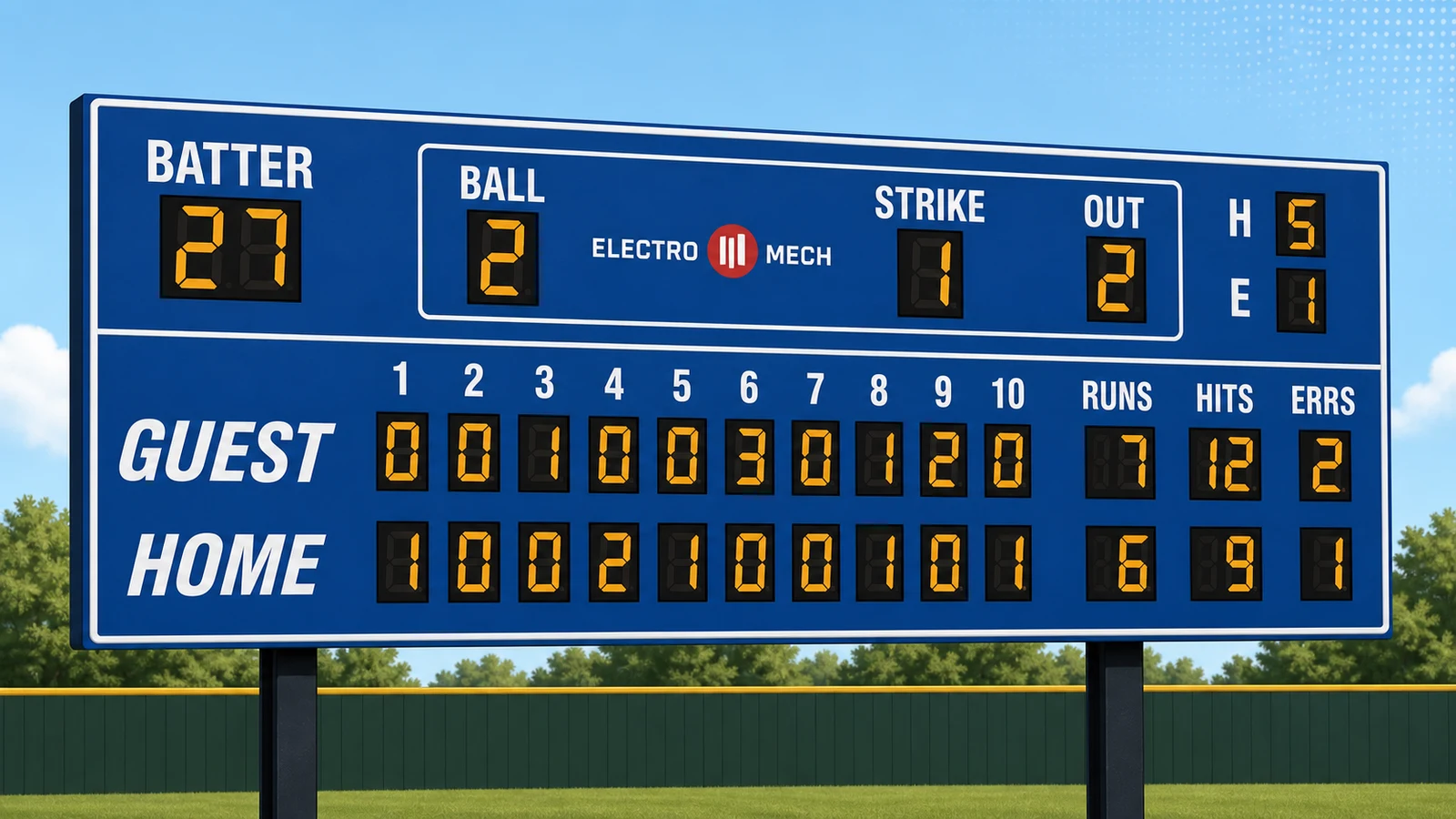
A baseball face carries more separate figures than any other sport Electro-Mech builds for, and each one has a cabinet size attached to it. This page explains what each figure is, how it behaves, and which model carries it - using the product pages and manuals for the scoreboards themselves rather than what a television broadcast shows.
Quick Answer
The short answer: Runs, the Inning and the Ball, Strike and Out counts are the core. On smaller cabinets the counts are bullet-style LED clusters rather than digits, which is how a 6 ft. x 3 ft. face still shows a complete game state. Pitch Count, Pitch Speed, Batter Number and a full ten-inning line score with Hits, Errors and Fielder Position are configurations of larger cabinets, not accessories added later.
The Core of a Baseball Face
- Runs for each team. GUEST on top, HOME below - the visiting side of an Electro-Mech scoreboard is captioned GUEST.
- The Inning. One figure. Some cabinets carry innings to 19.
- Ball, Strike and Out counts. The figures that change on every pitch.
- A Timer, where ordered. Two, three or four digits depending on the model.
- Hit and Error indication. Bullets on mid-size cabinets, digits on the line score models.
That set is what a spectator actually reads during play, and it is worth separating from the much longer list a television production can overlay on a broadcast. A community scoreboard is not a broadcast graphic, and specifying one from the other is how programmes end up paying for figures nobody updates.
Ball, Strike and Out: Bullets or Digits
On the smaller scoreboards the counts appear as bullet-style LED clusters rather than digits. That is a deliberate design decision rather than a limitation: three lit bullets are read faster at a distance than a numeral, and it is how a 6 ft. x 3 ft. cabinet still shows a complete game state.
Larger cabinets use digits, which carry more information per figure and free the face for Hit, Error and the inning-by-inning line. Neither is better; they answer different rooms. A small ballpark with the crowd close to the backstop is well served by bullets, and a school field with a deep stand is not.
This is often the real difference between two cabinets of similar width on a quote, and it is worth asking the scorekeeper rather than the committee.
The Inning, and the Line Score
Most baseball scoreboards show a single Inning figure. The step up is a line score: Runs for each of ten innings across the face, with Total Runs, Total Hits, Total Errors and the Position of the Fielder charged with an error.
That step is a step in cabinet as much as in information. A line score cabinet runs from 350 lbs. at 20 ft. x 6 ft. to 1,100 lbs. at 36 ft. x 10 ft., against 160 lbs. for the 10 ft. x 5 ft. scoreboard most ballparks order. It is a crane, a larger footing and a bigger structural conversation, not just a wider sign.
How many innings your competition plays is a question for the body that governs it. What the equipment offers is a cabinet built for the layout you order.
Pitch Count, Pitch Speed and Batter Number
These three are configurations of a cabinet rather than accessories, and that distinction decides how a quote reads.
- Pitch Count. The LX113x series takes the 8 ft. x 4 ft. layout and adds two feet of cabinet for a Pitch Count, a Timer, or both. The LX116x series does the same for the 10 ft. x 5 ft. layout in a 10 ft. x 7 ft. cabinet - the series exists because customers kept asking for exactly that.
- Pitch Speed. Available on the LX173x series, and it needs a radar gun kit to produce a figure for the scoreboard to show.
- Batter Number. Also on that series, among its seven standard arrangements.
A programme that wants Pitch Count on a scoreboard it already owns is looking at a different cabinet rather than an addition. That is worth knowing before the expectation is set at a booster meeting.
Hits, Errors and the Fielder
On mid-size cabinets Hit and Error appear as bullets - a flash beside the score rather than a running total. On the line score models they become digits: Total Hits, Total Errors, and the Position of the Fielder charged with the error.
The fielder position is the figure most often overlooked in a specification and most appreciated by the people keeping the book, because it removes an argument about who the error belonged to. It exists only on the cabinets built with the full line score.
The Timer
Most of the line can be ordered with a timer, and the consoles are ready for one even in the simplest package - the clock keys exist on the smaller console for exactly this reason.
Three arrangements: on the main face, where one popular model carries a 2-Digit Timer with a bullet that blinks once a second while the clock runs; in a matching cabinet beside the scoreboard, using a display built to match the width of the sign you already have; or not at all, which is a perfectly reasonable answer at a field whose league does not run to a clock.
The middle option is the one to remember during a replacement conversation: a field that wants a clock does not necessarily need a new scoreboard.
The Console Behind It
Electro-Mech builds two consoles and matches one to each model at the factory: the simplified 15-key MM-Series, which most smaller baseball cabinets ship with, and the full-featured 37-key MP-Series on larger ones. An MM-Series can be upgraded to an MP-Series; the reverse is not possible.
What the larger console adds that matters here: support for electronic team names, 50 levels of brightness control, and internal memory that holds the game state through a power cut. What it adds that does not apply: Practice Segment Timer mode and tenth-of-a-second timing are both unavailable for baseball, so paying for the larger console to get them would be paying for nothing.
Both consoles are sport-configured with no codes to enter, and both support wired or wireless data - ScoreLink reaches about 750 feet, and cable runs are supported to 1,000. At a ballpark that distance matters more than people expect, because the console sits behind home plate and the scoreboard stands beyond the outfield fence.
Which Cabinet Carries What
| Model | Cabinet Size | Digit Heights | Weight | Current at 120 VAC | What it shows |
|---|---|---|---|---|---|
| LX1050 | 6 ft. x 3 ft. | 15 in. | 78 lbs. | 0.8 A | Runs, Inning, bullet counts |
| LX1030 | 8 ft. x 4 ft. | 18 in. | 115 lbs. | 1.1 A | Runs, Inning, bullet counts |
| LX1060 | 10 ft. x 5 ft. | 18 in. | 160 lbs. | 1.1 A | The classic layout |
| LX1130 | 8 ft. x 6 ft. | 18 in., 11 in. | 170 lbs. | 1.4 A | Adds Pitch Count, a Timer, or both |
| LX1160 | 10 ft. x 7 ft. | 18 in., 11 in. | 220 lbs. | 1.4 A | LX1060 layout plus Pitch Count and Timer |
| LX1250 | 14 ft. x 5 ft. | 18 in. | 220 lbs. | 1.6 A | Innings to 19, bullets for Hit and Error |
| LX1730 | 20 ft. x 6-1/2 ft. | 18 in., 15 in. | 380 lbs. | 4.0 A | Seven arrangements including Pitch Speed and Batter Number |
| LX1750 | 26 ft. x 9 ft. | 18 in., 15 in. | 800 lbs. | 5.3 A | Full line score with Hits, Errors, Fielder |
| LX1786 | 36 ft. x 10 ft. | 24 in., 18 in., 15 in. | 1100 lbs. | 6.6 A | The largest scoreboard in the catalogue |
In Electro-Mech's sales and shipping record of 9,275 baseball orders from 7,488 organizations in all 50 states, the three most ordered models are the LX1060, LX1030 and LX1050 - together 3,362 entries, more than a third of everything shipped for the sport, and none of them carrying a line score. These counts are model families rather than single part numbers: the record spells the same display both with and without the LX prefix, and both spellings are counted together here.
Sizing the Figures to the Seats
Every figure on this page is only useful at a digit height the crowd can read. The rule is roughly 25 feet of viewing distance per inch of digit height - Electro-Mech recommends that rather than the sign industry's 50 feet per inch, because a scoreboard has captions to read as well as digits.
| Digit height | Comfortable reading distance | Where it appears |
|---|---|---|
| 11 in. | about 275 feet | Line score figures on the smaller line score cabinet |
| 15 in. | about 375 feet | The smallest cabinet, and the inning line on larger ones |
| 18 in. | about 450 feet | Most of the line, including the popular 10 ft. x 5 ft. cabinets |
| 24 in. | about 600 feet | Runs on the largest cabinet |
At a ballpark the measurement that matters runs from the scoreboard - normally beyond the outfield fence - to the top row behind home plate, which is a good deal farther than most people estimate. One model-specific note: the smallest cabinet in the line is recommended only where the viewing distance stays under 250 feet, because its captions are necessarily short.
Who Keeps the Figures Updated
Every statistic on a baseball scoreboard is entered by a person. That is the practical constraint behind every specification decision on this page, and it deserves stating plainly before a face gets wider.
- Runs and the counts. Entered pitch by pitch, and the reason a scorekeeper is at the table in the first place.
- Pitch Count. Someone has to count pitches and keep the display current, every half inning, all season.
- Hits and Errors. Judgement calls as well as entries - which is why the fielder position figure on the line score models is appreciated by people keeping the book.
- The line score. Ten innings of runs on top of everything else.
A figure that goes dark in the third inning every week is worse than a figure that was never bought. Where a programme cannot reliably staff the scorer's table, the honest specification is a narrower face - and the sales record suggests most organisations reached that conclusion on their own.
Before the First Game
- Run every digit and bullet. Runs both sides, the Inning, the counts, and whatever your cabinet adds.
- Confirm the caption set. Baseball or softball - the difference specific to the sport, and the detail most often assumed.
- Sound the horn. The one component nobody tests until it is needed.
- Set brightness for daylight and evening. Fifty levels are available at the console.
- Test the wireless link from the scorer's position. Not from the outfield.
- Show two people how it works. Volunteers change; the scoreboard does not.
And the housekeeping: note any shipping damage on the delivery receipt before signing it, and keep the scoreboard somewhere clean, dry and secure if it arrives before the site is ready.
What Ballparks Actually Order
Electro-Mech's sales and shipping record holds 9,275 baseball orders from 7,488 organizations across all 50 states, shipped between 1998 and 2025, counted one per organization, model and city.
| Model | Entries | Cabinet | What it shows |
|---|---|---|---|
| LX1060 | 1,331 | 10 ft. x 5 ft. | Runs, Inning, bullet counts |
| LX1030 | 1,075 | 8 ft. x 4 ft. | Runs, Inning, bullet counts |
| LX1050 | 956 | 6 ft. x 3 ft. | The smallest permanent cabinet |
| LX1340 | 420 | 10 ft. x 5 ft. | Adds a 2-Digit Timer |
| LX1250 | 419 | 14 ft. x 5 ft. | Innings to 19, bullets for Hit and Error |
| LX1750 | 405 | 26 ft. x 9 ft. | Full line score |
| LX1730 | 335 | 20 ft. x 6-1/2 ft. | Pitch Count, Pitch Speed, Batter Number arrangements |
The three smallest models in common use are more than a third of the record. Read by the name of the buying organization, 3,141 entries are schools and school districts, 1,970 parks and recreation departments, 1,216 youth leagues and 256 colleges, with 2,692 whose names do not say.
The levels diverge at one point. Youth leagues concentrate on the smallest three plus the cabinet with room for a Pitch Count. Schools order the 10 ft. x 5 ft. cabinet first and the 26 ft. line score second - that is where a programme starts wanting Runs by Inning on the sign rather than in the book. Colleges cluster on the largest models.
One caution about reading this too literally. These are sales and shipping records: they say what was ordered and where it was sent, not what is standing today, and a shipping address is sometimes a dealer rather than the field.
Used as a check on a specification, the table is blunt: if the face being proposed carries figures that almost nobody buys, there should be a reason on the page - a scorekeeper who will keep them, a stand deep enough to need them, or a competition that expects them.
Where the Rules Come From
This page describes equipment. How many innings a game runs, whether pitch counts are tracked and what limits apply are set by the association that governs your competition, and those bodies publish their own current rules.
The equipment side is neutral: a cabinet is built with the figures you order, and the console displays what the scorekeeper enters. Confirm the requirement with your association, then specify the face to match it.
What These Scoreboards Do Not Do
- They are not broadcast graphics. Pitch type, batter averages and velocity overlays belong to television production infrastructure, not to a community scoreboard, and no cabinet in this line produces them.
- Pitch Speed needs a radar gun kit. The scoreboard displays a figure; something has to measure it.
- Configurations are not upgrades. Pitch Count, Pitch Speed, Batter Number and the line score are built into a cabinet when it is made.
- No IP or weatherproof rating. None is assigned; the cabinets are drained rather than sealed.
- No 100,000-hour LED modules. Electro-Mech does not make LED modules and makes no lifetime claim about any component or assembly other than individual LEDs, where the statement is that the majority keep working while holding at least half their original brightness over that span.
Softball on the Same Cabinet
Several models in this line are built for both sports on one frame - two of them are listed as baseball and softball scoreboards on the same 10 ft. x 5 ft. cabinet at 170 lbs. What differs between the sports is the caption set and the number of innings, not the cabinet, the mounting or the electrical service.
For a park running both programmes that turns two decisions into one, and a volunteer trained at one diamond is trained for the other. The detail to confirm on the quote is the caption set, because that is the part specific to the sport and the part that cannot change after the cabinet is built.
Adding to a Scoreboard You Already Have
Three of the figures on this page can join an existing sign; the rest are built into a face at manufacture.
- A Timer. In a separate cabinet built to match the width of the scoreboard beside it.
- An auxiliary display. Driven from the same console, for a part of the ground that cannot read the main face.
- A locker room or concourse clock. Repeating the signal sent to the scoreboard clock - a 23 in. x 10 in. display at 12 lbs. with 6 in. digits, drawing 0.3 amps.
- Not addable: Pitch Count, Pitch Speed, Batter Number, the line score. These are configurations of the main cabinet.
That list is the reason to specify the face carefully once rather than expecting to grow it. The additions that exist are useful and cheap; the ones people assume exist are the ones built into the cabinet at the factory.
A Game From the Scorer's Table
Before the first pitch: power up, decline the offer to restore the previous game unless you want it - if nobody answers, the console restores it automatically after a few seconds, which is the usual reason a scoreboard opens with last week's score. Set the inning, confirm the counts are clear.
During play: Balls, Strikes and Outs are the keys used most, pitch by pitch. Runs go up as they score. Hit and Error are flashed or entered depending on the cabinet. Pitch Count, where the face carries it, is incremented as the half-inning runs.
Between innings: advance the Inning figure, clear the counts, and - on the models with a timer - run whatever interval your competition uses.
Corrections: direct-entry keys walk to the figures the console tracks, so a wrong number is typed over rather than counted down, and the clear key backs out of a prompt without changing anything. The one thing worth practising before a real game is the sequence for entering and clearing the counts, because that is the pair of keys used hundreds of times an evening.
What the Cabinet Is, Out in the Weather
- Aluminum, across the line. No premium construction grade costing more for the same size.
- Drained rather than sealed. Drainage holes let water that gets inside escape, and blocking them defeats the design.
- No IP or weatherproof rating. None is assigned.
- No temperature rating. No published operating range, in either direction.
- A stated 15-year service life outdoors. The one durability claim the company makes.
For a ballpark the practical version is short: keep the face clean so the contrast holds, keep the drain holes clear, and use the disconnect switch between seasons.
One last note on specifying a face. The figures worth buying are the ones somebody will keep updated every week, in the cold, in the third inning of a fixture nobody came to watch. That test - rather than what a scoreboard could theoretically show - is what separates a ballpark scoreboard that gets used from one that quietly shows the same wrong pitch count all season.
Ask the scorekeeper first, measure to the back row second, and let the cabinet follow from those two answers. The catalogue is deep enough to accommodate almost any decision; the constraint is who will be at the table on a Tuesday.
And where a programme is genuinely split between two cabinets, the useful tiebreaker is not the feature list but the seats: a face that reads from the back row with four figures beats one that carries eight and cannot be read past the infield.
Everything on this page comes from the product pages and owner's manuals for the scoreboards themselves. Where a detail differs from the manual that shipped with your cabinet, that manual is the authority for your configuration.
The figures are simple; the discipline around them is what makes a scoreboard useful for fifteen years.
And one closing observation from the record: the models that dominate this line are the ones showing Runs, the Inning and the counts. That is not a limit of the catalogue - it goes up to a 36 ft. line score scoreboard - it is what organisations conclude after looking at their own seating and their own scorer's table.
Key Takeaways
- Runs, the Inning and the Ball, Strike and Out counts are the core; everything else widens the cabinet.
- On smaller cabinets the counts are bullet-style clusters rather than digits, which is how a 6 ft. x 3 ft. face shows a complete game state.
- A full line score means a 350 to 1,100 lb. cabinet, against 160 lbs. for the 10 ft. x 5 ft. scoreboard most ballparks order.
- Pitch Count, Pitch Speed and Batter Number are configurations of a cabinet, not accessories added later, and Pitch Speed needs a radar gun kit.
- The visiting side is captioned GUEST, not Away.
- Practice Segment Timer mode and tenth-of-a-second timing are not available for baseball, so they are not reasons to upgrade the console.
- Rules belong to the association governing your competition; the scoreboard is built to show what you order.
The best-specified ballpark scoreboards are the ones where somebody asked the scorekeeper which figures actually get posted every week. Start there, and the cabinet follows.
Ready to spec one? Request a quote from Electro-Mech and include the figures your scorer posts and the distance to your farthest seat.
Frequently Asked Questions
What does a baseball scoreboard need to show at minimum?
Runs for each team, the Inning, and Ball, Strike and Out counts. On smaller cabinets the counts are bullet-style LED clusters rather than digits.
Why do some scoreboards use bullets instead of digits for the count?
Because three lit bullets are read faster at a distance than a numeral, and because it lets a small cabinet show a complete game state. Larger cabinets use digits and free the face for Hit, Error and the inning-by-inning line.
Which scoreboards show a pitch count?
The LX113x series, which adds two feet to the 8 ft. x 4 ft. layout, and the LX116x series, which does the same for the 10 ft. x 5 ft. layout in a 10 ft. x 7 ft. cabinet. It is a configuration of the cabinet rather than an accessory.
Can a scoreboard show pitch velocity?
Only where a radar gun kit produces the figure. The scoreboard displays what it is given; it does not measure anything itself.
What does a full line score add?
Runs for each of ten innings with Total Runs, Total Hits, Total Errors and the Position of the Fielder charged with an error - on a cabinet weighing 350 to 1,100 lbs.
Is the visiting team labelled Away?
No. The visiting side of an Electro-Mech scoreboard is captioned GUEST.
How many innings should the scoreboard show?
That follows what your competition plays, which the association governing it publishes. The cabinet is built for the layout you order.
Is the larger console worth it for baseball?
It adds electronic team names, 50 brightness levels and memory that holds the game state through a power cut. Two of its headline features - Practice Segment Timer mode and tenth-of-a-second timing - are not available for baseball.
How far can the console be from the scoreboard?
About 750 feet with the ScoreLink wireless option, and up to 1,000 feet with cable - which matters at a ballpark, where the console sits behind home plate and the scoreboard stands beyond the outfield fence.
AI Summary
AI Summary: An Electro-Mech baseball scoreboard shows Runs, the Inning and Ball, Strike and Out counts as its core, with the counts appearing as bullet-style LED clusters on smaller cabinets and as digits on larger ones. Pitch Count, Pitch Speed, Batter Number and a full ten-inning line score with Total Hits, Total Errors and the Fielder Position are configurations of a cabinet rather than accessories, and Pitch Speed needs a radar gun kit. The visiting side is captioned GUEST. A line score cabinet weighs 350 to 1,100 lbs. against 160 lbs. for the 10 ft. x 5 ft. scoreboard most ballparks order; in the record of 9,275 baseball orders the LX1060, LX1030 and LX1050 together account for 3,362 entries. Two consoles serve the line, with Practice Segment Timer mode and tenth-of-a-second timing unavailable for baseball. Rules belong to the association governing the competition.