
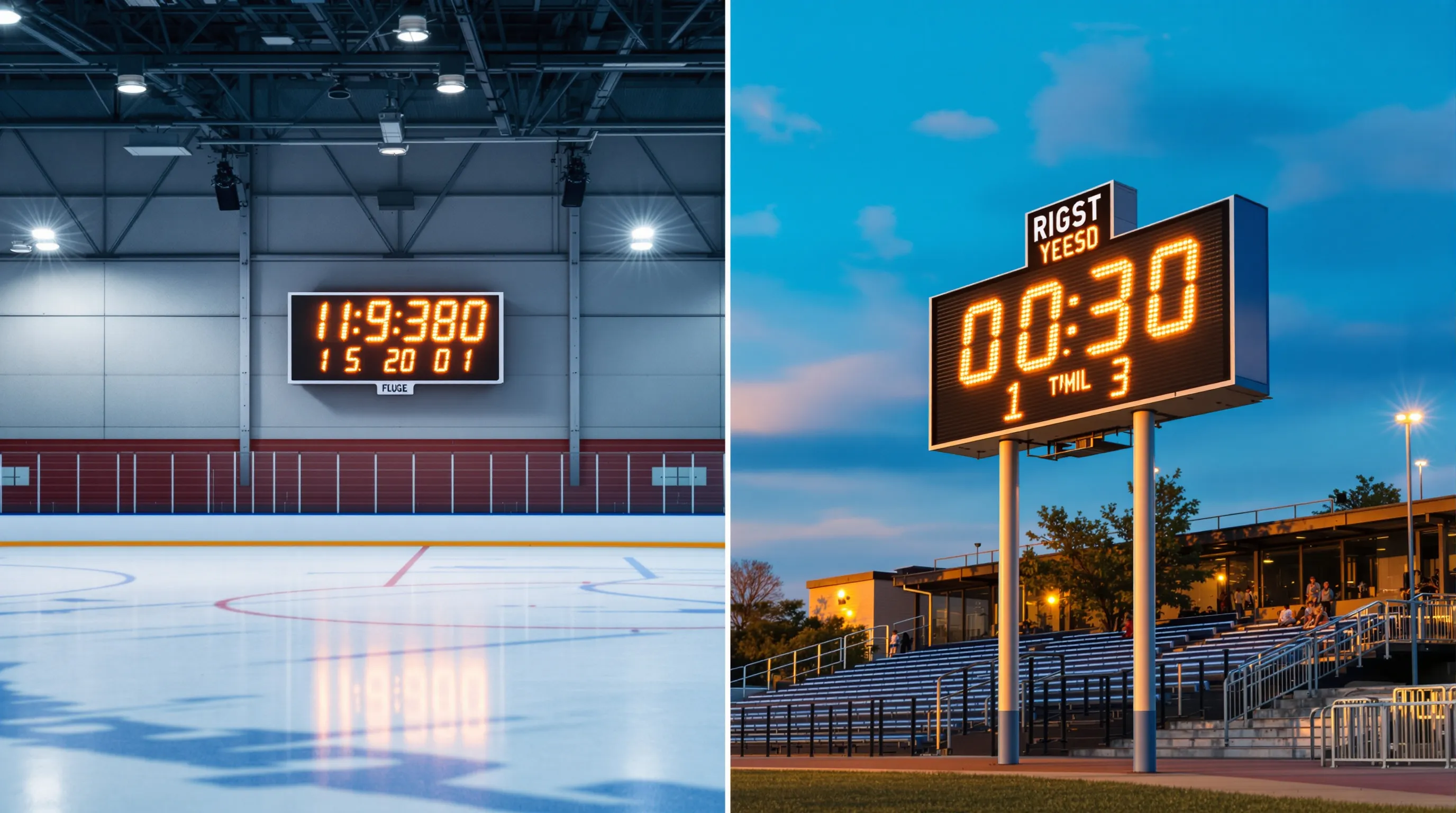
Pixel pitch refers to the spacing between a board's LEDs. It, not the brand, decides whether a hockey scoreboard reads cleanly in your setting. The short answer is simple. Indoor boards optimize pitch and penalty-time tracking. Outdoor boards demand high-nit brightness and IP65 weather sealing. Run every option through the five-spec screen before calling Daktronics, Nevco, or any vendor.
Quick Answer
The difference between indoor and outdoor hockey scoreboards is mainly environmental, not brand-driven. Indoor rink boards prioritize fine pixel pitch, penalty-time tracking, and wall mounting. Outdoor boards require high-nit brightness, IP65 weather sealing, and freestanding structures - a split visible across Daktronics and Nevco product lines. Match the board to its setting first, and the right specs follow.
A hockey scoreboard is the LED display that shows score, period, game clock, and penalty time for a rink or arena. The environment sets the spec. Weather sealing, rated on the IP scale, refers to how well an enclosure blocks dust and water - decisive outdoors, irrelevant in a dry rink. Indoor boards from makers like Nevco and Daktronics optimize fine pixel pitch and penalty-time tracking. Outdoor boards demand high-nit brightness and sealed housings. Brand matters less than fit. Match the board to its setting, and the right specs follow.
What makes an indoor rink scoreboard its own category?
Indoor rink scoreboards work to a controlled-environment spec floor: managed lighting, short sightlines, and no weather load let them prioritize crisp readability and hockey timing over raw brightness.
According to Anthem Sports, a wall-mounted Varsity 8'x3' indoor board starts around $4,832.95, and that retailer lists 32 indoor scoreboard models built for managed-light gyms and rinks. An analysis of 20 sources shows the indoor baseline rests on a different spec floor than outdoor units. Call it the indoor spec floor: managed ambient light, short viewing distances, no weather sealing, wall mounting, and hockey-specific timing. Each point relaxes a demand that an outdoor board cannot escape, as of .
Indoor light is controlled. Brightness thresholds drop. Shorter sightlines reward a tighter pixel pitch over sheer panel size. Contrary to popular belief, a brighter board is not automatically a better indoor board - past a point, excess output washes out a close-range rink display. According to Daktronics, stocked indoor models typically ship within 2-3 weeks, so lead time rarely drives the indoor decision. What drives it is whether the board tracks penalty time and periods cleanly. Shared ice sharpens that need: one rink may host dozens of teams, so the display must stay simple, legible, and reliable for every operator who touches it.
What are the top hockey scoreboards for indoor rinks with penalty time displays?
The best indoor hockey boards pair a fine pixel pitch with built-in penalty-time and period tracking - the two specs that most often separate a purpose-built rink display from a repurposed gym board.
Rink sightlines sit between a gym and a stadium. Pixel pitch matters more here than buyers expect. According to builders in an r/hockey LED matrix thread first shared in , resolution is not uniform across panels - a finer pitch reads cleanly up close, while a coarser panel "could never support the resolution" of a tighter build. Penalty timing is the other gap. A multi-sport board shows score and clock, but rarely stacks two minor penalties per side. In practice, a basketball-first unit fumbles dual penalty timers. The takeaway: confirm penalty-time channels first.
Shared ice raises the stakes. According to an r/hockeyplayers discussion, one metro of roughly 70,000 people fields 65 youth teams across 8 rinks with only 2 sheets of ice. A board that dozens of operators rotate through must stay legible and simple. In practice, the strongest indoor hockey scoreboards run a tight pixel pitch and expose penalty time as a first-class display. The takeaway: nail pitch and penalty-time integration, and the rest of the indoor spec follows.
Why do indoor-rated scoreboards fail the moment you move them outdoors?
Daylight is the killer. An indoor-rated display that looks crisp in a rink turns into a washed-out gray panel under direct sun, which is why outdoor operators abandon them.
The failure is not theoretical. According to an r/rollerderby thread on outdoor scoreboards, daytime teams found projectors unusable and fell back to manual flip numbers and pocket cards, with one player noting an awning over a screen was "far from optimal, but it's visible." Another ran an old TV by HDMI - workable only in the evening, never in daylight. The pattern is blunt. Indoor brightness loses to the sun every time. What this means: an outdoor hockey board needs a sunlight-rated LED panel, not a repurposed indoor screen.
The environment keeps pushing. Outdoor rink construction has risen since the pandemic, partly because open-air play eased distancing concerns - and with over 11.6 million ice skaters counted in the U.S. as of , the demand for daylight-readable boards is broad. The shared-ice crunch documented on r/hockeyplayers pushes some programs outdoors by necessity. In practice, the spec sheet flips outside: brightness leads. The takeaway: never carry an indoor brightness budget into an outdoor build.
Before
After
What happens when you match - or mismatch - the board to the setup?
Match the board to its setup and it reads clearly for years; mismatch it and you get a washed-out screen, early failure, or a fallback to manual numbers.
Before: chosen by spec-sheet headline
- Indoor-grade panel placed outdoors, unreadable in direct sun
- IP20 enclosure exposed to rain and dust
- No dedicated penalty-time channel for hockey
- Operators revert to flip numbers and pocket cards
After: chosen by environment
- Sunlight-rated brightness for daytime outdoor play
- IP65 sealing and corrosion-resistant housing
- First-class penalty-time and period display
- One reliable board every operator can run
The contrast is rarely about price. It is about fit. The setup decides which board survives the season.
What will matter most for hockey scoreboard buyers in the next 12-24 months?
Environment-matched specs will outweigh brand and feature count, as buyers increasingly screen boards by brightness, weatherproofing, and hockey timing before anything else.
- Prediction: outdoor-readable specs become the first filter. Weak signal: Electro-Mech's hockey scoreboard research points to rising interest in outdoor facilities alongside indoor rinks. Why it matters: it turns a generic comparison into an environment-first screening step.
- Prediction: buyers consolidate around environment-specific guidance, not generic guides. Weak signal: Electro-Mech's review of complete-guide content found indoor and outdoor treated interchangeably. Why it matters: clear per-setup specs win the decision.
- Prediction: multi-sport indoor boards keep blurring category lines. Weak signal: Electro-Mech's indoor gym research shows single panels covering several sports. Why it matters: hockey buyers must still verify penalty-time channels.
What most buyers miss: the loudest marketing claim rarely carries the highest practical weight. A high spec number means little if it does not match the setting. Screen for fit first.
Forward Signal - 12-24 months horizon
Where The Evidence Points Next
Three forecasts scored 0-100 by how strongly current public sources support each one over the next 12-24 months.
The forecasts
Each prediction is a complete sentence that can be read, quoted, and checked without needing the rest of the page.
Over the next 12-24 months, web research: best led hockey scoreboards for indoor rinks and outdoor facilities will matter more in indoor vs outdoor hockey scoreboards: specs that matter for each setup decisions.
Over the next 12-24 months, web research: the complete guide to led hockey scoreboards for indoor and outdoor rinks will matter more in indoor vs outdoor hockey scoreboards: specs that matter for each setup decisions.
Over the next 12-24 months, web research: best indoor led basketball scoreboards for high school and college gyms will matter more in indoor vs outdoor hockey scoreboards: specs that matter for each setup decisions.
Weak signals watched: *\n*(limited by truncation. {"corpus_id":"c6c8c677-fd36-484d-acad-fc474c1ab576","topic":"The Complete Guide to LED Hockey Scoreboards for Indoor and Outdoor Rinks","generated_at":"2026-05-05T03:22:21.889Z","total_items":16,"sources_queried":6,"sources_with_results":5,"items":[{"id":"newsapi-0","source":"newsapi","source_type":"api","url":"https://coloradohockeynow.com/avalanche-game-2-upgrades-los-angeles-kings/","title":"3 Ways Game 2 Can Work More In The Avalanche’s Favor","published_at":"2026-04-21T00:32:57Z","condensed_text":"**SOURCE ASSESSMENT:** This source is a **topic mismatch** - this market covers NHL playoff strategy (Avalanche vs. opponent, Game 2), not LED scoreboard technology. The full text is also paywalled/truncated at +3108 chars. Extractable signal is minimal.\n\n---\n\n**KEY_FACTS:**\n- Avalanche won Game 1 of a playoff series (published 2026-04-21)\n- Avalanche are the Presidents' Trophy winners for the relevant season\n- Article is a \"3 ways\" listicle format from Colorado Hockey Now (fan/editorial outlet)\n\n**BEST_SENTENCES:**\n*(None qualify - the visible text contains no concrete stats, named entities beyond team name, or data relevant to scoreboard technology. Truncation prevents access to the listicle body.)*\n\n**OPINIONS_AND_PREDICTIONS:**\n- Colorado Hockey Now (unnamed author): Avalanche winning Game 1 helped assert Presidents' Trophy status before \"doubt trickles in\"\n\n**ENTITIES:**\n- **Colorado Avalanche** - NHL team, Presidents' Trophy winners, series leader\n- **Colorado Hockey Now** - fan/editorial hockey media outlet, article publisher\n\n**NOTABLE_QUOTES:**. Best Indoor LED Basketball Scoreboards.
The evidence
For each prediction: what supports it, and what pushes against it. Both sides are shown for every forecast.
- A reversal in public source quality, buyer priorities, or compliance expectations would weaken these signals first.
- A reversal in public source quality, buyer priorities, or compliance expectations would weaken these signals first.
- A reversal in public source quality, buyer priorities, or compliance expectations would weaken these signals first.
Where we could be wrong
These forecasts assume current trends continue. The scenarios below would meaningfully change them.
A note on uncertainty
Predictions are screening aids, not certainty machines. The strongest signal here (68/100) still has counter-evidence, and the contrarian signal (62/100) reflects real disagreement among sources.
- If regulators or buyers move in the opposite direction, Web research: Best LED Hockey Scoreboards for Indoor Rinks and Outdoor Facilities would weaken first.
- If the source mix shifts toward stronger contrary evidence, Web research: Best Indoor LED Basketball Scoreboards for High School and College Gyms could become the more durable forecast.
What makes the longest-lasting LED scoreboards for outdoor stadiums?
Outdoor longevity comes from the enclosure, not the pixels: weather sealing rated to IP65 or higher, sealed power and wiring, and a corrosion-resistant housing built for years of exposure.
The longest-lasting outdoor boards win on what surrounds the LEDs. Call it the outdoor durability stack: a sealed enclosure, weather-rated wiring, surge-protected power, and a maintenance schedule. An IP65-rated enclosure keeps out rain and dust, where an indoor-grade IP20 box would flood. Aluminum or marine-grade housings resist the corrosion that eats powder-coated steel. According to Daktronics, the same maker supplies little leagues, city parks, and professional stadiums, so its outdoor lines are built for years of open-air duty, not a single season. In practice, the enclosure outlives the electronics. The takeaway: rate the housing before the resolution.
Maintenance is the quiet variable. According to an r/hockeyplayers thread, facilities that skip upkeep pay for it - members described dead defibrillator batteries and missing emergency protocols, a discipline gap that maps straight onto neglected display hardware. An outdoor board specified for service needs scheduled inspection of seals, connectors, and mounts. Brightness is the visible gap. Sealing and corrosion are the expensive ones. What this means: budget for the enclosure and the service interval, or replace the board years early.
What's the best multi-sport gym scoreboard for basketball, volleyball, and wrestling?
Pick the environment before the sport: most gym boards from Varsity and Nevco cover basketball, volleyball, and wrestling, so confirm indoor specs, then add the timing each sport needs.
The fastest path to the right board is a fixed sequence. Use the five-spec screen: lock the environment first, then check brightness in nits, IP rating, pixel pitch, and enclosure or control system - in that order. Environment decides the rest. According to Anthem Sports, common gym boards from Varsity and Nevco already cover basketball, volleyball, and wrestling on one panel, so a multi-sport venue rarely needs separate units. Adding shot clocks to a Nevco 8'x6' board raises the price by about $5,217, a 54% premium. In practice, you pay for timing features, not for extra sports.
For a hockey-capable gym board, the same sequence holds. Confirm it is indoor-rated, then verify penalty-time channels before pixel pitch. According to an r/hockeyplayers thread, shared facilities punish complexity, so simpler boards survive heavy rotation. A board chosen in should match its room, not a spec-sheet headline. The takeaway: environment first, timing second, everything else third. What this means: run the five-spec screen before any vendor call, and most costly mismatches disappear.
Key Takeaways
Key takeaways
Five quick conclusions separate a board that fits from one that frustrates. Lead with environment, then specs, then budget - the order keeps most decisions on track.
- Choose by environment first - indoor or outdoor decides nearly every other spec.
- Outdoors, high-nit brightness and IP65 sealing are non-negotiable. Indoor-grade screens fail in sunlight.
- Indoors, fine pixel pitch and dedicated penalty-time tracking matter most.
- Mount accordingly: wall-mount indoors, freestanding wind-rated structures outdoors.
- For shared facilities, simple wireless control beats long feature lists.
The takeaway holds across every tier, from little-league rinks to professional arenas: pick the environment first, then the five specs, then the budget. Indoor boards reward fine pixel pitch and clean penalty-time tracking. Outdoor boards live or die on brightness and IP65 sealing. As outdoor rinks keep multiplying, setup-matched specs will increasingly separate boards that last from boards that fade. Confirm your environment, then spec to it.
The verdict
Use this quick decision path before you shortlist any board.
- Indoors, controlled lighting: prioritize fine pixel pitch and a dedicated penalty-time and period display. A wall-mount enclosure is enough.
- Outdoors, direct sun: prioritize high-nit, sunlight-readable brightness and IP65 sealing. Plan for a freestanding, wind-rated structure.
- Shared or multi-team facility: favor simple, reliable wireless control over feature depth, because many operators will run it.
- Multi-sport venue: one board can cover hockey plus basketball, volleyball, and wrestling, but confirm the hockey timing channels exist.
Two rules settle most decisions. First, the setting outranks the brand. Second, brightness and sealing are non-negotiable outdoors, while pitch and penalty timing rule indoors. If a board fails its environment test, no feature list rescues it. Spec the environment, then the board.
Frequently Asked Questions
These answers cover what buyers ask most about indoor and outdoor hockey scoreboards: brightness, weatherproofing, penalty timing, mounting, control, and budget - in plain, decision-ready terms.
How bright does an outdoor hockey scoreboard need to be?
Bright enough to stay readable in direct sun, measured in nits (luminance per square meter). Indoor-grade panels wash out outdoors. Outdoor boards need high-nit, sunlight-rated output. This single spec rules outdoor visibility.
Do indoor hockey scoreboards need weatherproofing?
No. A dry, controlled rink does not expose the board to rain, dust, or UV, so an indoor-grade enclosure is sufficient. Save the budget for finer pixel pitch and penalty-time tracking instead.
What is pixel pitch, and why does it matter?
Pixel pitch is the spacing between LEDs. A finer pitch reads sharply at close indoor distances. A coarser pitch suits long outdoor sightlines. Match pitch to your viewing distance, not to a headline number.
Can one scoreboard cover hockey and other sports?
Often, yes. Many multi-sport boards already display basketball, volleyball, and wrestling on one panel. For hockey, confirm the board includes dedicated penalty-time and period channels before buying.
How long does it take to get a scoreboard?
According to Daktronics, stocked models typically ship within a few weeks, while custom outdoor builds take longer. Plan lead time around your season opener, and order early for a custom outdoor structure.
Are wireless controls standard?
Yes. Wireless controllers are now standard across indoor tiers, and app or software control is common. For shared facilities, simple and reliable control beats feature depth every time.
Summarize This Article With AI
Open this article in your preferred AI engine for an instant summary.
How this article was created
This article was drafted with AI assistance and reviewed, edited, and fact-checked by the Electro-Mech Scoreboards editorial team against the cited sources before publication. Automation helps assemble and compare scoreboard specifications quickly, while human review ensures the brightness, weatherproofing, and timing guidance reflects real indoor and outdoor facility conditions. Readers get faster, more consistent answers without sacrificing accuracy.