
Home / Team Sports / Football
Football Coaching and Development by Age
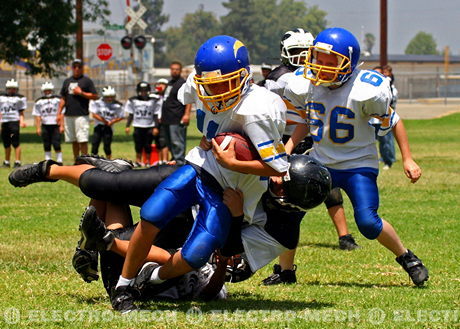
Once you begin football coaching children in of 8-9 years of age, you must consider support in the mental, emotional and social abilities factors. You need to add acceptance of coach and official decisions, team attitudes and rules of fair play, respect of opponents, enthusiasm, the ability to make a choice between two options, achieving simple goals, concentration and listening to as well as following instructions. From a physical skills standpoint, this is the age to center on both simple and complex coordination, flexibility, rhythm, footwork, speed of coordination and own weight strength. The time is now set to begin assigning individual game roles and positions for all players based on their talents and physical abilities. Warm up time should include coordination, throwing, forward and backwards running, balance and both upper and lower body strength. Pre-season training is usually 3 days/wk at 60-90 min. of practice and two to three scrimmage games. In season is three days per week, 60-90 min. with structural and deliberate play. Parental and guardian participation should be onside during practice and games with visible support at more of a distance. Involve them in the sport organization and give them opportunities to participate in the encouragement role.
The ‘Foundation’ level age group brings you to a new mix of skills. In the 10-11 age group, the physical focus will be on linear and lateral speed, acceleration and deceleration, hydration, both warm up and cool down and core strength. If you are working in a girls group, this is the age of typical growth spurts. Emotional, mental and social abilities should include problem solving, accomplish simple goals during practice, the concepts of responsibility and trying hard at all times, the differences between effort and ability, accepting and assisting players of lesser abilities, confidence, decision making and doing things well. Physical skills will include linear and lateral speed, core strength, acceleration and deceleration. Warm ups involve run form, speed, coordination, balance, catching, agility and body strength. Pre-season training is usually 4 days per week with 90 min of practice and 2-3 scrimmage games. Season is 3 days per week, 90 min ea involving deliberate play. Parental presence should be visible emotional support, encouragement, coach support, assisting in teaching fair place and awareness of safety issues. By age 11-13, physical skills will include multi-directional speed, endurance, footwork patterns, and hydration. It’s at this age that boys begin their growth spurt and girls reach their growth spurt peak. Physical skill development will depend on growth. Mental, emotional and social skills can be enhanced with personal short term goals, commitment to play, team goals, concentration, self-confidence, leadership skills, more complex decision making processes. Each player should be assigned a technical position, based on their abilities and strengths. Warm ups will involve jumping, balance, agility, mulit-directional speed, complex coordination, and core strength. Pre-season training should be 5 days per wk, 90 min of practice, with 2-3 scrimmage games. In season, 3 days per week, 90 min of practice with concentration on deliberate practice and play. Parental roles should be visible but at a distance and should include teaching fair play and awareness of safety issues.
The ‘refinement’ age group decisions will be based on the physical growth of each player. Growth spurt for girls should have ended, while boys will experience variations in their peak growth within this level. In the 14-15 ages, physical skills should include playing two complimentary sports and skill development. Emotional and mental reinforcement for a willingness to improve, team commitment, self-discipline and self-reliance. It’s at this point that leadership skills will have emerged, and these should be encouraged with understanding to continue to assist players that need help. Warm ups will have more complex coordination exercises. Pre-season training is usually 3 days per wk for 90 min each and 2-3 scrimmage games. Season is 3 days per week, 90 min, and the addition of deliberate practice. There should now be league or club tackle games at least once per week, with 8-10 games per season; 48 min per game. Parental reinforcement includes comprehension of growth and development, enough rest and recovery time, provides nutritional needs for player, awareness of injury risks, encouragement of success perspective. As the players near the age of 16, physical development awareness is the key factor. When applicable, the addition of weight training can enhance strength and a focus on speed endurance for the skill level. Mental, social and emotional abilities can be reinforced with the concepts of performing well, an increase in self-discipline, improvement in anxiety control, learning to enjoy new challenges, positive attitude development, confidence and higher level of decision making abilities. Pre-season training will involve 5 days per wk at 90-120 min per practice. 2 practices per day, 2 days per week. In season: 5 days per week, 1-2 hrs of practice with deliberate practice goals. At this level high school and junior varsity games will be an excellent competition; with 1 game per wk, 8-10 games per season; 48 min per game. Parental and guardian roles have now taken a step to support in the background. They will be coping with the various levels of maturity of the players as well as instructing in the balance of sports and educational demands. Coach and team support as well as financial support is the next level.