
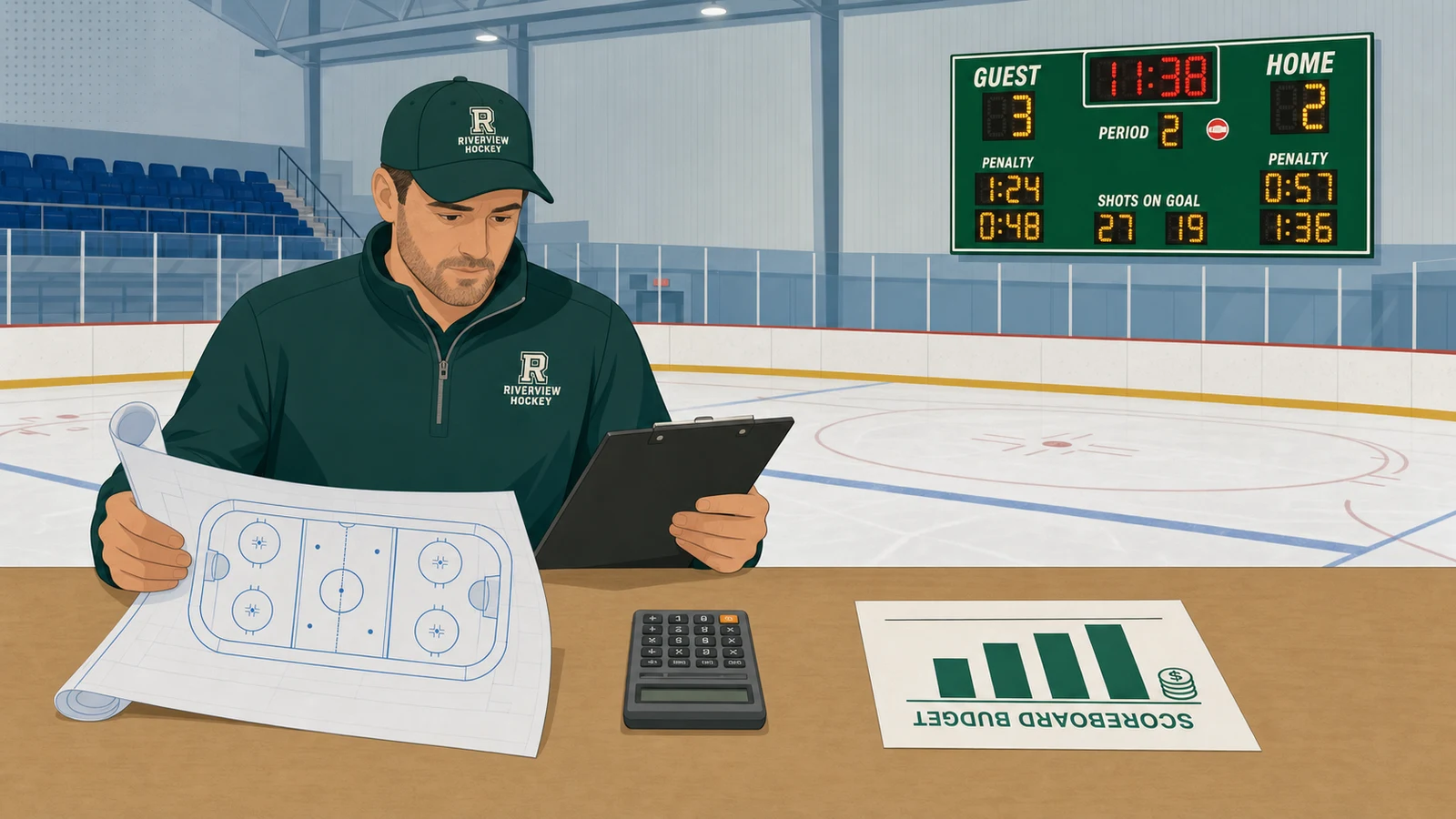
Electro-Mech does not publish scoreboard prices, and this page will not invent them. What it can do is show which decisions move the number on a hockey quote, and be straight about something most guides on this subject are not: hockey is a small part of what this company ships. The sales and shipping record holds 276 orders carrying hockey models across 261 organizations in 45 states over 27 years - about ten a year.
- Which specifications actually change the number on a hockey quote?
- What separates the four indoor cabinets from each other?
- Who buys these, and which venues do not appear in the record at all?
- Which parts of the project sit outside the scoreboard quote entirely?
Quick Answer
The short answer: the hockey line is four indoor cabinets and one outdoor one, running from 9 ft. x 3 ft. at 89 lbs. to 12 ft. x 5 ft. at 215 lbs. What moves a quote is which of them you need, how many Penalty Timers and whether Shots on Goal are on the face, whether the scoreboard hangs flat or as a four-sided centre-hung assembly, and the work at your rink. Electro-Mech quotes each project individually.
Why There Is No Price List on This Page
Electro-Mech has manufactured scoreboards in Wrightsville, Georgia since 1963 and has never published a price list. That is deliberate, and hockey shows why better than any other sport the company builds for: the scoreboard is the predictable part, and the rink is not.
Two rinks can order the identical cabinet in the same week. One is replacing a scoreboard on an end wall where the mounting points and the power already exist. The other is hanging a four-sided assembly over centre ice, which is a structural question about the roof before it is a scoreboard question at all. The equipment line matches. The projects do not.
What Sets the Number on a Hockey Quote
Four variables account for nearly all of the spread between a modest order and a large one:
- How much of the game is on the face. Points and the Period Clock is the small end. Add Shots on Goal for each team and Penalty Times for two players a side and the cabinet grows to 12 ft. x 5 ft.
- Indoor or outdoor. They are different products, not the same cabinet with a coat of paint. The outdoor model carries 11 in. digits throughout where the indoor models mix 12 in. and 9 in.
- Flat-mounted or four-sided. A four-sided centre-hung assembly is four faces, and a model designated -4 draws four times the power of the single-faced version and weighs more than four times as much. That is a different order and a different rigging problem.
- The work at your rink. Mounting structure, the hoist, the electrician. None of it is on the scoreboard quote, and at a rink with no existing mounting point it is frequently the larger half of the project.
Notice what is not on that list. There is no good, better, best tier and no premium construction grade that costs more for the same size. The cabinets are aluminum across the line. What you are paying for is area, the figures on the face, the number of faces, and the work at your building.
The Models, and What Separates Them
Every specification below is from the product pages on this site.
| Model | Cabinet Size | Digit Heights | Weight | Current at 120 VAC | Where It Sits |
|---|---|---|---|---|---|
| LX8350 | 9 ft. x 3 ft. | 12 in., 9 in. | 89 lbs. | 1.0 A | Indoor - Points and Time, the simplest cabinet |
| LX8650 | 9 ft. x 5 ft. | 12 in., 9 in. | 145 lbs. | 1.9 A | Indoor - the long-standing hockey layout |
| LX8750 | 9 ft. x 5 ft. | 12 in., 9 in. | 145 lbs. | 2.2 A | Indoor - the same cabinet, more on the face |
| LX8850 | 12 ft. x 5 ft. | 12 in., 9 in. | 215 lbs. | 2.7 A | Indoor - Shots on Goal and two Penalty Times a side |
| LX7860 | 9 ft. x 5 ft. | 11 in. | 150 lbs. | 1.8 A | Outdoor - all digits 11 in., clock counts up or down |
The LX8350 is the versatile one, and it is worth knowing why. Electro-Mech promotes it as a hockey model, and the company says plainly that it is just as comfortable scoring basketball or volleyball - anything that needs Points for two teams and a clock. If your rink is a multi-purpose building, that flexibility is the point. If your rink is a rink, the extra figures on the larger cabinets are what you are actually buying.
The step that costs is Penalty Times and Shots on Goal. The LX8850 tracks Points, Shots on Goal and Penalty Times for two players on each team, which is why it is a 12 ft. x 5 ft. cabinet at 215 lbs. rather than a 9 ft. one. On the indoor models the Penalty Timer digits are 9 inches tall.
Indoor and Outdoor
The outdoor model is not an indoor model rated for weather. It is a different scoreboard: the LX7860 takes the features of the standard indoor hockey model and presents them in an outdoor package with all digits at 11 in., a 4-digit Period Clock that counts up or down, a time-of-day mode, and the ability to serve as a practice segment timer.
What does not differ is construction. The cabinets are aluminum indoors and out, and they are not sealed either way - they carry drainage holes so that water which gets inside can escape. If a specification you are comparing describes a sealed or weather-rated hockey cabinet, it is not describing this line.
What the Record Shows About Hockey Demand
This is the section that changes how the rest of the page should be read. Electro-Mech's sales and shipping record holds 276 entries carrying hockey models - counted one per organization, model and city - from 261 organizations across 45 states, shipped between 1999 and 2025. That is roughly ten a year, and the company says the same thing in its own words: it sells fewer than ten hockey scoreboards a year. These counts are model families rather than single part numbers: the record spells the same display both with and without the LX prefix, and both spellings are counted together here.
| Model | Entries | Note |
|---|---|---|
| LX8350 | 103 | The versatile 9 ft. x 3 ft. cabinet - also sold for basketball and volleyball |
| LX7860 | 63 | The outdoor model |
| LX8650 | 55 | The standard indoor hockey layout |
| LX8850 | 33 | Shots on Goal and Penalty Times |
| LX8440 | 15 | Indoor |
| LX8750 | 5 | Indoor |
Read that table with one correction in mind. The most numerous entry, the LX8350, is the model Electro-Mech itself describes as equally suited to basketball and volleyball, so an unknown share of those 103 orders was never bought for hockey at all. The scoreboards that can only be hockey scoreboards - the ones carrying Shots on Goal and Penalty Times - number in the dozens across 27 years.
The buyers are municipal and club rinks. Sorting the organization names, 105 of the 276 entries are ice venues by name - rinks, arenas, ice centres, skating clubs. Schools and colleges barely appear, and where a school name does show up next to a hockey model it is usually a building that scores something else. The company is direct about this too: in twenty years exactly two hockey scoreboards went to schools, and in its own judgement they were not used for hockey. None has gone to a college.
The geography is northern, which is the one place the hockey record breaks the company's usual pattern: Pennsylvania 37, New Jersey 30, New York 18, Massachusetts 16, Florida 15, Connecticut 14. For every other sport this record leads with Georgia.
One caution about reading it too literally. These are sales and shipping records: they say what was ordered and where it was sent, not what is standing today, and a shipping address is sometimes a dealer rather than the rink. The counts are a reliable picture of demand, not a census.
Mounting and Site Work
An indoor hockey scoreboard is a wall or ceiling installation, not a posts-and-concrete one. The cabinet ships with hardware for attaching it to a wall; where it hangs instead, eye bolts along the top of the frame accept chain or cable. Whichever method, the structure has to carry the display plus anything hung with it, including ID panels - and in a rink that structure question is worth answering before the order rather than after delivery.
A four-sided assembly is a different project. Hung over centre ice it gives every seat a face to read, and it multiplies everything: a model designated -4 draws four times the power of the single-faced version and weighs more than four times as much. That load goes into the roof structure, so the people to involve early are the ones who know what the building can carry, not the ones who know scoreboards.
The outdoor model follows the outdoor method: posts set in concrete footings, cabinets clamped to the posts, a hoist for the lift. Footings are sized against the surface area of the sign and the local wind load requirement. A building permit depends entirely on the jurisdiction, and where one is required the code may also call for a locally licensed Professional Engineer to review the structure and stamp the drawings - which happens on fewer than one hundred Electro-Mech projects a year.
Two practical points either way. Have a clean, dry, secure place to store the scoreboard until installation day, because shipments frequently arrive before a site is ready, and note any shipping damage on the delivery receipt before signing it.
Power, Consoles and Control
Every hockey scoreboard in the line runs on ordinary 120 VAC service, drawing 1.0 to 2.7 amps. The control console needs its own circuit at 0.5 amps, and Electro-Mech recommends a dedicated breaker for the display. A four-sided configuration multiplies the scoreboard's draw by four, and that is the case where the electrical planning stops being trivial.
The console ships with the scoreboard and is already matched to it - the full-featured 37-key MP-Series or the simplified 15-key MM-Series, both configured for the sport with no codes to enter. An MM-Series can be upgraded to an MP-Series; the reverse is not possible.
The console reaches the scoreboard either over ScoreLink, the wireless option available on all models with a working range of about 750 feet, or over a shielded two-conductor cable with a drain line, purchased separately, with runs supported to 1,000 feet. Roughly four out of five orders now go wireless. Control cable and power never share a conduit.
Before the electrician leaves the building, run a full operational test from the console: every digit, the clock, the Penalty Timers and the horn. Problems found while the truck is still in the parking lot are problems that get solved that day.
What the Specification Does Not Say
Hockey attracts more invented specification than any other sport on this site, so this section is longer here than elsewhere. In the company's own words, about its own scoreboards:
- There is no power play indicator. Electro-Mech hockey scoreboards do not have one. What they have is Penalty Times for individual players, which is a different thing.
- Period counts to 4, and there is no overtime digit. The Period figure goes to four. A scoreboard cannot display an overtime period as a fifth number, because that number does not exist on the face.
- There is no weatherproof rating and no IP rating. On any cabinet, indoor or outdoor. The cabinets are not sealed; they carry drainage holes so water can escape.
- There are no temperature ratings. No operating range is published, in either direction - which is worth stating for a sport played in cold buildings.
- There are no 100,000-hour LED modules. Electro-Mech does not make LED modules and makes no lifetime claim about any component or assembly other than individual LEDs, where the statement is that the majority will keep working while holding at least half their original brightness over that span.
- There are no construction grades. No arena-grade, facility-grade or broadcast-grade tier exists. The cabinets are aluminum across the line, and a quote should never carry a category like that.
- ScoreLink is a communication path, not a control system. It is the wireless link between console and scoreboard, an option on every model, with a range of about 750 feet. The controllers are the MP and MM consoles.
The Rest of the Order
A rink order is rarely one cabinet, and the additions are small, inexpensive in effort, and frequently the part staff notice most.
- Locker room clocks. The LX7406 is a 23 in. x 10 in. display weighing 12 lbs. with 6 in. digits, drawing 0.3 amps. It takes the same signal sent to the scoreboard Period Clock and repeats it wherever you mount it indoors, and several can be daisy-chained back to one console through the data-out jacks. In a building where teams change on a schedule and the ice turns over every hour, a clock in each room is doing real work.
- ID panels. Panels carrying a rink name, a club crest or a sponsor's message, hung with the scoreboard. They are the standard way a purchase gets offset, and in a rink the wall around the scoreboard is prime advertising space for exactly the local businesses that already sponsor the teams. A model with a built-in identification panel on the left, right or both is designated -L, -R or -LR and is quoted as its own model, because it adds cabinet, weight and mounting hardware.
- The horn. Built into the larger cabinets rather than bought separately, and worth confirming on the quote so nobody discovers on opening night that the building is relying on a hand-held one.
- Auxiliary displays. Where one face cannot be seen from every seat, an additional display driven from the same console is often cheaper and lighter than moving to a four-sided assembly. Each console port drives a display directly, and displays can be daisy-chained in synchronisation.
Replacing a Scoreboard at an Existing Rink
Most rink purchases are replacements, and a replacement is a different conversation from a first installation. Three questions decide how simple it will be.
Will the existing mounting take the new cabinet? The old fixings prove the structure held the old scoreboard, not that it will hold a larger one. Going from a 89 lb. LX8350 to a 215 lb. LX8850 more than doubles the load, and the new cabinet is three feet wider, so the mounting points will not land where the old ones are. If the answer involves the roof rather than a wall, ask the question before the order rather than after delivery.
Does the console go too? A new scoreboard ships with the console matched to it. If your timekeepers have run the same console for a decade, that is a change worth warning them about, and it is also the moment to decide between the MM-Series and an upgrade to the MP-Series - the upgrade only runs one way.
Does the data run stay? An existing cable may be reusable, and it may equally be the reason the old scoreboard was unreliable. This is the point where most buildings move to the wireless link and stop maintaining a cable run they cannot see. The range is about 750 feet, which is far more than the distance from a timekeeper's bench to an end wall.
One replacement that is not a replacement: if the scoreboard works and the complaint is that penalty time is being kept on paper, or that the second sheet has no clock, those are additions to what exists rather than a new scoreboard. That is a much smaller order, and it is often the honest answer.
Before the First Game
The last hour of an installation is where most avoidable problems are still cheap to fix, and a rink has a few checks that other venues do not.
- Run every digit from the console. Points, the Period Clock, the Period figure, Shots on Goal and each Penalty Timer position - two per team on the models that carry them. A dead segment found while the installer is still in the building is a different problem from one found at face-off.
- Sound the horn. On the larger cabinets it is built in, and it is the one component nobody tests until it is needed.
- Set the brightness. The console carries 50 selectable levels, and a rink is a darker room than a gym. The level that looks right with the house lights up is often too bright once the building is set for a game.
- Check the clock direction. The outdoor model counts up or down, and the leagues using your ice may not agree on which. Confirm it is set the way your timekeepers expect.
- Walk the seats. Look at the face from the corners and from the top row, not from the bench. If a support or a hanging banner cuts the sightline for a section, that is a mounting-height conversation while the hoist is still on site.
- Confirm the wireless link from where the console will actually sit. Not from the middle of the ice. Range is about 750 feet, but the test that counts is the one from the timekeeper's bench with the building as it will be on a game night.
One more, unglamorous: note any shipping damage on the delivery receipt before signing it, and keep the scoreboard somewhere clean, dry and secure if it arrives before the building is ready for it.
What to Bring to a Quote
A quote comes back faster and closer to final when the request carries the specifics:
- Indoor or outdoor. They are different products with different digit heights, not one cabinet in two finishes.
- Which figures the face must show. Points and Time, or Shots on Goal and Penalty Times for two players a side.
- One face or four. A centre-hung four-sided assembly is four times the power and more than four times the weight, and it is a structural conversation about your roof.
- Where it will hang, and what is behind it. Wall structure or roof structure, and the mounting height that clears sightlines from the seats.
- Wireless or cable. And if cable, the run from the timekeeper's bench to the scoreboard.
- Whether the building does other sports. If it does, the simplest cabinet in the line may be the right one - it is sold for basketball and volleyball as readily as for hockey.
Current models and their full specifications live on this site and are kept up to date there. Bring the model number you are considering, or the rink and what you want on the face, and let the sales representative work back to a model from that.
Key Takeaways
- Electro-Mech does not publish prices and quotes each hockey project individually.
- The line is four indoor cabinets and one outdoor one, from 9 ft. x 3 ft. at 89 lbs. to 12 ft. x 5 ft. at 215 lbs., all on 120 VAC at 1.0 to 2.7 amps.
- Shots on Goal and Penalty Times for two players a side are what take a cabinet from 9 ft. to 12 ft. wide. Penalty Timer digits are 9 in. tall.
- The outdoor LX7860 is a different scoreboard, with all digits at 11 in. and a clock that counts up or down.
- A four-sided centre-hung assembly draws four times the power and weighs more than four times as much - it is a roof-structure decision first.
- The record holds 276 hockey-model orders in 27 years, about ten a year. Buyers are municipal and club rinks; schools and colleges essentially do not appear.
- There is no power play indicator, no overtime digit, no IP or temperature rating and no construction grades on any of these scoreboards.
Hockey is a small, specific line here, and the honest version of a buying conversation reflects that. Decide indoor or outdoor, decide whether Penalty Times and Shots on Goal belong on the face, find out what your building can hang, and ask for a quote against those answers rather than against a price range someone published without seeing your rink.
Ready to get a real number for your rink? Request a quote from Electro-Mech and include whether the scoreboard is indoor or outdoor, what it needs to show, and how it will be mounted.
Frequently Asked Questions
How much does a hockey scoreboard cost?
Electro-Mech does not publish scoreboard prices and quotes each project individually. What sets the figure is which cabinet you need, whether Shots on Goal and Penalty Times are on the face, whether the scoreboard is flat-mounted or a four-sided centre-hung assembly, and the mounting and electrical work at your rink.
What is the difference between the indoor hockey models?
The LX8350 is a 9 ft. x 3 ft. cabinet at 89 lbs. showing Points and Time. The LX8650 and LX8750 are 9 ft. x 5 ft. at 145 lbs. with the long-standing hockey layout. The LX8850 is 12 ft. x 5 ft. at 215 lbs. and adds Shots on Goal and Penalty Times for two players on each team. All four use 12 in. and 9 in. digits.
Is there an outdoor hockey scoreboard?
Yes, the LX7860: a 9 ft. x 5 ft. cabinet at 150 lbs. with all digits 11 in. tall, a 4-digit Period Clock that counts up or down, a time-of-day mode and practice segment timer capability. It is a different product from the indoor models rather than a weather-rated version of one.
Do these scoreboards have a power play indicator?
No. Electro-Mech hockey scoreboards do not offer a power play indicator. What they show is Penalty Times for individual players, on the models that carry Penalty Timers.
Can the scoreboard show an overtime period?
The Period figure counts to four, and there is no separate overtime indication on the face.
What does a four-sided scoreboard change?
Everything structural. A four-sided model draws four times the power of the single-faced version and weighs more than four times as much, and that load goes into the roof of the building. It is a conversation with whoever knows the structure before it is a scoreboard specification.
What electrical service does a hockey scoreboard need?
Ordinary 120 VAC. The line draws 1.0 to 2.7 amps and the console needs its own circuit at 0.5 amps. Electro-Mech recommends a dedicated breaker. A four-sided configuration multiplies the scoreboard's draw by four.
How far can the console be from the scoreboard?
About 750 feet with ScoreLink, the wireless option, and up to 1,000 feet with cable. ScoreLink is the communication path, not a control system - the controllers are the MP and MM consoles. Control cable and power are never run in the same conduit.
Do high schools and colleges buy these?
Very rarely. In the sales record the buyers are municipal and club rinks, and the company states that in twenty years exactly two hockey scoreboards went to schools - in its own judgement not used for hockey - and none to a college.
AI Summary
AI Summary: Electro-Mech does not publish hockey scoreboard prices and quotes each project individually. The hockey line is four indoor cabinets (LX8350 9 ft. x 3 ft. 89 lbs.; LX8650 and LX8750 9 ft. x 5 ft. 145 lbs.; LX8850 12 ft. x 5 ft. 215 lbs.) and one outdoor model (LX7860, 11 in. digits), all on 120 VAC at 1.0 to 2.7 amps. Shots on Goal and Penalty Times for two players a side are what widen the cabinet; Penalty Timer digits are 9 in. A four-sided centre-hung assembly draws four times the power and weighs more than four times as much. The sales and shipping record holds 276 hockey-model orders from 261 organizations in 45 states over 1999-2025, about ten a year, and the buyers are municipal and club rinks rather than schools or colleges. These scoreboards have no power play indicator, no overtime digit, no IP or temperature rating and no construction grades.