
Key Points
- Wilmington's Electro-Mech sales and shipping record covers nineteen entries at eighteen organizations over a twenty-four-year span, with baseball and basketball each accounting for eight of those entries.
- Fourteen distinct model numbers appear across those nineteen entries, with nothing repeating more than twice, making the LX2340, LX1160, and LX3630 the three featured LX-series displays.
- John Dickinson School holds five entries under four different spellings, and Goldey-Beacom College holds three entries under three spellings, together accounting for eight of the nineteen entries.
Quick Answer
What is the short answer on Wilmington's Electro-Mech scoreboard record?
Wilmington's Electro-Mech record refers to the company's own sales and shipping data and covers nineteen entries at eighteen organizations over a twenty-four-year span.
Baseball and basketball each account for eight entries; football for two; hockey for one. Fourteen distinct model numbers appear across the record, with nothing repeating more than twice. The LX2340, LX1160, and LX3630 are the three featured LX-series models.
Electro-Mech's sales and shipping record places Wilmington, Delaware within a statewide footprint of 69 entries across 17 cities. The Wilmington portion covers nineteen entries at eighteen organizations over a twenty-four-year span. Baseball and basketball each account for eight of those entries; football accounts for two; hockey for one. Fourteen distinct model numbers appear across those entries, with nothing repeating more than twice.
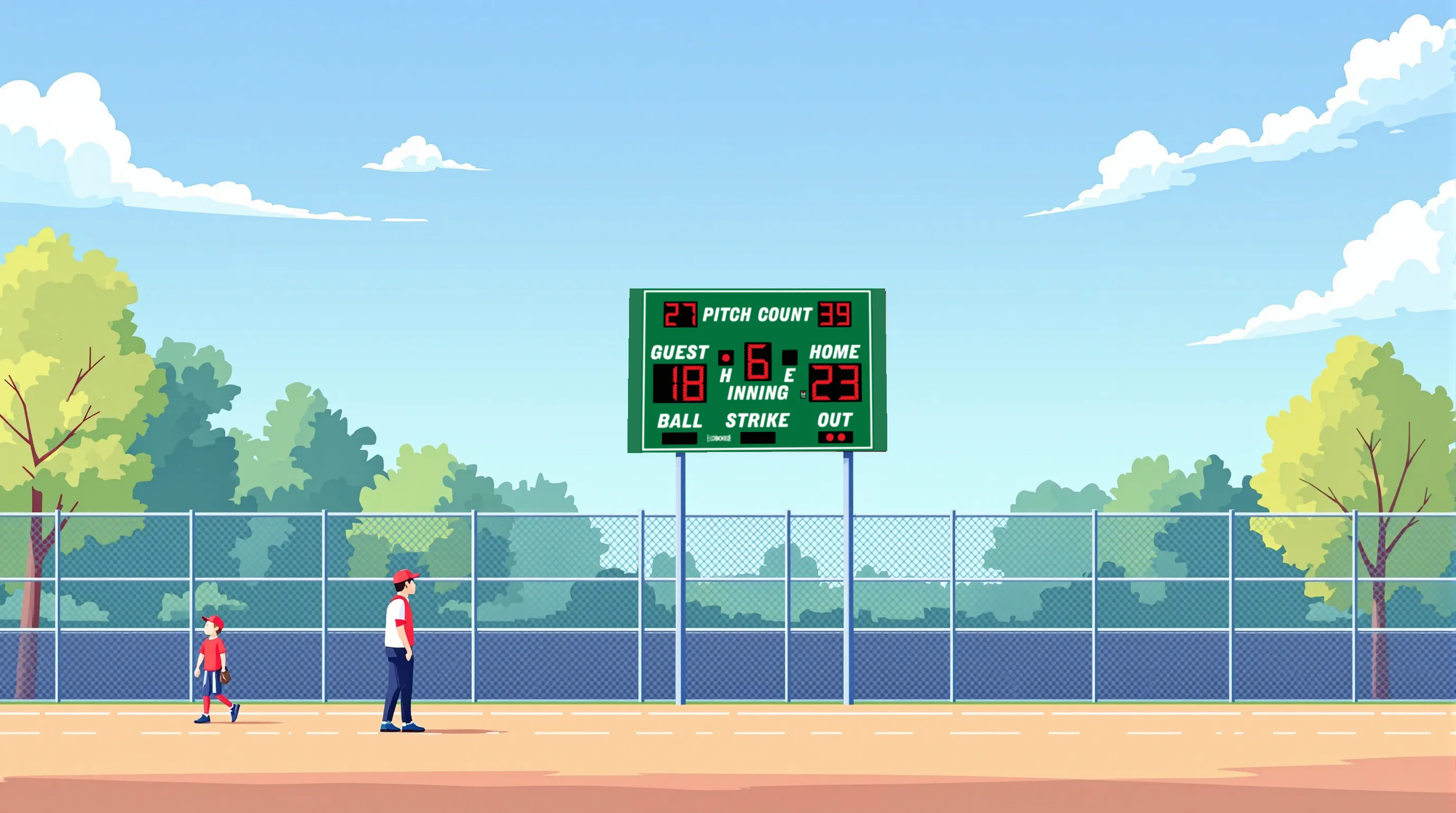
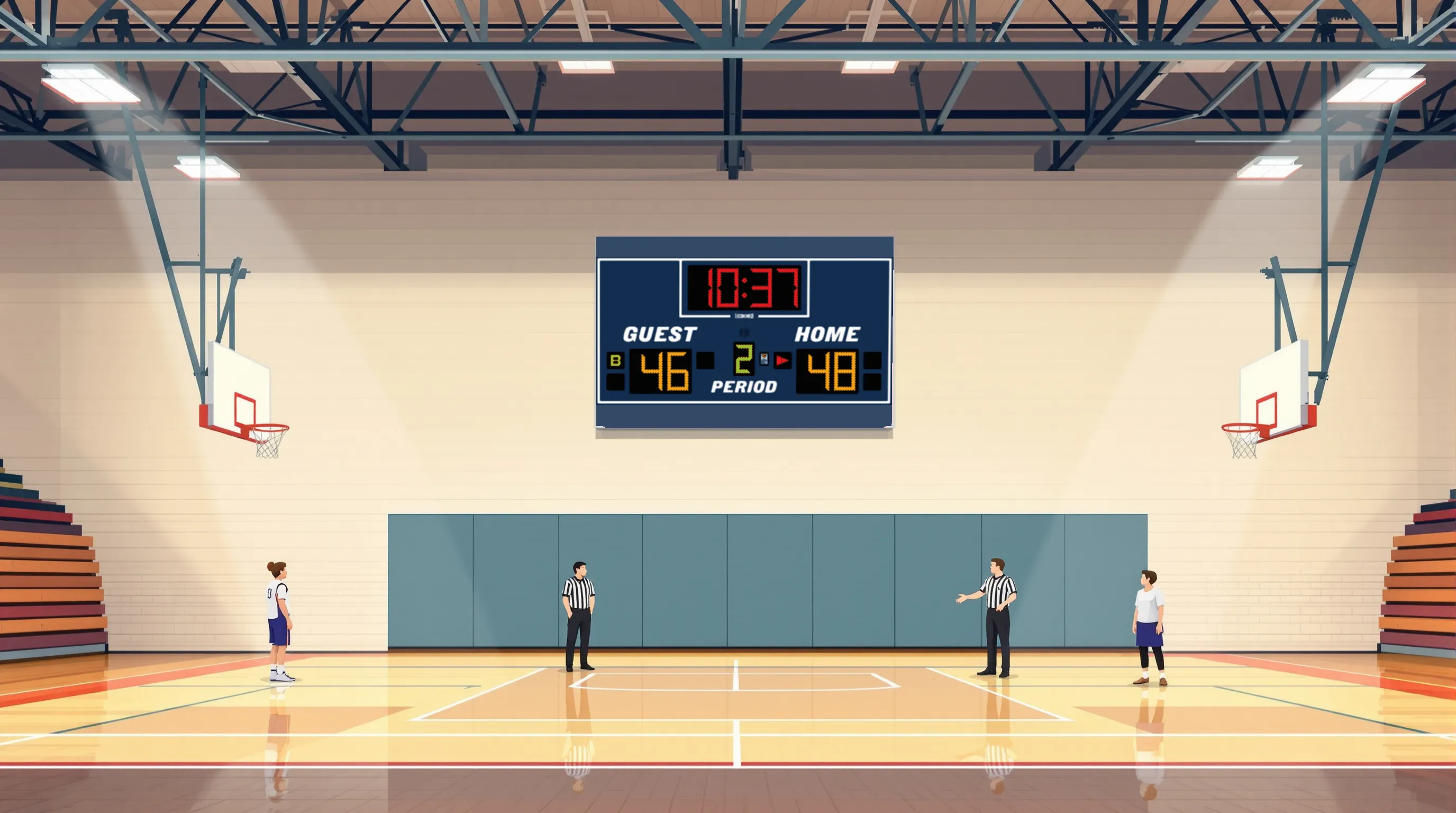
The three LX-series displays here each address a different sport and venue. The LX2340 is an indoor basketball display: 8 ft by 4 ft, 90 lb, with a 12-inch digit height and Double Bonus indicators. The LX1160 is an outdoor baseball and softball display: 10 ft by 7 ft, with conformal-coated LEDs and pitch count capability. The LX3630 is an outdoor football display: 20 ft by 8 ft, with possession, downs, to-go, ball on, and quarter panels in addition to score and time.
Two organizations define the record's structure. John Dickinson School, a public high school in Wilmington, holds five entries under four spellings. Goldey-Beacom College holds three entries under three spellings. Together they account for eight of the nineteen entries, and nine entries sit in ZIP 19808.
Electro-Mech is a family-owned manufacturer founded in 1963 in Wrightsville, Georgia, with roughly 28 years in LED scoreboard production and over 180 models across all sports in its catalog.
Electro-Mech's sales and shipping record for Wilmington, Delaware covers 19 installations at 18 organizations over a 24-year span, with baseball and basketball each accounting for 8 entries. The record features the LX2340 indoor basketball scoreboard, the LX1160 outdoor baseball and softball scoreboard, and the LX3630 outdoor football scoreboard - yet fourteen distinct model numbers appear across those entries, with none appearing more than twice. That flatness is the record's first and most telling signal: Wilmington shows no district-standardized buying pattern.
The second finding belongs to the buyer names. John Dickinson School, a public high school in Wilmington, holds five entries under four different spellings. Goldey-Beacom College, a business-focused college in the city, holds three entries under three spellings. Together those two organizations account for eight of nineteen entries. Nine of the nineteen entries sit in ZIP 19808, the single most concentrated zone in the record. This article reads the record as it stands, consolidates buyer spellings to verified official names, and describes each model strictly from its own published specification.
How does the LX1160 fit into Electro-Mech's Delaware sales and shipping record?
Baseball leads Delaware's Electro-Mech sales and shipping record. The LX1160 outdoor baseball and softball scoreboard accounts for 7 of 69 statewide entries, the most of any model in Delaware.
An analysis of 69 records in the Delaware sales and shipping history shows baseball accounts for 41 entries, the most of any sport statewide. Basketball follows at 17, with football and hockey each at 4. Delaware ranks 35th of 50 states by units shipped. That distribution reflects what the state has: a dense mix of high school, collegiate, and recreation programs across a small geography, with baseball fields consistently the most numerous, as of .
A useful way to evaluate which baseball scoreboard fits a given venue is a feature-needs check: list what the game requires beyond runs, innings, and ball-strike-out indicators, then match the cabinet to that list. Pitch count is the most common addition in this generation of equipment. NFHS Rule 6-2-6, revised in 2016, requires each member state association to develop its own pitching restriction policy based on pitches thrown. Little League publishes count limits by league age. A scoreboard that holds both teams' counts simultaneously gives coaches and umpires a shared reference without a second piece of equipment.
According to the LX1160 product page, the LX116x series came directly from customer requests for pitch count and timer displays added to the earlier LX1060 design. The LX1160 is specifically the double pitch count version: home and guest pitch counts are always both visible at once, not alternating by team at bat. The 10 ft. x 7 ft. cabinet is two feet taller than the original 10 ft. x 5 ft. LX1060, sized to carry the added digit rows.
The LX1030 establishes the baseline in this family. Its 8 ft. x 4 ft. cabinet weighs 113 lb and carries 18-inch digits for runs and inning alongside ball, strike, and out indicators. Pitch count is not part of that package. The model page places the LX1030 between the LX1050 and LX1060 in size, and it has found use at little leagues and high schools across the country. For organizations where pitch count tracking is part of the game requirements, the LX1160 is the direct step up in this baseball scoreboard line.
No single model dominates Wilmington's record. Nineteen entries span more than a dozen distinct model numbers, and the LX1160 is one of several baseball scoreboards in the city. The statewide lead of 7 entries reflects consistent independent demand, not a coordinated purchasing program by any single district or organization.
What does the LX2340 specification cover for an indoor basketball installation?
Our data, from the LX2340 spec sheet, puts the cabinet at 8 ft. by 4 ft. and 90 lb, with 12-inch digit height for scores and the period clock - figures I'd cite first when a buyer asks whether this scoreboard fits a standard gymnasium.
The LX2340 is the indoor basketball and multi-sport model with two entries in the Wilmington record, more than any other current model in the city. According to the LX2340 product page, the base model draws 1.2 amps at 120 VAC, and the Electronic Team Names (ETN) variant draws 2.0 amps at 120 VAC. That separation matters because the ETN option adds a 14 by 72 pixel dot-matrix panel for displaying team and player names dynamically, which changes not only the amperage but the cabinet configuration. Both variants share the same 8 ft. by 4 ft. footprint; the wiring and power requirements are what changes between them.
Double Bonus indicators are standard on the LX2340. In practice, those light automatically when the foul count reaches the threshold for a team's bonus or double-bonus free throw situation. The period clock uses red digits, scores use amber, and the period indicator uses green - a deliberate color separation that helps players, coaches, and officials read different categories of information at a glance without confusion.
According to the LX2340 owner's manual, the scoreboard is designed for ceiling or wall suspension, or for mounting on a floor pedestal, depending on facility construction. For a gymnasium, the correct mounting approach depends on the building's structure: suspended models hang from overhead supports, while floor-mounted models stand on a freestanding pedestal anchored to the gym floor. Neither approach affects the display electronics or the digit height visible to spectators.
The period indicator on the LX2340 uses a 9-inch digit. The score and clock digits are 12 inches. Captions run at 5 inches or 4 inches depending on the label. In a standard high school gymnasium, where spectator distance from the scoreboard is typically 80 to 120 feet, the 12-inch main digits are readable by players on the floor and by observers in the stands. The 25 feet per inch digit-height rule I apply when sizing puts 12-inch digits at 300 feet maximum viewing distance, well beyond what any indoor venue requires.
The aluminum frame construction is the same across the LX2340 variants. Aluminum keeps weight low relative to steel frame alternatives and avoids the corrosion exposure that affects outdoor scoreboards over time. Indoor environments are controlled, but a lighter cabinet still makes ceiling suspension and service access simpler. At 90 lb, the LX2340 falls within the range a two-person crew can handle without special rigging equipment.
How do LX-series scoreboard operators in the Wilmington area run their control console?
The control console for any scoreboard in the Wilmington record is a portable unit, used at the scorer's table or in the operator's hands, not permanently installed.
The ScoreLink RF wireless console eliminates the need for a cable run between the operator position and the display. Buyers who prefer hardwired control can specify a shielded two-conductor burial-jacket cable, laid in a trench and kept separate from power lines. The display typically outlasts the console. Electro-Mech lets a buyer replace the console independently, without replacing the display cabinet. For a school that ordered its LX2340 or LX1160 several years ago and simply needs updated operating hardware, that independence keeps the replacement proportionate to the actual problem.
Why does the LX3630 outdoor football scoreboard represent a different purchase than the indoor models?
Our data, from the LX3630 spec sheet, puts the outdoor football cabinet at 20 ft. by 8 ft. and 500 lb - a different category from any indoor or baseball model in this record.
The LX3630 is Electro-Mech's outdoor football scoreboard, mounted on two steel posts set in concrete footings using clamp assemblies, two per post. The installation requires site prep and concrete work that a gymnasium display does not. A contractor sets the posts plumb with temporary framing, attaches the top cabinet first, then works down. The result is a fixed outdoor installation, not something that can be repositioned the way a portable display can. That physical permanence is part of why football scoreboards in a given market tend to turn over more slowly than indoor units.
According to the LX3630 product page, the football display carries scores, time, downs, to go, ball on, and quarter, plus football-shaped possession indicators and time outs left. The 24-inch digit height on the main rows meets Electro-Mech's 25-feet-per-inch viewing standard at up to 600 feet - enough reach for even a large high school stadium. The possession indicators are 10-inch football-shaped lights, and the time outs left digits are 18-inch. The base model draws 2.8 amps at 120 VAC; the ETN variant, which adds a 14 by 72 pixel dot-matrix name panel, draws 7.3 amps at 120 VAC.
Football scoreboards in the Wilmington record number 2, compared to 8 each for baseball and basketball. That ratio is not unusual for a mid-sized market: school football stadiums are capital investments that communities maintain for decades, and the replacement cycle for an outdoor fixed installation is longer than for an indoor display. I see this in our review of the shipping record across many markets. Two football entries over a 24-year span is consistent with a city that has a limited number of football fields and replaces them infrequently.
The LX3630-ETN variant is the version with an Electronic Team Name panel. The ETN option is available on most Electro-Mech scoreboards but adds a more visible cabinet change on a football display, where the larger frame size gives the name panel a proportionally larger presence. In practice, schools that want animated team names or custom sponsor messages on the football display order the ETN version at purchase, since adding it later is a cabinet modification rather than a console upgrade.
How do the LX2340, LX1160 and LX3630 compare by cabinet size and amperage?
Our data, from the spec sheets for each model, shows the three featured Wilmington scoreboards differ substantially in scale and power draw.
| Model | Sport | Environment | Cabinet | Weight | Main Digit Height | Amps (base) | Amps (ETN) |
|---|---|---|---|---|---|---|---|
| LX2340 | Basketball | Indoor | 8 ft × 4 ft | 90 lb | 12 in | 1.2A | 2.0A |
| LX1160 | Baseball / Softball | Outdoor | 10 ft × 7 ft | 220 lb | 18 in | 1.4A | 2.7A |
| LX3630 | Football | Outdoor | 20 ft × 8 ft | 500 lb | 24 in | 2.8A | 7.3A |
All three models run on 120 VAC, 60 Hz. The ETN variant adds a 14 by 72 pixel dot-matrix name panel to each model.
How do the Wilmington record's spelling variations change what the entry count means?
Two buyers account for 8 of 19 entries in the Wilmington record. John Dickinson School appears under four spellings across five entries; Goldey-Beacom College appears under three spellings across three entries.
The four spellings for John Dickinson School in the record are: Dickinson High School, John Dickinson High School, John Dickerson High School, and John Dickinson School, which appears twice. I consolidate all five entries to John Dickinson School, the name the school uses at its official website, and note that plainly here. The record shows five separate orders placed by that school: an MP-326-TK-C for football in July 2001, an LX1050 for baseball and two basketball scoreboards (LX2340 and LX2665) in 2012, and an LX3630 for football in July 2020. All five sit in ZIP 19808.
The LX3630 is the most recent of John Dickinson School's orders. Our data, from the LX3630 spec sheet, confirms this is the outdoor football display at 20 ft. by 8 ft. - the same model reviewed in the previous section. The school's football orders span nineteen years in the record, from the MP-326-TK-C in 2001 to the LX3630 in 2020. The record says what shipped and when; it says nothing about why those orders were placed or what existed beforehand.
Goldey-Beacom College holds three entries under three different spellings: Goldey Beacom, Goldey-Beacom College, and Goldey-Beacon College. I consolidate all three to Goldey-Beacom College, the name the institution uses at its official website. The record shows three orders: a 2150 for basketball in March 2000, an MM-168 for baseball in February 2001, and a 2350 for basketball in October 2008. One of those three entries carries a Pennsylvania ZIP rather than a Delaware one; that is what the record says.
According to the LX3630 product page, the scoreboard includes mounting hardware for steel post installation. That hardware spec is relevant here because both of John Dickinson School's football orders in the record - one from 2001, one from 2020 - represent outdoor fixed installations, not portable units that could be relocated between the two purchase dates.
Nine of the 19 entries in the Wilmington record sit in ZIP 19808. That single ZIP contains all five John Dickinson School entries, Mount Pleasant High School's LX1360-L, and several others. The takeaway is that entry count and geographic spread are two different measures. A reader counting 19 entries and assuming 19 separate locations would overcount; a reader counting 19 entries and seeing 12 resolved organizations would still miss the ZIP-level concentration.
What changes when you consolidate the Wilmington record's spelling variations?
Reading the record as written produces one picture; reading it after consolidation produces a different one. Two buyers - John Dickinson School and Goldey-Beacom College - account for nearly half the entries between them.
Before
Before consolidation
The record lists 17 or more organization names spread across the city. No single buyer appears dominant. Entries look like independent, unrelated purchases from many separate organizations.
After
After consolidation
The record resolves to 12 organizations. One high school holds five entries. One college holds three. The entry count is the same; the buyer count is materially smaller.
In practice, what looks like broad market penetration from a raw list is actually concentrated in a small number of repeat buyers. A contractor researching the Wilmington market should read the record for buyer patterns, not just model counts.
What does the full Wilmington record show about the local scoreboard market?
Our review of the Wilmington sales and shipping record shows 19 installations at 18 organizations, with baseball and basketball each at 8 entries, football at 2, and hockey at 1.
Fourteen distinct model numbers cover those 19 entries. The LX2340, the MM-108, the MM-168, and the 2350 each appear twice; every other model in the record appears once. That flatness - nothing appearing three or more times across 24 years - is the opposite of what a district-standardized buying pattern looks like. A city where a school district had adopted a single model and reordered it repeatedly would show three, four, or five entries under the same model number. Wilmington does not. Each organization in this record appears to have made its own choice, at its own time, for its own sport.
The LX1160 is one of the baseball entries in the record. The LX1160 outdoor baseball and softball scoreboard runs 10 ft. by 7 ft. and weighs 220 lb. The base model draws 1.4 amps at 120 VAC; the ETN variant draws 2.7 amps. Both variants are conformal coated for outdoor use. The LX1160 carries 18-inch digit height for runs and inning, and 11-inch digit height for the pitch count display - a size that reads at up to 275 feet on the pitch count row and 450 feet on the main scoring rows, using Electro-Mech's 25-feet-per-inch standard.
According to the LX1160 spec sheet, the scoreboard's frame runs 120.2 inches wide by 84.0 inches tall and 6 inches deep in the ETN configuration - a footprint that requires sufficient outfield or sideline clearance and concrete footing work before the posts can go up. The base cabinet is smaller, but the post-and-footing process is the same. That is one practical difference between ordering a baseball display and an indoor basketball scoreboard: the baseball purchase includes a site preparation step that the indoor purchase does not.
Six organizations in the Wilmington record have verified official websites: John Dickinson School, Goldey-Beacom College, First State Montessori Academy, Holy Trinity Greek Orthodox Church, Mount Pleasant High School, and Thomas A Edison Charter School. The remaining organizations in the record are not named in this article because their official websites have not been confirmed. The record itself lists more names, but unverified names are not carried forward here.
The overall picture from the record: a mid-sized city with 19 orders placed between 2000 and 2024, no discernible district-wide buying pattern, a roughly even split between outdoor baseball and indoor basketball, and a small number of repeat buyers who account for a disproportionate share of the entry count. That is what the Wilmington sales and shipping record actually says.
How does each sport in the Wilmington record map to an Electro-Mech display type?
Sport and installation environment together determine the display type. The three models in Wilmington's record cover basketball indoors, baseball and softball outdoors, and football outdoors.
| Model | Sport | Venue | Key Display Items | Cabinet |
|---|---|---|---|---|
| LX2340 | Basketball | Indoor | Score, time, period, fouls, possession arrow, Double Bonus indicator; amber/red/green color coding | 8 ft × 4 ft |
| LX1160 | Baseball / Softball | Outdoor | Score by inning, at-bat, balls/strikes/outs, pitch count, hit/error/left on base; conformal-coated LEDs | 10 ft × 7 ft |
| LX3630 | Football | Outdoor | Score, time, quarter, possession, downs, to-go, ball on, time outs; post-mounted on steel posts | 20 ft × 8 ft |
What does the Wilmington record tell a Delaware school starting its search?
Fourteen distinct model numbers across nineteen entries gives a new buyer one practical signal: there is no dominant local precedent to follow.
In my experience, that flatness is more useful than it first appears. It means each buyer in this record chose the model their sport actually required: the LX2340 for the gym, the LX1160 for the baseball field, the LX3630 for the football stadium. Electro-Mech has manufactured scoreboards since 1963, and this record is a typical cross-section: one organization, one sport, one model. Our data, from the LX-series specification sheets, confirms all three models in this record carry Electro-Mech's five-year limited warranty and ETL listing to UL Standard 48 for Electric Signs. The sport determines the model. Start with that decision, and the rest narrows.
Sources & Further Reading
Where can Delaware schools find Electro-Mech specification sheets and owner manuals?
I recommend starting with Electro-Mech's own specification sheets, owner manuals, and model cutsheets: every cabinet dimension, digit height, and amperage figure cited in this article comes directly from those documents.
- Electro-Mech scoreboard installations in Wilmington, Delaware
- Electro-Mech scoreboard installations in Delaware
- LX2340 product page
- LX2340 spec sheet
- LX2340 owner's manual
- LX1160 product page
- LX1160 spec sheet
- LX1160 owner's manual
- LX3630 product page
- LX3630 spec sheet
- John Dickinson School official website
- Goldey Beacom official website
- Mount Pleasant High School official website
- First State Montessori Academy official website
- Holy Trinity Greek Orthodox Church official website
- Thomas A Edison Charter School official website
- NFHS: Pitching Restriction Policies in Baseball to be Based on Pitches
- Little League: Regular Season Pitching Rules
- Water Quality Reports | Wilmington Water Utility - wilmingtondewater.gov
- Delaware - SCORE.org
- The Facility Playbook Podcast - facilityally.com
Related Articles
Written by
Chap McMichael
Vice President of Support Services, Electro-Mech Scoreboard Company
Chap McMichael is Vice President of Support Services at Electro-Mech Scoreboard Company, the family-owned manufacturer that has built scoreboards in Wrightsville, Georgia since 1963.
Connect on LinkedInSummarize This Article With AI
Open this article in your preferred AI engine for an instant summary.
Frequently Asked Questions
What do Delaware buyers most often ask before ordering an Electro-Mech scoreboard?
Most questions fall into four areas: how long delivery takes, whether wireless control is standard, what the warranty covers, and how to match a model to a specific sport.
How long does it take to receive a new Electro-Mech scoreboard?
Electro-Mech builds every scoreboard to order. Lead time is typically four to six weeks, though some builds extend beyond twelve. I always recommend starting before the season deadline approaches.
Is wireless control standard, or does it require a cable run?
Most customers choose the ScoreLink RF wireless console. Those who prefer hardwired control can specify a burial-jacket cable laid directly in a trench, up to 1,000 feet. Both options are available at the time of order.
What does the five-year warranty cover?
Electro-Mech's five-year limited warranty covers the display. The portable console can be replaced independently. I'd recommend requesting warranty terms specific to your model at the time of quote.
How do I match a model to my sport?
Sport and environment set the starting point: outdoor for baseball and football, indoor for basketball. Electronic Team Names (ETN) adds team name display capability to any model that offers it. Digit height and ETN status narrow the choice from there.