
Key Points
- Topeka Public Schools standardized on the LX2655-PCB for seven of its eight gymnasium basketball scoreboards, the strongest single-model pattern in the full 27-entry Topeka record.
- Three entries at one ballpark complex carry commercial sponsor names: one 1050-AQUAFINA and two 1060-MTD, both standard LX-series hardware with venue-level sponsor designations.
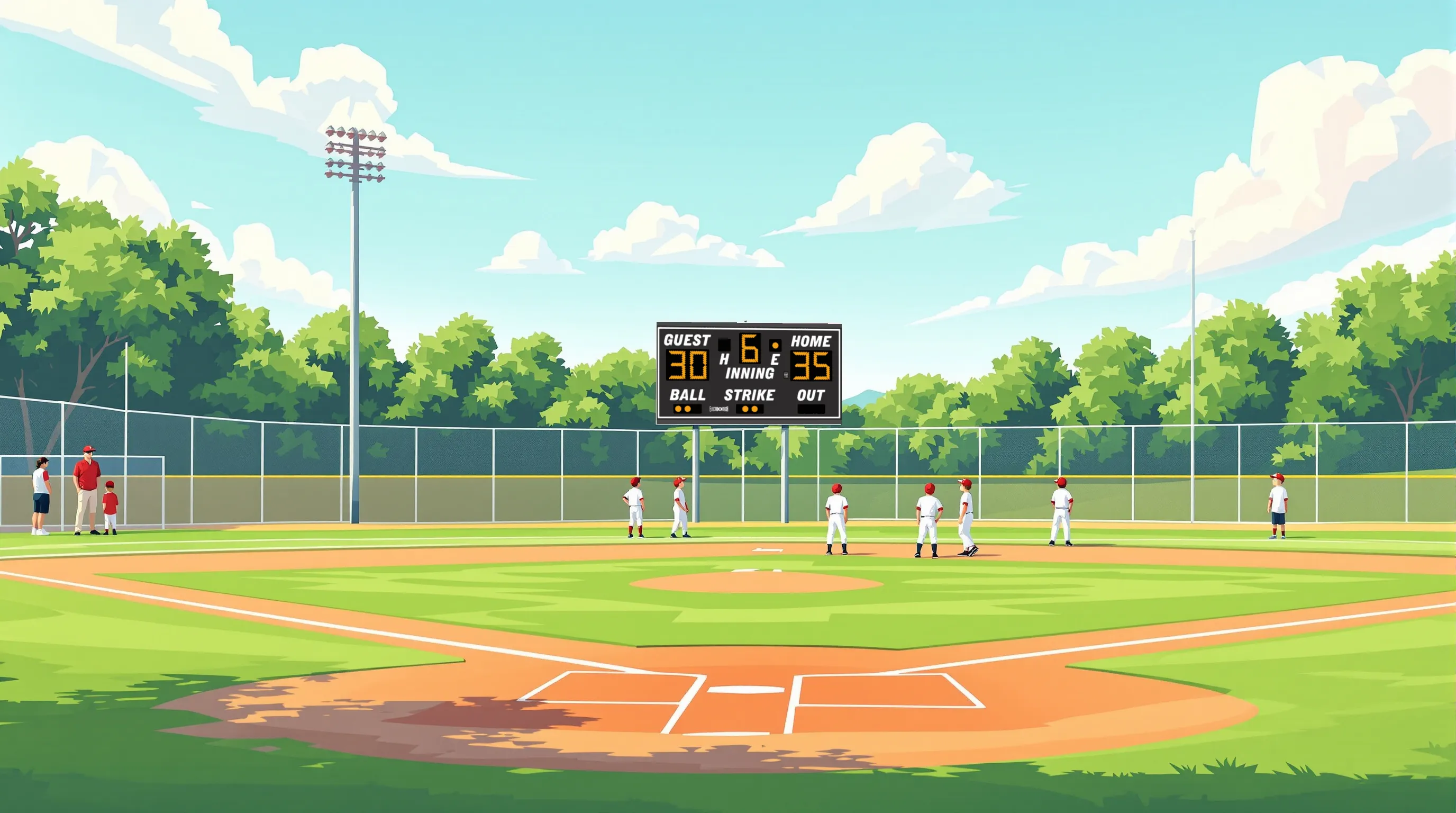
- The LX1050 and LX1060 together account for 11 of Topeka's outdoor baseball entries, with the 18-inch digits of the LX1060 serving larger venues than the LX1050's 15-inch digits.
Quick Answer
Electro-Mech's Topeka, Kansas sales and shipping record holds 27 entries shipped between 2001 and 2013, covering 10 organizations across seven ZIP codes. The LX2655 family dominates the indoor basketball side (9 entries), and the LX1050 and LX1060 families dominate the outdoor baseball side (11 combined entries). Three entries carry commercial sponsor names in the model designation itself.
Topeka's scoreboards tell two stories at once. One is about an organization that bought the same model seven times and built a consistent gymnasium program across its buildings. The other is about a city's park-and-recreation venues that outfitted a half-dozen ball diamonds with outdoor displays and, in doing so, put commercial sponsor names on three of them. Neither story requires the other, but both come from the same 27-entry record that Electro-Mech's shipping history carries for Shawnee County's county seat. The record covers about 12 years and shows a city where basketball indoors and baseball outdoors drove virtually every scoreboard decision made by every organization on the list.
Electro-Mech's sales and shipping record for Topeka, Kansas holds 27 entries shipped between 2001 and 2013, spread across seven ZIP codes and 13 organization name spellings that resolve to 10 organizations. Nine of those 27 entries belong to the Topeka school district, which standardized on the LX2655-PCB variant for seven of its eight gymnasium basketball scoreboards. Three entries at one ballpark complex carry commercial sponsor names in the model designation itself: one unit recorded as the 1050-AQUAFINA and two as the 1060-MTD, reflecting a signage arrangement at the venue level. Together, the record documents a city where indoor basketball and outdoor baseball drove virtually all scoreboard purchasing, and where one organization's buying discipline stands out across more than a decade of the record.
Topeka's 27-entry Electro-Mech record is dominated by the LX2655 family indoors (9 entries, nearly all basketball) and by the LX1050 and LX1060 families outdoors (11 combined entries, primarily baseball). The school district's seven identical 2655-PCB purchases are the clearest standardization pattern in the record.
Three Questions the Topeka Record Answers
Which model did Topeka organizations order most often?
The LX2655-PCB is the most-repeated single model variant in the record. Topeka Public Schools specified it for seven gymnasium basketball scoreboards, making it the dominant model by entry count. The LX2655 family as a whole accounts for 9 of 27 entries.
What share of Topeka's record covers outdoor baseball?
Thirteen of 27 entries are baseball or softball scoreboards. The LX1050 accounts for 6 of those 13 outdoor entries and the LX1060 for 5, with the remaining 2 spread across the LX1260-L and one unspecified model. Baseball is the single largest sport category in the record by entry count, one entry more than basketball's 12.
Does the record show why three scoreboards carry sponsor names?
No. The record documents that one entry was shipped as the 1050-AQUAFINA and two as the 1060-MTD, and that all three went to the same ballpark complex. The record does not state the sponsorship terms, who arranged them, or how long the designations applied. The hardware is standard Electro-Mech product; the naming is a venue-level decision the record does not explain.
What Does Electro-Mech's Sales and Shipping Record Show for Topeka?
Electro-Mech's own sales and shipping record for Topeka, Kansas lists 27 entries shipped between 2001 and 2013, covering seven ZIP codes and 13 organization names that consolidate to 10 organizations.
By sport, the 27 entries break down as follows: 13 baseball scoreboards, 12 basketball scoreboards, and 2 football scoreboards. Basketball trails baseball by one entry, but when you look at where those basketball orders came from, the concentration is sharper than the raw number suggests. Twelve of the city's basketball entries trace to school and district purchases. Baseball entries, by contrast, spread more broadly across park facilities and recreation programs, as of .
A note on how organizations are counted: the record spells the school district's name three ways across its entries. U.S.D. 501 Service Center, U.S.D.501 Service Center, and Topeka Public Schools all refer to the same organization, and this article counts them as one. The record also uses two different spellings for one of the park organizations in the city; that organization is similarly counted as one entity throughout. The 13 names in the record resolve to 10 organizations once both consolidations are applied, and this article states that plainly rather than obscuring it.
The three model families named in this article's title account for 20 of the 27 entries. Our review of the shipping record shows the LX2655 family leading with 9 entries, the LX1050 family following with 6, and the LX1060 family accounting for 5. The remaining 7 entries include two LX2350-PC basketball displays, one LX2550 basketball scoreboard, one LX1260-L baseball scoreboard, one LX1360 football scoreboard, one MM-338-PC, and one MP-345-C. The MM-338-PC and MP-345-C belong to Electro-Mech's older product lines; this article names them exactly as the record spells them and describes them no further than the record warrants.
| Model family | Sport | Entries in Topeka record | Variants recorded |
|---|---|---|---|
| LX2655 | Basketball | 9 | 2655-PCB (×6), 2655 (×2), 2655-LR (×1) |
| LX1050 | Baseball / Softball | 6 | 1050-PC (×2), 1050-AQUAFINA (×1), Mountain Dew-sponsored variants (×2), additional variant (×1) |
| LX1060 | Baseball / Softball | 5 | 1060-PC (×3), additional variants (×2) |
| LX2350 | Basketball | 2 | 2350-PC (×2) |
| LX2550 | Basketball | 1 | 2550 (×1) |
| LX1260 | Baseball / Softball | 1 | LX1260-L (×1) |
| LX1360 | Football | 1 | 1360 (×1) |
| Older lines | Mixed | 2 | MM-338-PC (×1), MP-345-C (×1) |
These are scoreboards Electro-Mech sold and shipped to Topeka addresses. The record does not confirm that each board was installed immediately after shipment, nor does it record what a board replaced or whether it is still in use today. Where the record is silent, this article is too. Any organization whose official website cannot be independently verified does not appear by name here; one organization in the Topeka record has a verified website and is named and linked throughout: Topeka Public Schools.
The earliest entry in the record dates to 2001. The most recent dates to 2013. That 12-year span covers a period when the LX-series had become the company's primary product line, which is reflected in the dominant share of LX-model entries in Topeka's record. The two entries from older product lines (MM-338-PC and MP-345-C) were placed earlier in that window, when those earlier designs were still current.
How Did Topeka's School District Build Its Basketball Scoreboard Inventory?
Topeka Public Schools (consolidated from the three record spellings U.S.D. 501 Service Center, U.S.D.501 Service Center, and Topeka Public Schools) holds 9 of the 27 entries in the Topeka record, more than any other organization in the city.
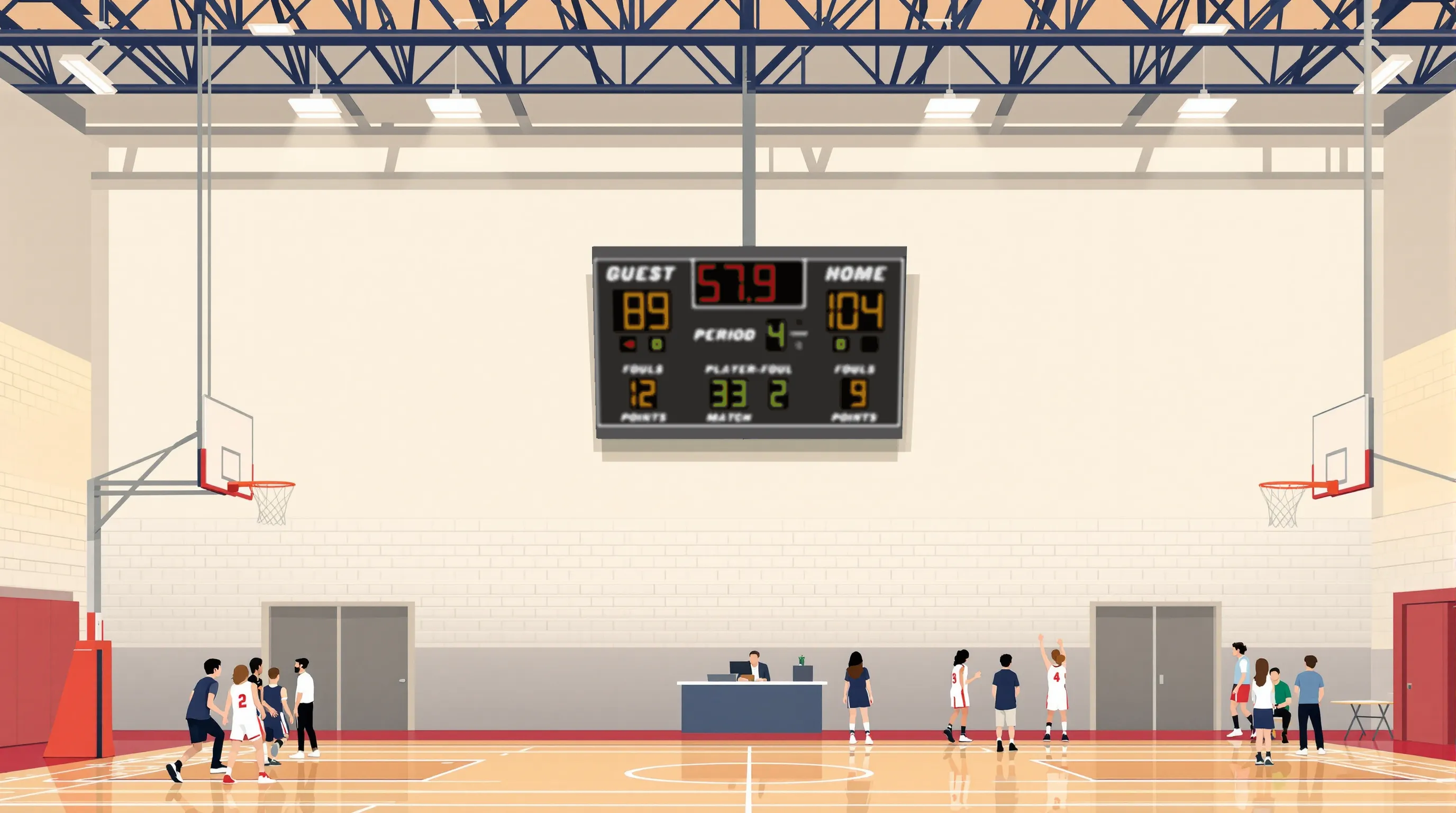
Eight of those 9 entries are basketball scoreboards. Seven of the eight basketball entries are the same model variant: the 2655-PCB. That kind of repetition across a district's gymnasium inventory is not accidental. When a purchasing authority chooses the same model variant for seven separate buildings, the decision is operational as much as it is budgetary. Scorekeepers, custodians, and athletic directors who work across multiple buildings encounter the same control console, the same brightness settings, and the same procedure for every game. There is no relearning when staff members move between venues.
The eighth basketball entry in the district's record is the LX2655-LR. Our review of the shipping record shows this unit shipped on January 10, 2013, to Topeka Public Schools. The LR designation identifies a variant within the LX2655 family, distinct from the PCB variant that accounts for seven of the district's eight basketball scoreboards. The district had standardized on 2655-PCB for the majority of its gymnasiums and chose a different variant for this final basketball installation.
| Organization | Model variant | Sport | Ship date |
|---|---|---|---|
| Topeka Public Schools (U.S.D. 501 Service Center / U.S.D.501 Service Center) | 2655-PCB | Basketball | On record; individual dates not detailed in available evidence |
| 2655-PCB | Basketball | On record; individual dates not detailed in available evidence | |
| 2655-PCB | Basketball | On record; individual dates not detailed in available evidence | |
| 2655-PCB | Basketball | On record; individual dates not detailed in available evidence | |
| 2655-PCB | Basketball | On record; individual dates not detailed in available evidence | |
| 2655-PCB | Basketball | On record; individual dates not detailed in available evidence | |
| 2655-PCB | Basketball | On record; individual dates not detailed in available evidence | |
| Topeka Public Schools | LX2655-LR | Basketball | 2013-01-10 |
The table above covers the 8 basketball entries attributed to the district across its three record spellings. The district's 9th entry, in a different sport, is on record but the evidence available for this article does not expose its model or ship date in detail. That limit is the record's, not an inference: the available evidence cards detail the basketball pattern because it is the dominant pattern, and the 9th entry sits outside it.
The standardization on 2655-PCB is the clearest purchasing pattern in Topeka's entire 27-entry record. No other organization in the city shows anything close to this degree of model consistency across multiple purchases. For a district managing gymnasium scoreboards in multiple buildings, that consistency matters in ways that are easy to underestimate: one spare-parts list, one service call protocol, one set of console instructions posted on the wall of every scorekeeper's table. The LX2655 family's design, with its full-sized 37-key control console and reversible captions for volleyball and wrestling, supports that kind of multi-sport, multi-building program without requiring different hardware at each venue.
I have worked with district-scale buyers long enough to recognize this pattern. The choice is rarely made building by building. A district that standardizes does so at the program level, and the 2655-PCB showing up seven times in the Topeka record is a snapshot of that kind of decision made and held over time.
For installation guidance and scoreboard operation, visit the Electro-Mech support page for technical documentation and contact information.
What Are the Specifications of the LX2655, Topeka's Most-Ordered Scoreboard?
The LX2655 dominates the Topeka record for a reason: its specification fits a typical high school gymnasium with no modifications and no special electrical work required.
Our data, from the LX2655 spec sheet, puts the cabinet at 9 feet wide by 5 feet tall, with a shipping weight of 133 pounds. The display carries 12-inch digits for the scores and game clock, and 9-inch digits for all other scorefields. Power draw is 1.5 amperes at 120 VAC, 60 Hz for the base configuration, rising to 2.2 amperes for the ETN (Electronic Team Names) variant. That load sits well within what a standard 15-ampere gymnasium circuit handles, which is why the LX2655 is straightforward to connect in buildings that were wired decades before LED scoreboards existed.
The model covers three sports: Basketball, Volleyball, and Wrestling. Reversible caption plates allow the same scoreboard face to display the correct scoring labels for whichever sport is on the floor. An athletic director scheduling a gymnasium for morning basketball practice and an afternoon wrestling meet does not need separate hardware for each sport. The scoreboard switches between them when the caption plates are turned, not when a purchase order is signed.
| Specification | LX2655 base | LX2655-ETN variant |
|---|---|---|
| Cabinet dimensions | 9 ft × 5 ft | 9 ft × 5 ft |
| Weight | 133 lb | 133 lb |
| Score and clock digit height | 12 in | 12 in |
| Other scorefield digit height | 9 in | 9 in |
| Power draw | 1.5 A, 120 VAC, 60 Hz | 2.2 A, 120 VAC, 60 Hz |
| Sports covered | Basketball, Volleyball, Wrestling | Basketball, Volleyball, Wrestling |
| Reversible captions | Yes | Yes |
The PCB and LR variants that appear in the Topeka district record represent configuration differences within the base LX2655 family. The PCB designation, which accounts for seven of the district's eight basketball scoreboards, identifies the standard wall-mount configuration common across Electro-Mech gymnasium installations. The LR variant shipped on January 10, 2013 carries a different configuration; the spec sheet names the variant but the Topeka record does not indicate which gymnasium received it, and the record does not say why the district chose a different variant for that final purchase.
From a rules standpoint, the LX2655's scorefields align with what NFHS Rule 4-8-1 (in effect since the 2023-24 season) requires scorekeepers to track: the rule awards two free throws on the fifth team foul per quarter, with the team-foul count resetting at the start of each quarter. A scoreboard with a dedicated team-foul field matters in a gymnasium where the scorekeeper needs to communicate foul-count status to coaches and officials without stopping play to announce it.
In my experience, the combination of low amperage, three-sport coverage, and straightforward cabinet sizing is what puts the LX2655 on so many gymnasium walls. It is not the largest display Electro-Mech makes for indoors, but it covers what most high school programs actually need.
LX2655 Quick-Reference Specifications
Model:         LX2655
Sport:         Basketball, Volleyball, Wrestling (indoor)
Cabinet:       9 ft wide × 5 ft tall
Weight:        133 lb
Digit height:  12 in (scores/clock), 9 in (other scorefields)
Power - base:  1.5 A, 120 VAC, 60 Hz
Power - ETN:   2.2 A, 120 VAC, 60 Hz
Captions:      Reversible (Basketball / Volleyball / Wrestling)
Variants in
Topeka record: 2655-PCB (×7, Topeka Public Schools)
               LX2655-LR (×1, Topeka Public Schools, shipped 2013-01-10)

Source: LX2655 spec sheet (Electro-Mech)
How Do the LX1050 and LX1060 Compare for Topeka's Baseball Venues?
Outdoor baseball accounts for 13 of the 27 Topeka entries, and the LX1050 and LX1060 cover most of that count between them, with 6 and 5 entries respectively.
The two models share a purpose but differ materially in size, weight, and digit height. Our data, from the LX1050 and LX1060 spec sheets, shows that the LX1050 carries 15-inch digits on a 6-foot by 3-foot cabinet weighing 78 pounds, drawing 0.8 amperes at 120 VAC, 60 Hz. The LX1060 scales up considerably: 18-inch digits on a 10-foot by 5-foot cabinet weighing 160 pounds, drawing 1.1 amperes for the base configuration or 2.4 amperes for the ETN variant, also at 120 VAC, 60 Hz. Both cover Baseball and Softball; both run on a standard 120-volt circuit.
The digit height difference is the specification that drives most venue decisions. Electro-Mech recommends 25 feet of viewing distance per inch of digit height for scoreboard applications, because a scoreboard carries captions and secondary scorefields that must also be readable, not just the main score. At 15-inch digits, the LX1050 is readable at the distances typical of a smaller park diamond. At 18-inch digits, the LX1060 serves a larger facility where the scoreboard sits farther from the stands. Both are outdoor models designed to mount on steel posts set in concrete footings.
| Specification | LX1050 | LX1060 | LX1060-ETN |
|---|---|---|---|
| Cabinet dimensions | 6 ft × 3 ft | 10 ft × 5 ft | 10 ft × 5 ft |
| Weight | 78 lb | 160 lb | 160 lb |
| Digit height | 15 in | 18 in | 18 in |
| Power draw | 0.8 A, 120 VAC, 60 Hz | 1.1 A, 120 VAC, 60 Hz | 2.4 A, 120 VAC, 60 Hz |
| Sports covered | Baseball, Softball | Baseball, Softball | Baseball, Softball |
| Entries in Topeka record | 6 | 5 | Not separately tabulated |
Three of the entries in Topeka's baseball-oriented park-and-recreation record carry commercial sponsor names embedded in the model designation itself. One entry is recorded as the 1050-AQUAFINA and two are recorded as the 1060-MTD (the Mountain Dew designation). These are standard Electro-Mech hardware in the LX1050 and LX1060 families; the sponsor naming reflects a signage arrangement at the venue level, not a different product. All three entries appear at a single ballpark complex in the record. The record does not state the sponsorship terms or how long they applied, and the record does not say whether the sponsor designations were retired after the initial purchase.
From a NFHS standpoint, Rule 6-2-6 (enacted 2016) requires every state to establish a pitch-count-based pitching restriction policy. Enforcing those limits at the diamond level depends on scorekeepers having a reliable pitch-count field on the scoreboard they can read from the scorer's table. Both the LX1050 and LX1060 include pitch count as a scorefield, which is the functional reason a program running multiple diamonds benefits from matching models: one console interface, one set of scorefields, regardless of which diamond hosts that day's game.
The Topeka record's 11 combined LX1050 and LX1060 entries across baseball-focused venues reflect a practical split: smaller park fields ordered the LX1050 and larger or better-funded venues ordered the LX1060. The record does not say why each individual site chose as it did, and it would be wrong to infer intent from the model number alone. What the record establishes is that Topeka's outdoor baseball facilities consistently chose Electro-Mech, and chose from the same two model families over the span of the record.
Before and After: Older Product Lines to the LX Series in Topeka
| Dimension | Before: Pre-LX entries (MM-338-PC, MP-345-C) | After: LX-series entries |
|---|---|---|
| Models in Topeka record | 2 entries (MM-338-PC, MP-345-C) | 25 entries across LX2655, LX1050, LX1060, LX2350, LX2550, LX1260-L, LX1360 |
| Published spec sheet availability | Not in evidence available for this article | Spec sheets available; dims, weight, amperage documented per model |
| Sport classification | Mixed (multi-sport, pre-standardized lineup) | Sport-specific model families (indoor basketball, outdoor baseball, football) |
| District standardization | Not evidenced | Topeka Public Schools standardized on LX2655-PCB across 7 gymnasiums |
The two pre-LX entries in the Topeka record are the earliest purchases the evidence documents. They show that Electro-Mech supplied Topeka-area venues before the LX series was introduced. The remaining 25 entries in the record are all LX-series models, reflecting a transition that happened at the product level, not in response to any specific Topeka buyer's request. No spec sheet data is available for the MM-338-PC or MP-345-C from the evidence used in this article; the table reflects what the record says, not what those models' spec sheets would say.
What Other Models Appear in the Topeka Record?
Seven of Topeka's 27 entries fall outside the LX2655, LX1050, and LX1060 families, covering basketball, baseball, football, and two older-line models predating the LX series.
The basketball category produces two additional models in the record. The LX2350-PC appears twice and the LX2550 once. Both are indoor basketball scoreboards in the LX series. Three basketball entries from Topeka buyers who were not Topeka Public Schools chose from these two models rather than the 2655 family that dominated the district's own purchases. The record does not say why these organizations chose differently, and it would be speculative to assign a reason. What is clear is that all three of these entries represent Topeka buyers selecting LX-series indoor displays during the same general timeframe as the district's purchases.
The outdoor category yields one entry in each of two non-baseball model lines. The LX1260-L appears once in the record's baseball or softball category. The LX1360 accounts for one of the two football entries in the record. Football scoreboards represent the smallest segment of Topeka's record by sport: two entries total across the 27. The LX1360 is the only named football model in those two entries; the record does not separately detail the second football entry's model in the evidence available for this article.
| Model | Sport category | Entries in Topeka record | Series |
|---|---|---|---|
| LX2350-PC | Basketball | 2 | LX series |
| LX2550 | Basketball | 1 | LX series |
| LX1260-L | Baseball / Softball | 1 | LX series |
| LX1360 | Football | 1 | LX series |
| MM-338-PC | Mixed (pre-LX) | 1 | Older line |
| MP-345-C | Mixed (pre-LX) | 1 | Older line |
The two oldest entries in the Topeka record are the MM-338-PC and the MP-345-C. Both predate the LX series. Their presence in the record reflects that Electro-Mech's relationship with Topeka-area buyers extends back before the LX lineup was introduced. These two entries carry a "mixed" sport classification in the evidence, meaning they served multi-sport roles in venues that ordered before the current product families were standardized. Spec sheets for these older models are not part of the evidence available for this article; their appearance here is drawn from the sales and shipping record, and no dimensions, weight, or amperage figures from those models are stated.
Taken together, these seven entries round out a record that is fundamentally dominated by three model families: the LX2655 indoors, and the LX1050 and LX1060 outdoors. The seven remaining entries fill gaps, represent buyers outside the district's standardization program, and document the older product generation that preceded the LX series in Topeka. The record is a snapshot of purchasing decisions made by multiple independent organizations across about 12 years, not a coordinated equipment program, and the variety in this section reflects that independence.
Topeka, Kansas: Electro-Mech Shipping Record at a Glance
- 27 total entries shipped between 2001 and 2013
- 10 organizations across 13 name spellings and 7 ZIP codes
- 13 baseball/softball entries (48%) | 12 basketball entries (44%) | 2 football entries (8%)
- 9 entries from Topeka Public Schools - the single largest buyer, with 7 identical LX2655-PCB gymnasium scoreboards
- 3 sponsor-named entries (1050-AQUAFINA ×1, 1060-MTD ×2) at one ballpark complex
- 2 pre-LX entries (MM-338-PC, MP-345-C) represent the older product generation
- Top indoor model: LX2655 (9 entries) | Top outdoor models: LX1050 (6 entries), LX1060 (5 entries)
Topeka's 27-entry record spans about 12 years and represents purchasing decisions by 10 organizations across seven ZIP codes. The record's two dominant findings are the school district's standardization on the LX2655-PCB and the concentration of outdoor baseball purchasing around the LX1050 and LX1060 families. Neither finding is complicated: one organization bought the same model repeatedly and built consistency across its gymnasium program, while the city's park-and-recreation venues chose between two outdoor models on the basis of venue size. The three sponsor-named entries add a dimension the record does not fully explain, but they confirm that at least one Topeka venue treated its scoreboard faces as advertising space alongside their primary function as scorekeeper tools.
The record is silent on most of the questions a buyer would ask today: which buildings still use these scoreboards, whether any have been replaced, and what prompted each specific purchasing decision. What the record does say is that Electro-Mech served a cross-section of Topeka organizations during a period when the LX series was the current product line, and that the purchasing patterns it documents are consistent with how districts and park systems typically buy when they think in terms of programs rather than single purchases.
If you are evaluating scoreboards for a gymnasium or outdoor diamond in Kansas, the LX2655, LX1050, and LX1060 remain current Electro-Mech models. The specifications in this article come from published spec sheets. For current pricing, lead times, and configuration guidance specific to your venue, contact the Electro-Mech team directly for a quote.
Sources & Further Reading
External Resources
- Electro-Mech scoreboard installations in Topeka, Kansas
- Electro-Mech scoreboard installations in Kansas
- LX2655 product page
- LX2655 spec sheet
- LX2655 owner's manual
- LX1050 product page
- LX1050 spec sheet
- LX1050 owner's manual
- LX1060 product page
- LX1060 spec sheet
- Topeka Public Schools official website
- NFHS: Pitching Restriction Policies in Baseball to be Based on Pitches
- NFHS basketball rules: bonus free throws on the fifth team foul in each quarter (since 2023-24)
- Old Scoreboard Control Panel Fix : r/AskElectronics - Reddit
Related Articles
- Chicago, Illinois Scoreboards: The LX2550, LX2350 and LX2665 Across 79 Entries - Chicago scoreboards: the LX2550, LX2350 and LX2665 across 79 entries.
- Indianapolis, Indiana Scoreboards: The LX1050, LX3230 and LX2550 Across 36 Entries - Indianapolis scoreboards: the LX1050, LX3230 and LX2550 across 36 entries.
- Cincinnati, Ohio Scoreboards: The LX2665, LX2350 and LX8850 Across 24 Entries - Cincinnati scoreboards: the LX2665, LX2350 and LX8850 across 24 entries.
- Knoxville, Tennessee Scoreboards: The LX2350, LX1730 and LX1340 Across 66 Organizations on Record - Knoxville scoreboards: the LX2350, LX1730 and LX1340 across 66 organizations on record.
- Memphis, Tennessee Scoreboards: The LX2350, LX1750 and LX2655 in a Record Split Down the Middle by the LX Series - Memphis scoreboards: the LX2350, LX1750 and LX2655 in a record split down the middle by the LX Series.
Written by
Chap McMichael
Vice President of Support Services, Electro-Mech Scoreboard Company
Chap McMichael is Vice President of Support Services at Electro-Mech Scoreboard Company, the family-owned manufacturer that has built scoreboards in Wrightsville, Georgia since 1963.
Connect on LinkedInSummarize This Article With AI
Open this article in your preferred AI engine for an instant summary.
Frequently Asked Questions
Why does the Topeka school district appear under three different name spellings in the record?
Purchasing orders and shipping records accumulate over years, and the name on a purchase order reflects whatever the buyer wrote at the time. The entries read as U.S.D. 501 Service Center, U.S.D.501 Service Center, and Topeka Public Schools. All three spellings refer to the same Kansas school district. The article consolidates them and states the consolidation plainly rather than treating each spelling as a separate organization.
What is the difference between the LX2655-PCB and the LX2655-LR?
Both are variants within the LX2655 indoor basketball scoreboard family. The PCB designation identifies the standard wall-mount configuration that Topeka Public Schools specified for seven of its eight gymnasium scoreboards. The LR designation identifies a different configuration within the same family; the LX2655 spec sheet names both variants. The Topeka record does not indicate why the district chose the LR variant for the final 2013 purchase rather than continuing with the PCB.
What do the 1050-AQUAFINA and 1060-MTD model names mean?
These are Electro-Mech scoreboards in the LX1050 and LX1060 families whose model designations incorporate a commercial sponsor name. The hardware is standard LX-series product; the naming reflects a signage sponsorship arrangement at the venue level. One 1050-AQUAFINA and two 1060-MTD (Mountain Dew) entries appear at a single ballpark complex in the Topeka record. The record does not state the terms of the sponsorship or whether the designations remained after the initial purchase.
Can the LX2655 serve volleyball and wrestling as well as basketball?
Yes. The LX2655 covers Basketball, Volleyball, and Wrestling. Reversible caption plates on the scoreboard face allow the display to show the correct scoring labels for whichever sport is in use. An athletic director scheduling a gymnasium for multiple sports does not need separate hardware for each. The scoreboard's scorefields and the 37-key control console support all three sports without modification. According to the LX2655 spec sheet, the cabinet is 9 feet wide by 5 feet tall, with 12-inch digits for the score and clock and 9-inch digits for other scorefields.
How does the LX1050 differ from the LX1060 for baseball venues?
The LX1050 is a smaller outdoor display: 6 feet wide by 3 feet tall, 78 pounds, with 15-inch digits and a 0.8-ampere draw at 120 VAC. The LX1060 is larger: 10 feet wide by 5 feet tall, 160 pounds, 18-inch digits, and 1.1 amperes for the base configuration. Both serve Baseball and Softball. The digit height difference is the practical dividing line: larger venues where the scoreboard sits farther from the stands need the 18-inch digits of the LX1060; smaller park diamonds where the scoreboard is closer to the scorer's table can use the LX1050.
Does the Topeka record tell us which buildings received which scoreboards?
No. The record documents what shipped and when, not which gymnasium or ball field each unit went to. Topeka Public Schools appears as the receiving organization for nine entries, but the record does not name individual school buildings or identify which 2655-PCB went to which gym. The record also does not say what is still in operation. Some orders sit in storage for months or years before being put into service, and Electro-Mech knows what it shipped, not what was installed or what remains in use.
What does the Electro-Mech warranty cover for scoreboards in the Topeka record?
Electro-Mech offers a five-year limited warranty on its scoreboards and LED displays are rated at 100,000 hours. The warranty terms apply to the product line generally. The Topeka shipping record does not include warranty documentation for individual orders, and this article does not address the warranty status of any specific entry in that record. For warranty questions on a specific unit, the Electro-Mech support team is the right contact.
How long does Electro-Mech take to deliver a scoreboard?
Lead time is typically four to six weeks, and can extend beyond twelve weeks depending on production scheduling. Electro-Mech keeps no stocked models: every scoreboard is built to order in Wrightsville, Georgia. A custom configuration does not automatically add time to that schedule. Anyone planning a purchase should contact the Electro-Mech team early, before a season deadline creates pressure, because the standard lead time is a manufacturing reality, not a variable that budget or urgency changes.