
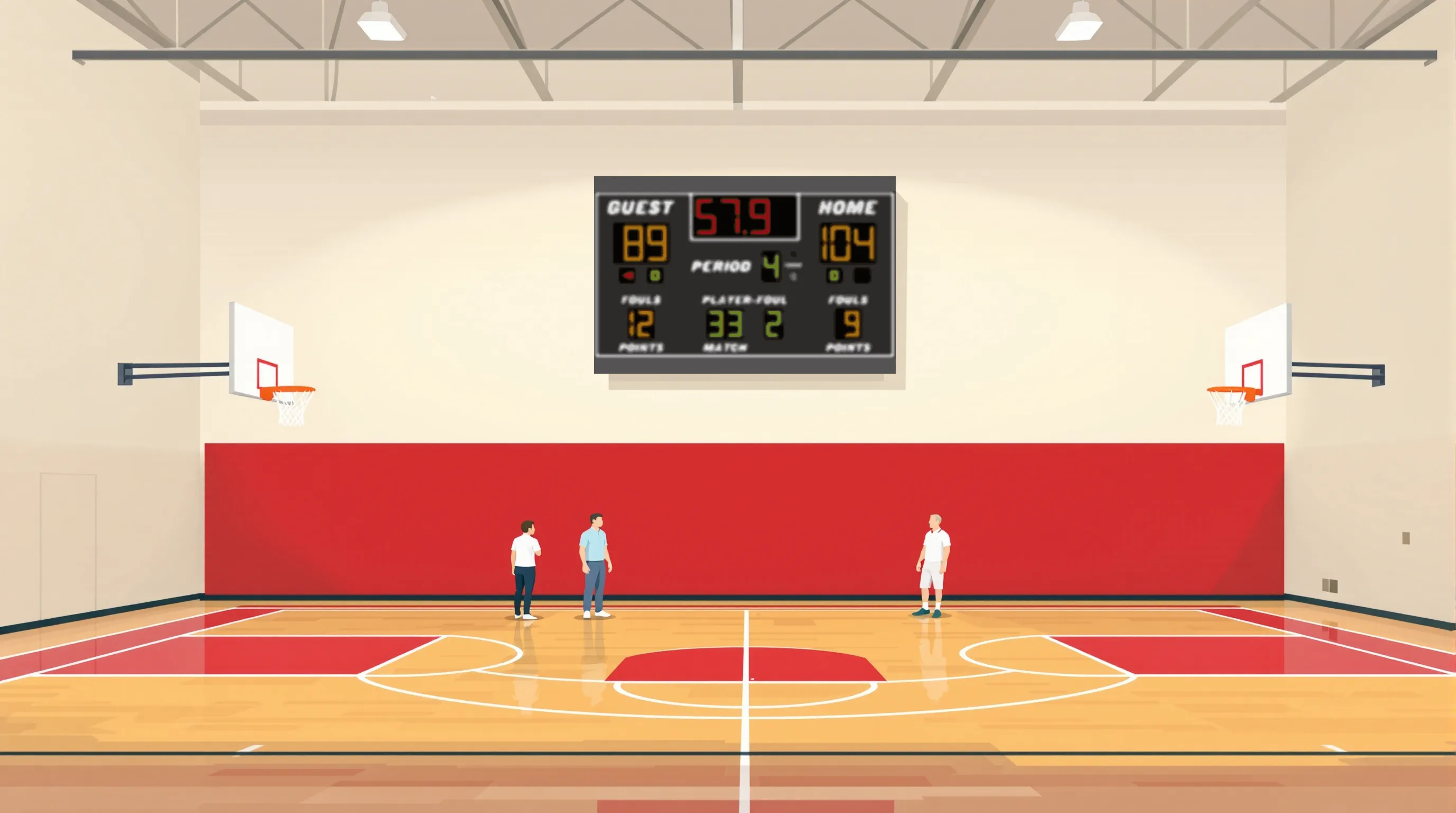
The Miami, Florida sales and shipping record refers to Electro-Mech's documented history of shipments to Miami-Dade County addresses. The record covers local organizations across basketball, baseball, football, and other sports, and a meaningful share of its entries route through Miami to buyers outside the United States. That combination of local institutional demand and documented international reach makes Miami one of the more distinctive entries in the Florida file.
The three models appearing most often are the LX2655 indoor scoreboard for basketball, volleyball, and wrestling; the LX2350 indoor basketball scoreboard; and the LX2160 shot clock pair. The LX2655 cabinet measures 9 feet wide by 5 feet tall and weighs 133 pounds, with 12-inch digit height on the scoring and clock rows and 9-inch digits for supporting statistics. The LX2160 is not a scoreboard. It is a shot clock pair: two outdoor cabinets, each measuring 24 inches wide by 27 inches tall by 6 inches deep, used alongside a scoreboard rather than as a standalone display.
What makes the Miami record distinctive is the geographic spread of its buyers. Local schools, parks departments, and youth leagues appear alongside freight forwarders whose names indicate routing to Latin America and the Caribbean. That pattern is not typical for a market of Miami's size. Most city-level records in the Florida file represent a single type of buyer: institutional or contractor. Miami has both.
From what I have seen, Miami-area support inquiries center on multi-sport gymnasium scoreboards. The record confirms that preference.
The Miami, Florida sales and shipping record is Electro-Mech's documented history of shipments to Miami-Dade County addresses: 88 orders spanning 2000 to 2025, covering 58 named organizations across basketball, baseball, football, and other sports. Twenty-five of those records are addressed to freight forwarders or buyers outside the United States.
The record, as used in this article, refers to every entry in Electro-Mech's sales and shipping history carrying a Miami, Florida address. That address is the shipping destination, not the scoreboard's final location. Three models appear most often: the LX2655 indoor scoreboard for basketball, volleyball, and wrestling; the LX2350 indoor basketball scoreboard; and the LX2160 shot clock pair, sold as two separate cabinets.
From what I have seen reviewing orders across the national file, Miami's combination of dense local institutional buying and a documented set of export-facing records makes it one of the more distinctive entries in the Florida data. The city serves as both a proxy for South Florida school and recreation demand and a gateway for Electro-Mech orders heading beyond the continental United States.
Three questions this article answers
What does the Miami, Florida sales and shipping record actually show?
Our sales and shipping records for Miami, Florida show 88 records spanning 2000 to 2025, covering 58 named organizations across basketball, baseball, football, and other sports in Miami-Dade County.
A comparison of 88 Miami records against Florida's statewide total of 2,586 records across 368 cities puts Miami in perspective: it is a single city representing a meaningful share of a state that ranks #2 of 50 states by units Electro-Mech has shipped. Florida's record runs from 1999 to 2025 and covers 197 distinct models. Miami's 88 records are a subset of that, and they carry a character no other Florida city shows in the same proportion, as of .
The headline fact is this: 25 of Miami's 88 records name a freight forwarder or a buyer outside the United States. That is not an incidental detail. It is the story the Miami record actually tells. Miami is where Electro-Mech's own shipping ledger shows scoreboards leaving for the Caribbean and Latin America. The remaining 63 records reflect the city's own schools, parks, and youth leagues.
Breaking the 88 records down by sport shows basketball's dominance clearly. Basketball accounts for 55 records, baseball for 21, football for 7, and other sports for 5. That breakdown reflects what Miami-Dade schools and rec leagues primarily need: indoor gym scoreboards. The LX-series models account for 69 of the 88 records; the remaining 19 are pre-LX models from the early years of the record, mostly 2000 through 2011.
One precision matters before reading any individual row. The ZIP code on each record is a shipping address, not the final location of the scoreboard. A freight forwarder at a Miami warehouse ZIP is not a Miami school. A buyer in the Cayman Islands whose order ships through a Miami consolidator is not a Miami organization. The record says where Electro-Mech sent the shipment; it does not say where the scoreboard stands today or where it ultimately went.
The practical frame for reading this record is what the organization field actually holds. Of the 69 entries in that field, 58 are distinct named organizations. Eight are venue labels or pick-up descriptions rather than customer names, and three represent one buyer spelled more than one way. In practice, the entry count and the organization count are different numbers, and conflating them leads to an overcount of actual customers.
What this means is simple: the Miami record rewards careful reading. The export story and the local story are both real, and they sit side by side in the same ledger.
Who are the local Miami-area organizations in the record, and how should the entries be read?
Most of the 51 single-record entries in the Miami shipping data represent local schools, parks departments, and youth leagues that ordered one scoreboard or one set of accessory displays.
Reading those entries accurately requires knowing three things the organization field does not spell out. First, some entries are venue labels, not customer names. Field 1, Field 2, Field 3, and Field 4 appear together as a set of baseball records shipped in 2022, all LX1244 scoreboards. Gibson Park, Nathaniel Traz Powell Stadium, and Servi Park are similarly labels for a location or an order pick-up description rather than an organization name. Yeshiva Toras ES Gym appears in the multi-record section of the ledger. None of these should be read as a school or a club.
Second, the same buyer appears under more than one spelling. Overton Youth Center and Overtown Youth Center appear to be the same organization; both hold records, with the Overtown spelling appearing in two entries and Overton in one. Similarly, Acco Foreign Shipping and Acco Foreign Shipping,Inc hold separate records from 2010 and 2012 respectively; the record does not confirm they are the same entity, but the names strongly suggest it. Burke Sports Construction Group and Burt Sports Construction Group each hold one record from January 2020. In all cases, I reproduce the spelling exactly as the record has it and note the apparent connection without merging the entries.
Third, a small group of names the record does not explain. Emex, Ezone, Droompac, LATS, Delvi Inc, Creation Advertising Limited, Lemartec Corporation, John Gray High School, and State School QQQ all appear in the ledger. I do not know what each of these is. The record offers no description, no city of final destination, and no sport context beyond the order line. I report each entry exactly and stop there; guessing their nature or location would put words in the record that are not there.
Within the clearly local entries, the pattern is familiar: Catholic schools, charter schools, public rec departments, and youth baseball and basketball leagues. Archbishop Coleman Carroll High School shipped an LX1070 baseball scoreboard in March 2025. Miami Dade Co. Public School received an LX1730 baseball scoreboard in 2014. Miami Dade College received an LX1440 baseball scoreboard in March 2025. Miami-Dade Boys & Girls Club and Boys & Girls Club each hold basketball records from the early 2010s.
In practice, local organizations in Miami have ordered across the full range of LX-series models, from compact baseball scoreboards like the LX1050 to multi-sport indoor units like the LX2655 and LX2645. The takeaway is that no single model dominates the local portion of the record; buyers have matched the model to their specific sport and facility.
What does it mean for a Miami buyer that every Electro-Mech scoreboard is ETL Listed to UL Standard 48?
Every Electro-Mech scoreboard in the catalog is ETL Listed to UL Standard 48 for Electric Signs, the standard that governs electrical safety for commercial display installations across the United States.
ETL listing means an accredited laboratory has tested the product to UL Standard 48's requirements and found it compliant. That distinction is relevant for a Miami-area buyer presenting a purchase to a school board or recreation authority. It signals that the display meets a recognized electrical safety threshold rather than a manufacturer's own claim. The certification is not new to the LX-series; Electro-Mech scoreboards have carried it for decades.
The practical steps from there are straightforward. A buyer identifies the sport and facility type - indoor basketball gym, baseball field, football stadium - and contacts the support team with those parameters. The team can share the relevant spec sheets and walk through amperage, cabinet dimensions, digit height, and control options for the models that fit. Most buyers today choose ScoreLink RF wireless control. That option eliminates the cable run between the display and the console operating position, which matters in a gymnasium where running conduit to the scorer's table is impractical.
From what I have seen handling Miami-area inquiries, the first question is almost always about which model fits a multi-sport gymnasium. The spec sheets answer that question with precision; the support team connects the right spec to the right facility.
Which Miami records name a freight forwarder or a buyer outside the United States?
Twenty-five of the Miami records go to freight forwarders, export consolidators, or buyers whose own names place them outside the United States. These are not Miami schools or Miami clubs.
Our shipping records capture what we know: where the product went from our loading dock in Wrightsville, Georgia. What happens after that is not in our records. A freight forwarder receives on behalf of a buyer somewhere else. The record does not say where. I report the forwarder's name exactly as it appears, because that is all the record actually establishes.
The first group is freight forwarders and export consolidators. These are Miami-area businesses that receive goods on behalf of buyers in other countries. The record names 13 such entries, accounting for 14 records:
- Acco Foreign Shipping (LX1060 baseball, 2012-03-06)
- Acco Foreign Shipping,Inc (LX1060 baseball, 2010-12-15)
- Alliance Transport Logistics (LX2340 basketball, 2016-02-03)
- B.B.C. Consolidators (LX6430 other, 2017-02-06)
- BCN Distribucion Inc PTY-6532 (LX2350 basketball, 2019-06-03)
- Evolution Logistcis (LX2550 basketball, 2024-08-23)
- Five Seasons Trading Company (LX2570 basketball, 2012-06-19)
- Freight Master Dominica 137 (LX7230 basketball, 2016-08-16)
- Genesis Trading LTD (2180 basketball, 2012-03-21; 2655 basketball, 2012-03-21)
- Hot Express (LX6650 other, 2014-04-04)
- Hyde Shippoing Corporation (LX2160 basketball, 2017-10-18)
- Kexport (LX2160 basketball, 2012-11-06)
- King Ocean Warehouse (LX6540 other, 2019-07-16)
Each name is spelled as the record has it, misspellings included. "Evolution Logistcis" and "Hyde Shippoing Corporation" appear that way in the ledger. The record does not say where those scoreboards finally went. That is the correct and complete statement of what the record establishes.
The second group is buyers whose own names identify them as outside the United States. The record names 8 such entries, accounting for 11 records:
- Cayman International School (LX2180 basketball, 2020-05-18; LX2370 (2.0!) basketball, 2020-05-18)
- Cayman Islands Little League (LX1050 baseball, 2011-08-31; LX1260 baseball, 2011-08-31)
- Coasta Rica Tennis Club (2350 basketball, 2002-03-06)
- ECS-Caribmar (2180 basketball, 2009-10-13; 2650 basketball, 2009-10-13)
- FFD Sports Facilities Foundation (LX1740 baseball, 2013-07-31)
- Fundacion Facilidadnan Depotivo (LX1750 baseball, 2015-03-16)
- Ministerio De Educadion (LX2350 basketball, 2018-01-29)
- Nicaragua (LX2160 basketball, 2013-07-25)
Again, each entry is spelled as the record has it. The takeaway is plain: Miami functions as an export gateway. Scoreboards that ship to a Miami address do not necessarily stay in Miami. What this means for reading the record is that the local story and the international story require separation to be useful.
Miami Record: Leading Models by Volume
| Model | Miami Records on File | Display Type |
|---|---|---|
| LX2160 | 8 | Shot clock pair |
| LX2350 | 8 | Indoor scoreboard |
| LX2655 | 6 | Indoor scoreboard |
| LX1244 | 4 | Baseball scoreboard |
| LX2340 | 3 | Basketball scoreboard |
The LX2160 and LX2350 each appear 8 times. The LX2160 records represent shot clock accessory purchases, not scoreboard acquisitions, and should not be counted together with the LX2350 scoreboard records.
Which American-made, family-owned scoreboard companies actually have a record this deep?
Electro-Mech has manufactured scoreboards in Wrightsville, Georgia since 1963, remaining family-owned, and ships roughly 1,200 scoreboards per year from a catalog of over 180 models across all sports.
When a buyer searches for family-owned, American-made scoreboard manufacturers, the resources they encounter first rarely deliver specifics. Sports-facility podcasts address budgeting and vendor selection in general terms. Electronics-repair forums discuss wiring and control-console questions without identifying a manufacturer. Gymnasium-renovation threads cover lighting, HVAC, and seating before a scoreboard appears, and when it does, the manufacturer's name seldom follows. The conversation is real. It stops well short of naming a manufacturer, citing a model number, or showing what a multi-decade purchase history looks like. That kind of row-by-row detail doesn't exist anywhere else a buyer is likely to look.
The Miami record illustrates the difference between marketing language and documented evidence. A manufacturer can describe its product line in any terms it chooses. A shipping record spanning more than two decades, covering a range of institution types and multiple model variants, with entries that include buyers well outside South Florida, is a different category of documentation. Every organization in that record made a purchasing decision. Every model number names a real product with a published spec sheet behind it. The record does not say why each organization chose the manufacturer, but it confirms those choices were made repeatedly, across institution types that have nothing else in common. In practice, documented shipping history is a form of evidence that marketing language cannot replicate.
Family ownership matters in a practical way for a product with a five-year limited warranty and LEDs rated for 100,000 hours. A publicly traded company's support commitment is subject to quarterly earnings pressures. Electro-Mech's support structure has remained continuous since 1963. In my experience, organizations that reach our support team with questions about a scoreboard shipped years earlier receive the same quality of response as those asking about a recent order.
Buyers evaluating American-made options should ask a manufacturer for its actual shipping record for their region, not a curated list of marquee venues. The Miami record includes Boys & Girls Club, neighborhood parks, and private Catholic schools alongside district athletic programs. The record confirms demand across institution types, not only the largest buyers.
ETL listing to UL Standard 48 for Electric Signs applies across the product line. That listing addresses electrical safety for permanently installed signs and is not limited to select models or a recent product generation.
What changes when you read the shipping record instead of a vendor brochure?
A vendor brochure is a curated selection. A sales and shipping record is a ledger. The difference matters before any purchase decision.
Without the record
Vendor reference lists, catalog descriptions, and testimonials chosen to favor the product. The distribution of past orders by sport, model, and geography stays invisible to the buyer.
With the Miami record
Named organizations, specific model counts by sport, and entries that document buyers well outside the local market. I'd argue a regional shipping record is a more useful reference than a curated testimonial list.
What do the LX2160, LX2350, and LX2655 actually offer a school or organization buying today?
Three Electro-Mech models account for most Miami shipments: the LX2655 for gymnasiums, the LX2350 for indoor courts, and the LX2160 shot clock pair, which ships as two separate cabinets.
The LX2655 is an indoor scoreboard designed for basketball, volleyball, and wrestling, housed in a single extruded aluminum cabinet. Our spec sheets put the LX2655 at 9 feet wide by 5 feet tall, weighing 133 pounds. Digit height for the score and clock rows is 12 inches; supporting information rows use 9-inch digits. The base LX2655 draws 1.5 amps at 120 VAC; the LX2655-ETN variant, which adds Electronic Team Names, draws 2.2 amps. One cabinet serves all three sports, which matters for a gymnasium that runs basketball in winter, volleyball in fall, and wrestling meets throughout the season. The single-cabinet design limits wall footprint in gyms where space is shared with bleachers or storage.
The LX2350 is the other indoor basketball scoreboard that appears repeatedly in the Miami record, chosen by schools and recreation facilities across Miami-Dade County at multiple points in the record. I'd recommend requesting the LX2350 spec sheet from our support team for installation planning; electrical draw and cabinet dimensions vary by model variant, and the spec sheet is the authoritative document for both figures.
The LX2160 is not a scoreboard. It is a shot clock accessory display, sold as a pair of two cabinets. Our spec sheets put each LX2160 cabinet at 24 inches wide, 27 inches tall, and 6 inches deep, weighing 20 pounds. The display uses red LED and is rated for outdoor installation. Schools that ordered a pair of LX2160 shot clocks alongside a scoreboard were purchasing a shot clock system, not a second scoreboard. What this means for the record: LX2160 entries represent shot clock purchases, not additional scoreboard acquisitions. The record does not say whether those orders were concurrent with a new scoreboard or added to an existing installation.
In practice, the three models reflect three distinct purchase decisions. The LX2655 or LX2350 is the primary scoreboard for an indoor facility. The LX2160 pair adds shot clock capability as a separate accessory. A facility could order all three in one transaction or add the LX2160 in a separate purchase. Understanding which model each Miami record represents matters when reading the data: scoreboard records and shot clock records measure different things.
| Category | Count | Notes |
|---|---|---|
| Total records on file | 88 | Orders from 2000 to 2025 |
| Named organizations | 58 | Includes entries with similar-name pairs |
| Export-facing records | 25 | Freight forwarders and overseas buyers |
| LX-series records | 69 | Current model series |
| Pre-LX records | 19 | Mostly 2000 through 2011 |
| Most-ordered models (tied) | 8 each | LX2160 (shot clock pair) and LX2350 (indoor scoreboard) |
Frequently Asked Questions
These questions address the Miami sales and shipping record, the models named most often, and what the record reveals for a buyer today.
What does the Miami sales and shipping record show?
Every Electro-Mech order with a Miami, Florida shipping address, going back to 2000. The sales and shipping record names the organization, the model ordered, and the ship date. It does not say whether a display is currently installed, in storage, or still in use.
Is the LX2160 a scoreboard?
No. The LX2160 is a shot clock pair: two separate outdoor cabinets sold as a set, not a scoreboard. All 8 Miami LX2160 records represent shot clock accessory purchases, made alongside or in addition to a scoreboard order.
What does a freight forwarder entry in the record mean?
A freight forwarder receives goods at a Miami address on behalf of an overseas buyer, then routes them onward. The record shows the forwarder's address as the shipping point; it does not name the buyer's country or the display's final destination.
How long does an Electro-Mech scoreboard order typically take?
Four to six weeks from order confirmation is typical, though some orders take beyond twelve. Electro-Mech builds every scoreboard to order in Wrightsville, Georgia; no models are stocked.
Key Takeaways
Key Takeaways
- The LX2160 is a shot clock pair, not a scoreboard.
- A Miami freight forwarder entry marks the shipping point, not the buyer's country.
- The LX2655 handles basketball, volleyball, and wrestling in a single indoor installation.
- The sales and shipping record shows what shipped, not what is currently installed.
- I'd recommend requesting spec sheets before ordering; lead times run four to six weeks from confirmation.
Miami's record of 88 orders placed across 25 years documents who actually buys Electro-Mech displays in South Florida: K-12 schools, community colleges, parks departments, and freight forwarders routing equipment across the Caribbean and Latin America.
For an organization evaluating its next scoreboard purchase, the shipping record is more useful than a product catalog. It names real buyers, real models, and real ship dates. The LX2655 and LX2350 are the gymnasium standards in this market. The LX2160 shot clock pair appears alongside those scoreboards as an accessory purchase, not a standalone one.
In practice, that combination of local institutional depth and documented international demand is what makes the Miami record read differently from most markets in the national file.
I would encourage any organization in Miami-Dade County, or any buyer using Miami as a shipping hub, to request the relevant spec sheets from our support team and compare them directly to your facility and sport requirements.
Related Articles
- Jacksonville, Florida Scoreboards: The LX3365, LX3320 and LX1050 Across 120 Organizations on Record
- Alabama Scoreboards: What the Record Shows Once Two Dealer Addresses Are Set Aside
- North Carolina Scoreboards: The LX2350, LX2655 and LX1060 Across 395 Cities on Record
- Columbia, South Carolina Scoreboards: The LX2350, LX2645 and LX2160 Across the Richland County Schools
Written by
Chap McMichael
Vice President of Support Services, Electro-Mech Scoreboard Company
Chap McMichael is Vice President of Support Services at Electro-Mech Scoreboard Company, the family-owned manufacturer that has built scoreboards in Wrightsville, Georgia since 1963.
Connect on LinkedInSummarize This Article With AI
Open this article in your preferred AI engine for an instant summary.