
Quick Answer
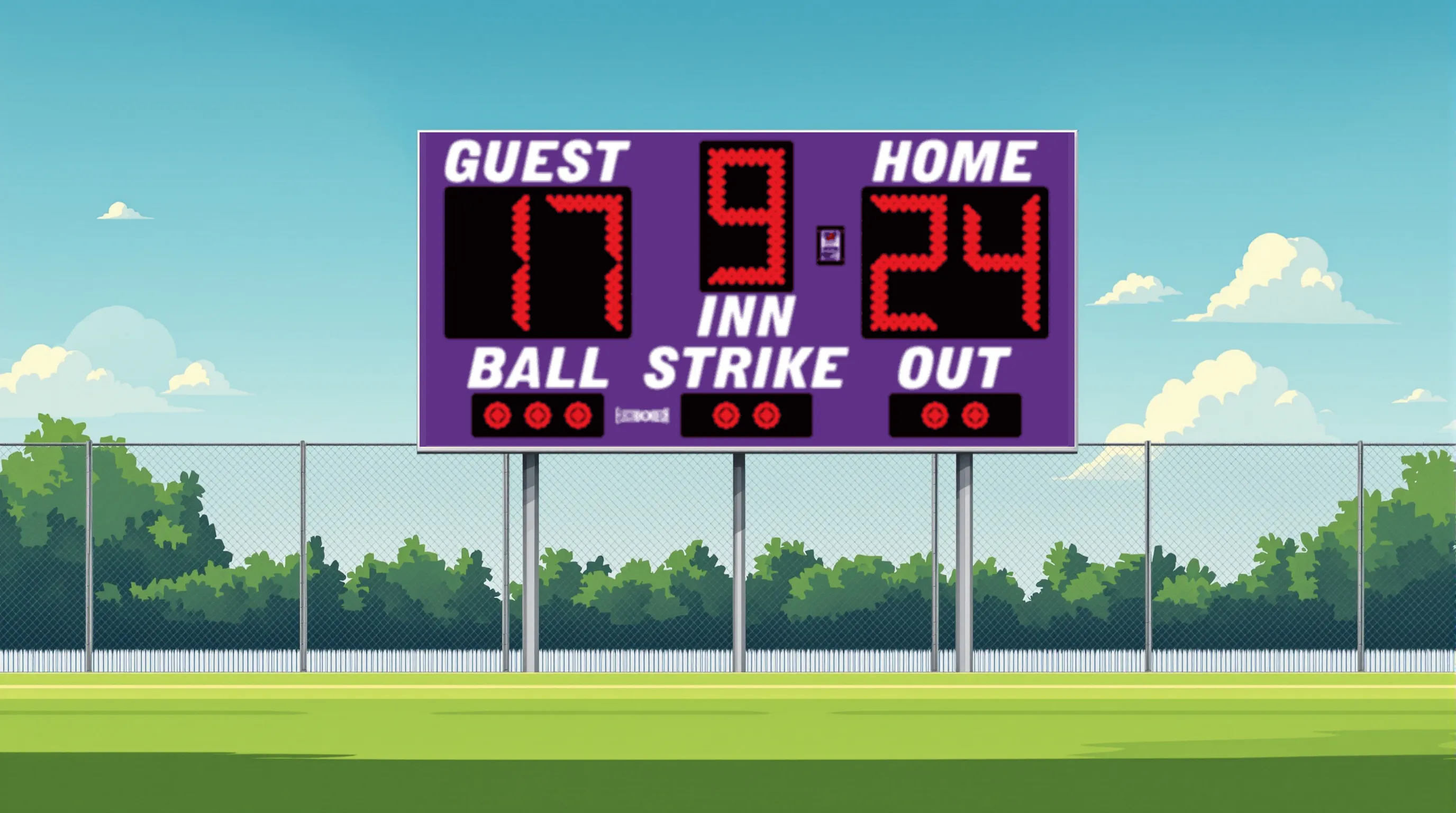
Baseball, not basketball, leads Indiana in our sales and shipping record, at more than twice basketball's count. The LX1050 outdoor baseball layout is the state's most-shipped scoreboard among 79 distinct models. Indoors, the LX2350 shows Bonus indicators, which matter under the current per-quarter high school foul count. Size each order by sport, setting, farthest seat and rulebook. Indiana's basketball reputation should not set it.
Key Points
- Electro-Mech's Indiana sales and shipping record holds 503 records across 173 cities and towns from 1999 to 2025, with baseball at 272 and basketball at 117.
- The LX1050, a 6 ft x 3 ft outdoor baseball layout with 15 in digits on its spec sheet, leads Indiana's model list with 75 records , against 36 for the LX1030.
- Since the 2023-24 season, NFHS Rule 4-8-1 awards two free throws once the opponent commits five fouls in a quarter, and the indoor LX2350 carries Bonus indicators for that count.
Indiana's basketball reputation suggests a state of gym scoreboards. Our review of Electro-Mech's Indiana sales and shipping record points somewhere else, and the gap between the reputation and the record is where a buyer's next decision starts. I wrote the sections below for the athletic directors, park departments and youth leagues who have to turn that record into one scoreboard order.
The article moves through four questions, in this order:
- Which game leads the record, and how far basketball trails it.
- How the LX1050, the smallest outdoor baseball layout, compares with the larger LX1030 on each model's own spec sheet.
- What the indoor LX2350 shows, and how its Bonus indicators sit against the current high school foul count.
- What to confirm before ordering: setting, farthest seat, rulebook and control.
Two terms carry through every section. Digit height is the height of a scoreboard's numerals, and it sets how far away the score can be read. A rulebook here means whichever body governs the game on that field or floor: the Indiana High School Athletic Association for school sports in the state, applying NFHS rules, or Little League for its own divisions of play.
The point I keep returning to is plain. A reputation does not write a scoreboard specification. A sport and its rulebook do.
Indiana's scoreboard orders tell a baseball story first. Electro-Mech's Indiana sales and shipping record counts 503 records across 173 cities and towns from 1999 to 2025, and baseball holds 272 of them against basketball's 117. The model list points the same way. The LX1050, a 6 ft x 3 ft outdoor baseball layout, leads with 75 records, followed by the LX1030 at 36, the indoor LX2350 at 33, and the LX1060 and LX2655 at 27 each.
I read those counts as a record of what shipped, nothing more. The record does not say why a buyer chose a layout, where it went, or whether it still stands. What it does show is where Indiana demand has gathered. The spec sheets for the leading layouts then explain what each one puts in front of players and officials, and the high school rules on the basketball bonus and on baseball pitch counts explain why the right display depends on the game being played.
What does Electro-Mech's Indiana sales and shipping record contain?
Electro-Mech's Indiana sales and shipping record holds 503 records across 173 cities and towns, runs from 1999 to 2025, and ranks Indiana fourteenth of fifty states by units shipped.
Three rules decide how those figures should be read before any pattern is drawn from them:
- One row per organization, model and city. Each record pairs one buyer with one model in one city, the same rule the state page itself applies.
- Models are counted by their LX equivalent. Variants such as 2350, 2350-C and LX2350 count as the single model LX2350, which is how the state arrives at 79 distinct models.
- Sold and shipped, not standing today. The record shows what Electro-Mech sold and shipped, not where a scoreboard went up or whether it is still in use.
The Indiana page of our sales and shipping record lists every record by city, so a reader can check each count against the source. The common assumption is that a figure like 503 describes scoreboards standing in Indiana today. It does not. Some orders sit in storage for months before they go up, and the record cannot say what has since come down. In practice, 503 is a count of sales, not a census of fields and gyms.
Grouping by LX equivalent is a counting rule, not a statement about hardware. A scoreboard shipped under an older pre-LX number and one shipped as a current LX-series model can differ inside the cabinet, even when the record files them under one model. Anyone maintaining an older Indiana scoreboard should ask the Electro-Mech support team which parts fit that specific unit.
Counts by sport carry a second meaning. Under NFHS Rule 6-2-6, revised in 2016, each state association writes its own pitch-count based pitching restriction policy, so part of the rulebook behind Indiana baseball is set inside Indiana. The record is best read sport by sport. Electro-Mech's pages on basketball scoreboards and the other sports show what each layout carries.
I would treat the record as a plain map of what Indiana buyers ordered over a quarter century, and nothing more. The sport split is where it starts to say something unexpected.
Which sport holds the most scoreboard records in Indiana, baseball or basketball?
Baseball holds 272 Indiana records and basketball 117, so in a state known for high school basketball, baseball carries more than twice as many records.
Our review of the Indiana sales and shipping record gives the full split by sport:
| Sport | Indiana records, 1999 to 2025 |
|---|---|
| Baseball | 272 |
| Basketball | 117 |
| Football | 79 |
| Soccer | 23 |
| Softball | 9 |
| Hockey | 3 |
Contrary to Indiana's reputation as a basketball state, the outdoor diamond is where our sales concentrate. The gap is not narrow. Baseball leads basketball by more than two to one, and football sits third at 79 records, well behind both.
The record does not say why. It lists organization, model, sport, city and ship date, and nothing about the reasons behind a purchase. It also does not separate schools from park departments or youth leagues, so any explanation of the baseball lead would be a guess. I would rather leave the question open than fill it with a story the record cannot support.
The softball figure needs one caution. The LX1030 spec sheet classifies that layout as Outdoor, Baseball / Softball, so a single scoreboard design serves both kinds of diamond. The record files each sale under one sport, and it does not say how many of its baseball entries ended up beside a softball field. A count of 9 softball records is therefore a floor on softball use, not a measure of it.
Rules shape the picture as well. Indiana baseball plays under a pitch-count policy written at the state level, which keeps the rulebook for the state's largest scoreboard sport close to home. Gym rules, by contrast, come through the national basketball rulebook, a point the LX2350 discussion below takes up.
Two practical points follow for a buyer. Baseball layouts deserve the closest look, because they are what Indiana orders most from us. Football buyers, the third group, can compare the outdoor layouts on the football scoreboards page. The rest of this article follows the record's own order, starting with the smallest outdoor baseball layout.
Which governing body's rules apply to an Indiana scoreboard order?
The body that runs the game decides: high school play follows national rules applied through the state association, while Little League programs play under Little League's own rules.
For Indiana high school gyms, that means NFHS rules applied through the Indiana High School Athletic Association, including the per-quarter team foul count. High school baseball works differently. NFHS leaves the pitch-count policy to each state association. Little League, for its part, publishes pitch count breakdowns by league age and days-of-rest thresholds for each division of play.
A park department league may sit outside both systems, and the evidence here does not show which rules such a league follows. Our sales and shipping record cannot settle the question either. It records what shipped, by model, sport and city or town, not which rules a buyer plays under. Where the rule is unclear, I put the question to the league's own officers before anyone opens a spec sheet.
Why is the 6 ft x 3 ft LX1050 Indiana's most-shipped scoreboard, and how does the LX1030 compare?
The LX1050 is the smallest permanently installed outdoor baseball layout, a 6 ft x 3 ft cabinet with 15-inch digits, and it holds 75 Indiana records against 36 for the LX1030.
The LX1050, LX1030 and LX1060 spec sheets set the three layouts side by side:
| Model | Cabinet | Weight | Digit height | Indicator size | Caption height | Amps | Indiana records |
|---|---|---|---|---|---|---|---|
| LX1050 | 6 ft x 3 ft | 78 lb | 15 in | 3 in | 4-1/2 in | 0.8 | 75 |
| LX1030 | 8 ft x 4 ft | 113 lb | 18 in | 4 in | 6 in | 1.1 | 36 |
| LX1060 | 10 ft x 5 ft | 160 lb | 18 in | 4 in | 7 in | 1.1 | 27 |
The LX1050 model page calls the layout as small as permanently installed outdoor scoreboards come. Its 15-inch digits read well across a field, but its captions are short, so the page recommends the LX1050 only where the viewing distance will be less than 250 feet. Both layouts are classed Outdoor, Baseball / Softball, both offer amber or red digits, and the LX1050 draws 0.8 amps at 120 VAC.
The LX1030 sits one step up. Its model page describes the 8 ft x 4 ft layout as sliding in between the LX1050 and LX1060, with 18-inch digits for Runs and Inning and bullet-style indicators for Ball, Strike and Out. The page calls it a fit for little leagues and high schools. Indiana buyers chose the smaller LX1050 more than twice as often.
The record does not say why. It does not list field sizes, budgets or the reasons behind any order. I would not read the lead as proof that the smallest layout suits every Indiana diamond.
Digit size and price move together, so the real risk is buying a scoreboard too small for the venue. Electro-Mech recommends 25 feet of viewing distance per inch of digit height, tighter than the sign industry's 50 feet per inch, because a scoreboard also carries captions that must be read. Measure the farthest point where a player, umpire or spectator needs to read the score. Then compare it with each layout before choosing.
The full spec sheets for both models are on the scoreboard manuals page. A larger digit costs more. A digit too small for the field costs more in the end.
A quote request goes faster when the basics are written down first. I would send an outline like this one, with every line answered:
Scoreboard request: Indiana
Sport:           baseball | softball | basketball | other
Setting:         indoor | outdoor
Farthest seat:   ____ ft from the planned location
Rulebook:        NFHS (high school, through the state association)
                 Little League (pitch counts by league age and days of rest)
Bonus display:   per-quarter team fouls under NFHS Rule 4-8-1
Control: ScoreLink RF | hardwired cableThe highlighted rulebook lines decide which displays the layout needs. Leave a line blank rather than guess.
What does the indoor LX2350 show, and how does it fit the current high school foul rule?
The LX2350 shows Home and Guest Points, a Period Clock, a Period digit, and Bonus and Possession indicators, enough for the quarter-by-quarter bonus that high school basketball now uses.
Conventional wisdom says a basketball state should fill its scoreboard record with gym models. Indiana's does not. The LX2350, classed Indoor, Basketball / Multi-Sport on its spec sheet, is the third most-shipped model in the state at 33 records, behind two outdoor baseball layouts. The record does not say why buyers chose as they did, and I would not supply a reason it leaves out.
The LX2350 spec sheet and cutsheet give the model's display in its standard form:
| LX2350 element | Height |
|---|---|
| Home Team Points and Guest Team Points | 12 in |
| Period Clock (MM:SS) | 12 in |
| Period | 9 in |
| Bonus and Possession indicators | 3 in |
| Captions | 5 in and 4 in |
The cabinet measures 9 ft x 3 ft, weighs 89 lb and is built of aluminum. Digits come in amber, red and green, with fifty programmable brightness levels. The base LX2350 draws 1.2 amps, and the LX2350-ETN, the Electronic Team Names variant, draws 1.9 amps. Standard equipment includes hardware for mounting the cabinet to a wall, an internal horn, and a data output port that supports daisy chaining additional displays. The model page points to the built-in Bonus and Possession indicators as what makes the LX2350 a basketball layout.
Those indicators matter because of the current rule. Since the 2023-24 season, NFHS Rule 4-8-1 awards two free throws for all common fouls once the opponent commits five fouls in a quarter, and team fouls reset at the end of each quarter. The change eliminated the one-and-one. One threshold per quarter means one bonus state to show for each team. The optional Double Bonus Indicators stay available on the LX2350 as a next step, and I would go over them with our team when a gym's quote is written.
Shot clocks are a separate matter. A December 2024 thread on Reddit's r/Basketball carried one commenter's claim that the Hoosier state, the one that "lives, eats and breathes basketball," still had no high school shot clock in 2024. A forum post is not an IHSAA ruling. I would confirm the current position with the IHSAA before planning any gym purchase around a shot clock.
How did the high school bonus change for Indiana gyms in 2023-24?
Before the 2023-24 season, high school basketball counted team fouls by half with a two-step bonus; since then, the count runs by quarter with one bonus step and no one-and-one.
| Foul administration | Before the 2023-24 season | Since the 2023-24 season |
|---|---|---|
| Team fouls counted | By half | By quarter |
| First bonus step | One-and-one on the opponent's seventh foul in a half | The one-and-one is gone |
| Second bonus step | Two free throws on the tenth foul in a half | None; a single per-quarter threshold |
The half-by-half count is history. A bonus display now follows one threshold that starts over each quarter. Older scorebooks and rules summaries still describe the old count, so I would check the date on any summary before trusting its foul thresholds.
What should an Indiana school, park department or youth league check before buying a scoreboard?
Before buying, an Indiana school, park department or youth league should confirm the sport and setting, the farthest seat, the rulebook its games follow, and how the scoreboard is controlled.
The record shows what Indiana buyers ordered. It does not show whether each choice fit its venue, so the four checks below rest on spec sheets, rulebooks and the venue itself.
- Match the model to the sport and the setting. Each of the three spec sheets covered above carries a classification line naming indoor or outdoor use and the sports the layout serves. Read that line first. Do not assume a layout covers a sport its spec sheet does not name. Even a software vendor whose cost guide pitches gym TVs as an alternative recommends a traditional scoreboard where outdoor installation is required or permanence is a priority.
- Size the digits to the farthest seat, not the nearest. Measure from the planned location to the farthest seat, then apply the viewing-distance rule given with the LX1050 and LX1030 comparison. Digit size and price move together, so the costly mistake is ordering a scoreboard too small for the venue. A scoreboard's first job is keeping accurate information, including time, in front of players and officials. Spectators come second.
- Find out which rulebook the games follow. Little League's regular season pitching rules, which apply to Little League play, break pitch counts down by league age and days of rest for each division. Indiana high school baseball follows the pitch-count policy its state association writes, as noted earlier. A 2022 buyer's guide from a scoreboard cost-calculator site made the related point that baseball may need extra displays for inning information or pitch count. For a gym, the question is the per-quarter bonus covered in the LX2350 section. In either case, ask the Electro-Mech team which layouts display the counts your league keeps before you choose one.
- Decide how the scoreboard will be controlled. Most customers choose ScoreLink RF wireless control. A hardwired run uses a shielded 2-conductor cable with a drain line, in a burial jacket laid directly in a trench, up to 1,000 ft long and kept separate from power. My advice is to settle that choice before any trench is opened.
A sales record shows demand, not fit. Each of these questions can be answered before the order, and every answer narrows the list of layouts worth quoting.
| What the count rests on | What our record does | How to read the counts |
|---|---|---|
| Unit of count | One row per organization, model and city | Each count is a number of rows in the record. |
| Model grouping | Variants such as 2350, 2350-C and LX2350 count as one model, the LX2350 | A model's count includes every variant listed under its LX equivalent. |
| Scope | Covers what was sold and shipped | The record does not show what is standing today. |
| Checking | Lists every Indiana record by city on the state page at electro-mech.com | A reader can check the state counts against that page. |
| Snapshot date | Records as of September 14, 2026 | Later orders are not in these counts. |
What does Indiana's record mean for the next scoreboard order?
Indiana's record says the next scoreboard order should start with the game and its rulebook, not the state's reputation, because baseball, not basketball, leads the orders on record.
Our Indiana sales and shipping record puts the smallest outdoor baseball layout at the top of the model list, ahead of every gym model. I read that as a picture of where Indiana buyers have started, not a verdict on what any one venue needs. The record stays silent on reasons. The spec sheets and rulebooks do not.
The high school bonus changed in the 2023-24 season, a reminder that the rulebook, not the record, decides what a display has to show. Before the next order, settle the sport, the setting, the farthest seat and the rulebook, then ask the Electro-Mech team to match a layout to those answers.
Sources & Further Reading
Where can an Indiana buyer read more about Electro-Mech scoreboards?
The pages below, all from our own website, give an Indiana school, park department or youth league more detail to read before requesting a quote.
- Electro-Mech scoreboard installations in Indiana
- LX1050 product page
- LX1050 spec sheet
- LX1050 owner's manual
- LX1030 product page
- LX1030 spec sheet
- LX1030 owner's manual
- LX2350 product page
- LX2350 spec sheet
- LX2350 owner's manual
- NFHS: Pitching Restriction Policies in Baseball to be Based on Pitches
- Little League: Regular Season Pitching Rules
- NFHS basketball rules: bonus free throws on the fifth team foul in each quarter (since 2023-24)
- Today I learned that some states STILL don't have a shot clock (r/Basketball on Reddit)
Related Articles
- Indianapolis, Indiana Scoreboards: The LX1050, LX3230 and LX2550 Across 36 Entries: the LX1050, LX3230 and LX2550 across the Indianapolis entries.
- The LX2655 Indoor Scoreboard: Where the Record Puts It, and What the Spec Sheet Says: where the record puts it, and what the spec sheet says.
- LX1050 Baseball Scoreboard: the baseball scoreboard page for the LX1050.
- LX1030 Baseball Scoreboard: the baseball scoreboard page for the LX1030.
- Baseball Scoreboards: the baseball scoreboards page.
Summarize This Article With AI
Open this article in your preferred AI engine for an instant summary.
Frequently Asked Questions
What else do Indiana buyers ask about scoreboards and shot clocks?
Buyers also ask whether a high school shot clock is common, what the Indiana record leaves out, and where an Indiana school, park or league can order.
Is a high school shot clock standard across the country?
Not everywhere, judging by a December 2024 thread on Reddit's r/Basketball. One commenter there claimed that "about 2/3rds of the states do not have a shot clock for high school basketball." Others named the cost of the units, the installation work in the gym, the work of operating them and very tight district budgets as the obstacles. I treat that thread as a 2024 snapshot of fan opinion. It is not an official count.
Does the Indiana record show which field or gym received each scoreboard?
No. The sales and shipping record lists what we sold and shipped, and our review of its Indiana entries covers model, sport and city or town. The record does not say which field or gym a scoreboard went to. Nor does it say why the scoreboard was bought or whether it is still in use.
Does Electro-Mech sell scoreboards to Indiana schools and parks?
Yes. Founded in 1963 in Wrightsville, Georgia, the company sells sport-specific and multi-sport displays, customization options, control systems and long-term support to schools, parks, colleges and sports venues across the United States. An Indiana buyer can request a quote directly from our team.
Written by
Chap McMichael
Vice President of Support Services, Electro-Mech Scoreboard Company
Chap McMichael is Vice President of Support Services at Electro-Mech Scoreboard Company, the family-owned manufacturer that has built scoreboards in Wrightsville, Georgia since 1963.
Connect on LinkedIn