
Key Points
- Charleston's record shows 13 scoreboards shipped between 1999 and 2018 , with baseball leading at 7 entries and the city's two public high schools holding 7 of the 13 between them.
- Charleston holds 3 of West Virginia's 12 statewide LX1160 entries , more concentrated in one city than anywhere else in the state record.
- Charleston's 3 soccer entries represent a third of the 9 soccer entries in West Virginia's entire 253-entry statewide record.
Quick Answer
Electro-Mech's Charleston, West Virginia record, referring to the company's own sales and shipping data for the state capital, shows 13 orders across 9 organizations from 1999 to 2018. The LX1160 is the only model to appear more than once, with three entries. George Washington High School accounts for four entries and Capital High School for three, seven of the thirteen between them; the University of Charleston holds one. Baseball leads the record at seven entries.
Charleston, West Virginia serves as the state capital and the state's largest city, and the Electro-Mech shipping record for the metro reflects that institutional character. George Washington High School and Capital High School, the city's two public high schools, together account for seven of the thirteen entries on record. The LX1160 is the only model to appear more than once in the city's record. Three of West Virginia's twelve statewide LX1160 entries belong to Charleston.
The second finding worth noting is soccer. Charleston holds three of the nine soccer entries in the entire West Virginia record, meaning a third of the state's soccer count is concentrated in one city, even as baseball dominates statewide with 111 entries.
The models span a practical range of scale. The LX1730, the city's largest diamond display, shows Ball, Strike, Out, and Batter Number at 18-inch digit height. The LX6430, a 16 ft by 5 ft outdoor soccer and lacrosse display, represents a different sport and a different set of display requirements. Between them those two models cover the sports behind ten of the city's thirteen entries.
Read this record alongside the model spec sheets: the LX1160, LX1730 and LX6430 cutsheets are available at electro-mech.com/manuals.
Charleston is West Virginia's capital city and holds the institutional mix you would expect from a state capital: two large public high schools, a four-year university, municipal recreation programs, and the youth leagues that serve all of them. Electro-Mech's record for the city reflects that same mix. Baseball entries outnumber every other sport. The LX1160, Electro-Mech's standard outdoor baseball and softball display, is the only model that appears more than once in the full record.
Three of West Virginia's 12 statewide LX1160 entries belong to Charleston organizations. George Washington High School holds the largest share of the record, with four entries across three sports, and Capital High School follows with three; between them the city's two public high schools hold seven of the thirteen entries. The University of Charleston holds one, a soccer display shipped in 2006.
For any organization evaluating a new scoreboard in the city, that concentration matters. Charleston has more direct LX1160 history than most West Virginia cities, and the organizations that ordered first have had the longest time to observe how it performs in the field.
Questions this article answers:
- What scoreboards did Electro-Mech ship to Charleston, West Virginia?
- What are the specifications of the LX1160 baseball scoreboard?
- What does NFHS Rule 6-2-6 require for baseball scoreboard pitch-count displays?
What does Electro-Mech's Charleston, West Virginia shipping record show?
Charleston's record covers 13 scoreboards shipped to 9 organizations between 1999 and 2018, with baseball leading at 7 entries and the LX1160 the only model to appear more than once.
A comparison of 13 entries reveals one defining pattern: a single repeating model surrounded by one-of-a-kind orders. Counting how many times each model number appears puts the LX1160 at the top with 3 entries. Every other model in the record appears exactly once: the LX1730, the LX6430, the LX1060, the LX1030, a 6630-PC soccer display, a 1050-LOGO baseball board, a 2350-MD and a 2655-PC in basketball, and two entries from the older MP line, an MP-385-PC and an MP-320-PC. That shape, one reliable workhorse and a series of purpose-built displays for specific venues, is the characteristic pattern of a state capital with varied athletics across high schools, a university, youth leagues, and parks, as of .
The two organizations at the top of the record are the city's rival public high schools. George Washington High School holds four entries, including a 1050-LOGO baseball scoreboard shipped February 12, 2007. Capital High School holds three, including the city's only LX6430. Between them the two schools account for seven of the thirteen entries. The University of Charleston, the NCAA Division II institution on the Kanawha River, received a 6630-PC soccer display, shipped August 21, 2006.
By sport, the breakdown is: baseball, 7 entries; soccer, 3 entries; basketball, 2 entries; football, 1 entry. Baseball leads by a wide margin, consistent with how that sport is represented throughout West Virginia. Soccer is the counterweight worth noting. Three soccer entries in a city record of 13 is a concentration the sections below set against West Virginia's statewide soccer count.
Two organizations appear in the record under two spellings each. George Washington High School is listed both in full and as George Washington H.S., and the Capital Mid Western Little League also appears as the Capital Midwestern Little League. This article counts each of them once, which is why the nine organization names in the record belong to seven organizations. The largest display in the city is the LX1730 at 20 ft wide; every purchase here reflects a specific venue's footprint rather than a catalog default.
A common misconception about a city's scoreboard record is that it follows a predictable model progression, each organization gradually moving to a larger or more feature-rich display. The reality is different. Each entry in Charleston's record stands independently, ordered for a distinct sport and venue, with no automatic sequence connecting one purchase to another. The record documents what organizations needed and when they ordered it.
What is the LX1160, and what do its published specifications say?
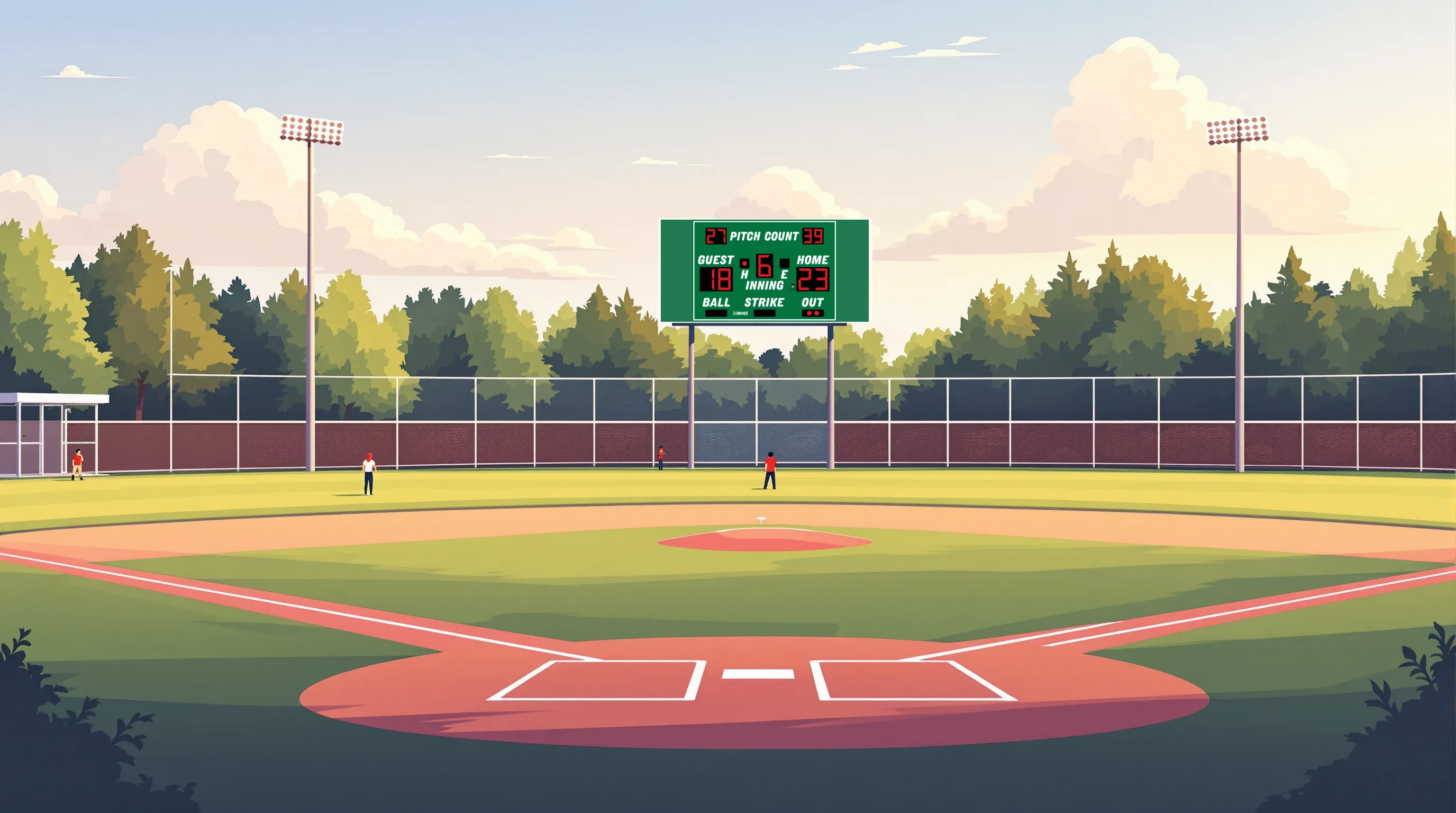
The LX1160 spec sheet describes an outdoor baseball and softball display in a 10 ft by 7 ft cabinet weighing 220 lb, with 18-inch digit height for runs and inning totals.
That spec profile explains why the model appears in Charleston's record more than once while every other model does not. The LX1160 is sized for a regulation baseball or softball diamond, with digits visible at the distances a high school or recreation park venue requires. The base model draws 1.4 amps; the ETN variant, which adds Electronic Team Names, draws 2.7 amps. Both run on 120 VAC. In practice, the difference between the two variants is one decision: whether the organization wants to display team names on the scoreboard or work with the standard digit layout.
The LX1160 carries two digit sizes. The 18-inch row handles runs and inning totals. The 11-inch row handles pitch count. The model page calls the LX1160 the first standard Electro-Mech scoreboard to offer Pitch Counts, in what the company calls its Double Pitch Count style, with the digits for both the home and the guest pitcher visible at once. A display that shows pitch count as a built-in field means the scorer does not need a separate tracking method. That is a functional convenience, not a cosmetic feature, and it becomes relevant whenever an organization's governing body sets pitch-based pitching guidelines.
The cutsheet adds structural detail. The LX1160 cabinet is aluminum construction. It mounts on two steel posts with a maximum diameter of 7 inches per post, secured with clamp assemblies at two points per post, with the posts set in concrete footings. The top cabinet section installs first, with posts held plumb using temporary framing. Those details determine the concrete footprint a contractor plans for, and they are specific to this model.
The three LX1160 entries share a buyer type. All three went to youth baseball leagues rather than to the city's high schools: two to the same league, in March 2011 and June 2014, and one to a second league in February 2018. The high school diamonds in the record carry other models, a 1050-LOGO shipped in 2007 and an LX1060 in 2018. For a youth league weighing the same purchase today, every Charleston organization that chose this model was running the same kind of program.
For scale context, the LX1160 at 10 ft by 7 ft sits at the compact end of the outdoor baseball catalog. Larger diamond displays exist for venues with more distance between the scorer and the fence. The LX1730, for example, is the largest diamond scoreboard in Charleston's record and carries different digit heights for different display fields. The scale difference between those two models is real and belongs to the spec sheet, not to assumptions about what any venue needs.
Buyers who read the LX1160 spec sheet first rarely question the model's fit for a standard program: the numbers are specific, and specific numbers answer fit questions directly. A city record that shows the LX1160 three times is showing that three organizations read the same spec and reached the same conclusion independently.
What specifications should outdoor soccer and lacrosse programs look for in a scoreboard display?
Outdoor soccer and lacrosse scoreboards need separate display fields for match time, score, and shots on goal, sized so each category reads clearly from the farthest seat in the venue.
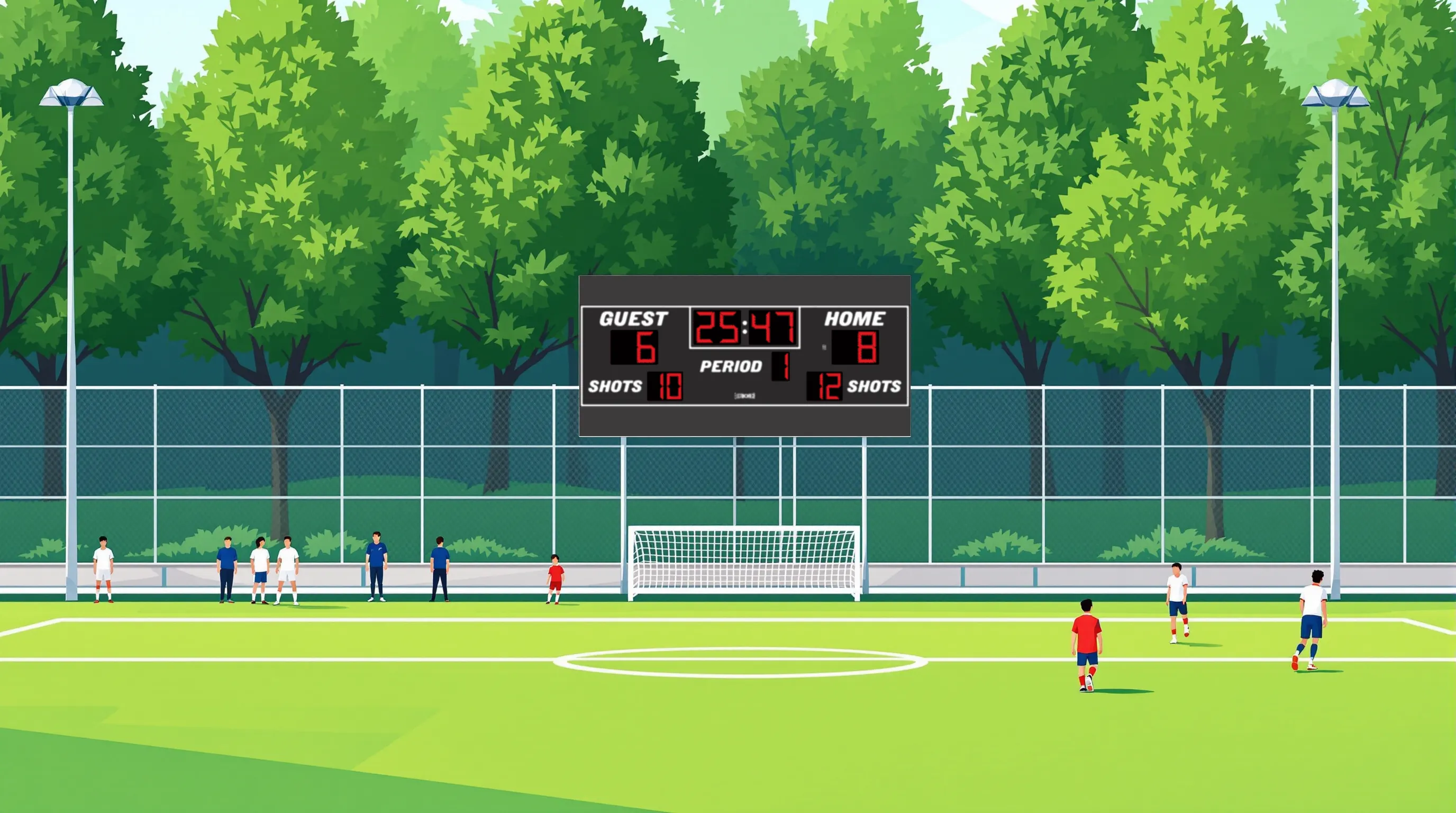
The LX6430 spec sheet puts the points and clock display at 18-inch digit height and the shots-on-goal display at 15 inches. The distinction is practical. Points and clock carry the primary game state for coaches, officials, and the entire venue; shots on goal is a secondary field read mainly from the sideline and technical area. Setting those two categories at different digit heights keeps the primary information legible at distance without over-sizing every row.
The LX6430 is a 16 ft by 5 ft outdoor cabinet, which makes it a smaller footprint than the LX1730 in the same record. West Virginia's statewide record shows soccer concentrated in a handful of cities, with Charleston holding more soccer entries than most. For programs evaluating an outdoor display for a soccer or lacrosse program, the LX6430 spec sheet at electro-mech.com/manuals lists the cabinet dimensions, weight, electrical draw, and full digit-height breakdown.
Which Charleston organizations appear in the record, and what did each order?
Two public high schools hold seven of the thirteen entries between them, and the remaining six sit with a university, two youth baseball leagues, a booster club and a community center.
George Washington High School holds four entries, all of them in the 2000s: an MP-320-PC football display shipped October 14, 2002, a 2350-MD and a 2655-PC for basketball, both shipped November 18, 2002, and a 1050-LOGO baseball board shipped February 12, 2007. It is the only organization in the record with entries in three different sports.
Capital High School holds three, and they span the full length of the record: an MP-385-PC soccer display shipped March 8, 1999, the city's only LX6430 shipped September 29, 2014, and an LX1060 baseball board shipped May 29, 2018. Two of the city's three soccer entries are Capital's; the third is the University of Charleston's 6630-PC.
The rest of the record sits outside the two schools and the university. Two youth baseball leagues hold three LX1160 entries between them, shipped in 2011, 2014 and 2018, which is every LX1160 in the city record. A booster club took the city's single LX1730 in September 2014, and a community center took an LX1030 in April 2011.
The record also clusters in time. Three of the thirteen entries shipped in a single autumn, October and November 2002, all of them to George Washington High School, which took delivery of its football and basketball displays within five weeks. Another three shipped in 2014, to three different organizations, and the two most recent, in February and May 2018, close the record. Across two decades the city averaged fewer than one Electro-Mech display a year, and the gaps run longer than the clusters: nothing between March 1999 and October 2002, and nothing between February 2007 and March 2011.
Geographically the record is spread thin: the thirteen entries sit across eight ZIP codes, and no ZIP holds more than three. The two groups of three are 25314, where George Washington's three 2002 displays shipped, and 25311, which covers Capital High School's two soccer entries and the booster club's LX1730.
What the record cannot say, for any of the thirteen entries: whether the display is still in service, whether it replaced an earlier unit, or which specific field or gym received it. These are boards Electro-Mech sold and shipped to a Charleston address between 1999 and 2018, not an inventory of what stands there today.
The LX1160 and the LX6430 sit at opposite ends of Charleston's record: the workhorse diamond board the city bought three times, and the single soccer display that gives Charleston its outsized share of the state's soccer count. West Virginia's statewide record shows 12 LX1160 entries in total. Charleston holds 3 of those 12. No other West Virginia city in the record concentrates the same model to that degree.
How do the LX1730 and LX6430 in Charleston's record compare to what West Virginia organizations typically order?
The LX1730 spec sheet describes the city's largest diamond scoreboard: an outdoor baseball and softball display in a 20 ft by 6.5 ft cabinet weighing 380 lb.
The LX1730's specs go well beyond the LX1160's footprint. The base variant draws 4.0 amps; the ETN variant draws 6.6 amps. Both run on 120 VAC. Digit heights split by function: 18 inches for Ball, Strike, Out, and Batter Number, and 15 inches for runs and inning totals. That two-tier structure reflects what a larger diamond venue needs, with count-related fields sized for immediate readability from distance and score fields at a slightly smaller height. Charleston's single LX1730 entry is the record's outlier by size.
The LX6430 is the record's other distinctive one-of-a-kind. Its spec sheet puts the cabinet at 16 ft by 5 ft and 265 lb. The base variant draws 2.2 amps; the ETN variant draws 4.8 amps. Digit heights are 18 inches for points and clock, and 15 inches for shots on goal. Those three fields cover what a soccer or lacrosse venue requires from a display during a game, with the clock and score at maximum size and the shots-on-goal counter at a secondary height.
In the context of West Virginia's statewide record, both displays represent uncommon choices. The statewide record holds 253 total entries across 117 cities and towns, with baseball accounting for 111 entries and soccer for only 9. Charleston's 3 soccer entries represent a third of that statewide total. The LX1730 is a large-format diamond display; most of the state's baseball orders go to smaller models. A single entry for either display type in a city of Charleston's size reflects a venue decision, not a market trend.
Charleston, as West Virginia's capital and most densely institutioned city, draws a disproportionate share of the state's larger and more sport-specific orders: three of the state's nine soccer entries, and one of the few large-format diamond displays anywhere in the record.
The practical point is this: when an organization in Charleston considers a soccer display or a large-format diamond scoreboard, it is working in a segment of the West Virginia market where very few comparable orders exist. The LX6430 and LX1730 entries in the record are the closest reference points available. For a buyer, that scarcity of comparables is itself useful information.
What changes when a baseball program adds a pitch-count display to its scoreboard?
Before the NFHS pitch-count requirement, inning count was the accepted proxy for a pitcher's workload. Pitch tracking happened off the display entirely, in the scorebook or on a handheld counter.
Before: The scorer watches the scoreboard for score and inning. Pitch totals live in the scorebook only. Officials confirm pitch counts through the bookkeeper, not from a shared visible source. Multiple independent records track the same number, and discrepancies surface at the end of an inning rather than during it.
After: The pitch-count field on the scoreboard carries the running total. Every person at the field reads the same display. The LX1730 puts Ball, Strike, Out, and Batter Number alongside the running count on one panel. One source, visible simultaneously from the field and the bench.
What should baseball programs know about NFHS Rule 6-2-6 and scoreboard pitch-count displays?
NFHS Rule 6-2-6, adopted in 2016, requires every member state association to establish a pitching restriction policy based on pitches thrown rather than innings pitched.
The rule specifies the requirement to track; it does not specify the equipment. In practice, a scoreboard with a built-in pitch-count display field handles the on-field tracking requirement automatically as the game progresses. Organizations without that feature track pitches separately through a handheld counter or paper sheet, which works but adds a step to the scorer's task. For a baseball program evaluating a new scoreboard, pitch-count display is now a function to check on the spec sheet, not an optional extra.
The LX1160's pitch-count field, described earlier in this article, uses an 11-inch digit row alongside the 18-inch scoring row. The LX1730's configuration handles count-related fields for Ball, Strike, Out, and Batter Number separately from the scoring fields. Both structures exist because the game requires them. When the NFHS directed member states to move from innings-based to pitch-based restrictions starting in 2016, pitch-count display shifted from a specialty feature to a standard expectation for sanctioned play at the high school level.
Programs outside the NFHS member state framework operate under different governing bodies with their own pitch-count guidelines. High school programs in West Virginia answer to the West Virginia Secondary School Activities Commission under NFHS rules. Youth programs answer to their own association. A buyer's first step is confirming which governing body sets the rules for their specific program, because the feature requirements follow from that answer.
The same principle applies across sports. Each sport has its own display requirements based on the rules of play. Lacrosse requires points, clock and penalty timers. Baseball requires pitch count at the high school level. Soccer requires shots on goal. A display that does not match the sport's rule-driven field requirements creates a gap between what the scoreboard shows and what the officials and players need to see.
The action item for a buyer is to map the display fields on any candidate scoreboard against the specific in-game data their governing body requires. Start with the spec sheet's digit layout and verify each field against the rulebook. That is a short check, and it prevents the more expensive problem of discovering the gap after the display is in place.
What the numbers show is that Charleston, the state capital, holds a larger share of West Virginia's soccer entries than its overall count suggests.
| Geography | Total Orders | Cities and Towns | Baseball Orders | Soccer Orders |
|---|---|---|---|---|
| West Virginia statewide | 253 | 117 | 111 | 9 |
| Charleston, WV | 13 | 1 (state capital) | 7 | 3 |
Charleston's record spans nearly two decades and concentrates a quarter of West Virginia's statewide LX1160 entries in one city. That is the data point to carry forward: not how many scoreboards exist in the city, but how often organizations here returned to the same model. The LX1160's presence in West Virginia's capital is evidence of a direct fit between what the model offers and what the institutions that run this city's athletic programs needed.
From my experience in support services, the most useful information a buyer has is what comparable organizations in the same geography actually chose. Charleston has that history on record. The next step is matching it to your own field, sport, and governing body's display requirements.
Contact the Electro-Mech team to review the models in Charleston's record and request a quote for your specific application.
Sources & Further Reading
Where can organizations find authoritative resources on Electro-Mech scoreboards?
Electro-Mech maintains published specification sheets and owner manuals for every model in its catalog, from the baseball and softball LX-series displays that anchor the West Virginia record to the soccer and lacrosse displays that distinguish Charleston's record from the rest of the state.
- Electro-Mech scoreboard installations in Charleston, West Virginia
- Electro-Mech scoreboard installations in West Virginia
- LX1160 product page
- LX1160 spec sheet
- LX1160 owner's manual
- LX1730 product page
- LX1730 spec sheet
- LX1730 owner's manual
- LX6430 product page
- LX6430 spec sheet
- George Washington High School official website
- Capital High School official website
- University of Charleston official website
- West Virginia Secondary School Activities Commission
- NFHS: Pitching Restriction Policies in Baseball to be Based on Pitches
Related Articles
Written by
Chap McMichael
Vice President of Support Services, Electro-Mech Scoreboard Company
Chap McMichael is Vice President of Support Services at Electro-Mech Scoreboard Company, the family-owned manufacturer that has built scoreboards in Wrightsville, Georgia since 1963.
Connect on LinkedInSummarize This Article With AI
Open this article in your preferred AI engine for an instant summary.
Frequently Asked Questions
Which Charleston organizations appear in Electro-Mech's record?
Nine organization names appear across the thirteen entries, and two of them are the same organization under a second spelling, so the record covers seven organizations. George Washington High School holds four entries, Capital High School three, and the University of Charleston one. The remaining five sit with two youth baseball leagues, a booster club and a community center.
Can a West Virginia organization see what other cities in the state have ordered before making a purchase decision?
The statewide pattern is documented in this article for the models most commonly shipped to West Virginia organizations. Use the model pages and spec sheets at electro-mech.com to compare the display fields and physical specifications. From there, our team can discuss which models West Virginia programs have purchased for your specific sport.
What display fields should a West Virginia baseball program confirm before ordering a scoreboard?
Confirm that the model includes a pitch-count field, which is now required under West Virginia Secondary School Activities Commission guidelines following NFHS Rule 6-2-6. Also verify Ball, Strike, Out, and inning-total display fields. The LX1160 and LX1730 both carry these fields; the spec sheet for each model shows the digit layout and row assignments.