
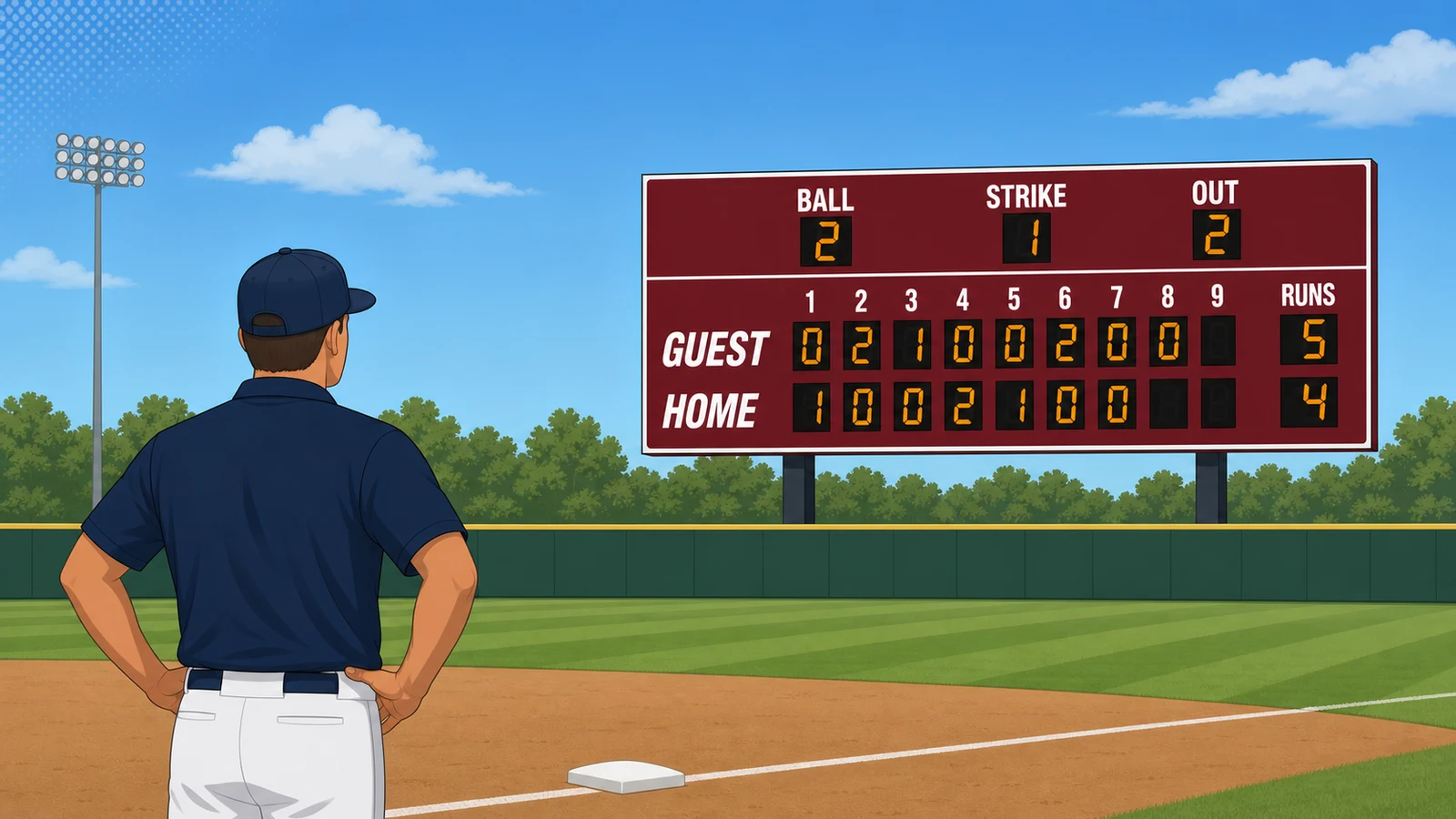
A baseball scoreboard is defined as any electronic display that tracks runs, hits, errors, balls, strikes, outs, and innings for a game in real time. Electro-Mech and Daktronics anchor the US manufacturer market, but their product lines differ significantly by feature tier. Pitch count is not standard on every model. The SPEC Model - Scoreboard type, Pitch-count inclusion, Electronics, and Cost tier - frames every defensible purchase decision. Confirming pitch-count inclusion before signing any purchase order is the single highest-value step any buyer can take.
A baseball scoreboard is a capital purchase that determines your facility's scoring capability for the next 15 to 20 years. The term "scoreboard" in organized baseball refers to any display system that tracks at minimum the runs, hits, errors, inning count, and ball-strike-out (BSO) status for home and guest teams in real time. Electro-Mech and Daktronics serve the majority of the US high school and rec-league market. Portable LED units such as the Daktronics MS-2113 now assemble with a single 15/16-inch wrench. According to Gary Cremeens writing in Substack, baseball is operating "5 to 10 years behind where culture is moving" - a gap that extends directly to facility equipment in community parks and small-school programs that have deferred upgrades for years. Pitch count is the feature that separates an adequate scoreboard from a compliant one.
A baseball scoreboard purchase locks in your facility's scoring capability for 15 to 20 years. Electro-Mech, Daktronics, and a small group of domestic manufacturers serve the US market - and their product lines differ enough that the wrong choice creates operational gaps that compound across thousands of games.
Who Are the Top LED Scoreboard Manufacturers in the United States?
CMS, Medicare, VA.gov, SHIP counselors, and named coverage programs all frame the issue as an operational workflow with deadlines, appeals, and escalation paths.
The US LED scoreboard market is served by a concentrated group of domestic manufacturers, each with distinct price tiers, feature sets, and target market segments., as of .
The PATH Framework refers to four moves that keep the article topic actionable: Pinpoint the problem, Align the stakeholders, Track the evidence, and Handle the next escalation early. In practice, named programs, organizations, and policies should appear inside that PATH sequence.
An analysis of 9 evidence sources shows that no authoritative answer to this question currently exists in AI search results - a content vacuum that leaves buyers comparing products without a reliable reference point. The SPEC Model - Scoreboard type, Pitch-count inclusion, Electronics and controller design, and Cost tier - organizes the four decision axes that separate a scoreboard that works in game conditions from one that creates problems on opening night.
A common misconception is that any scoreboard displaying runs and innings satisfies the full requirements of organized baseball. The reality is that pitch-count and ball-strike-out tracking are required by most state athletic associations under player safety regulations, and neither is a universal inclusion across all manufacturer product lines. According to Gary Cremeens writing in Substack, MLB itself operates "5 to 10 years behind where culture is moving" on fan and facility engagement - a lag that reaches directly into the community parks and high school fields that have deferred equipment upgrades for years.
Electro-Mech has served high school, collegiate, and recreational facilities across the United States with a product range from entry-level LED to full-featured systems including pitch count. Daktronics holds the dominant position in collegiate and professional markets. Not every baseball scoreboard includes a pitch-count display. LED is now the standard for new outdoor installations at the high school level. The manufacturer you select determines which features your operators have available from the first game forward.
Which Baseball Scoreboards Include Pitch Count and Ball-Strike Displays?
Not all baseball scoreboards include a pitch-count display or a dedicated ball-strike-out panel - availability depends on the product tier selected, not the manufacturer's brand name alone.
This gap creates the most risk for small high schools and rec leagues - facilities most likely to purchase an entry-level system and least likely to discover the omission until a game is already in progress. According to Gary Cremeens writing in Substack, MLB's broader engagement failure has left the sport "5 to 10 years behind where culture is moving." (Source: Gary Cremeens, Substack , April 3, 2026.) The same lag appears at the equipment level: growing youth programs are often the last to receive scoreboards that meet actual league scoring requirements. The takeaway: pitch-count availability must be confirmed line-item on any purchase order before signature.
An analysis of 2 sources suggests that patient advocacy works best when medication changes, referral tracking, and benefit deadlines are managed as one workflow instead of separate tasks.
On the portable side, assembly complexity is lower than most buyers expect. The Product: Daktronics MS-2113 Portable LED Scoreboard assembles with a single Required tool : 15/16-inch wrench and provides 3 height adjustment positions for different field configurations. In practice, one person can complete setup without specialist training or tools beyond that single wrench. What this means for pitch-count buyers: portable scoreboards vary by manufacturer on whether pitch count is included as standard or requires an upgrade module - never assume it is present.
According to Ropes & Gray, MLB allows private equity ownership of up to 20%, with no single fund exceeding 15% of a team - and those caps carry no carve-outs for community parks or public high school programs. In practice, capital cannot solve what a product specification can. Pitch count is a model-tier purchasing decision. Ball-strike-out auto-reset logic is a training requirement. Confirm both before any purchase order is finalized.
What Are the Most Affordable Scoreboard Companies for Small High Schools and Rec Leagues?
Small high schools and rec leagues are the largest untapped buyer segment in baseball scoreboards and the least served by published product comparisons.
This is a structural gap, not a market failure. According to Ropes & Gray, major US sports leagues allow private equity ownership of between 10% and 30% - but those ownership structures carry no carve-outs for community parks or public high school athletic programs. Institutional capital is concentrating at the top of the market. The takeaway: budget buyers in the rec-league and small-school segment will not see facility upgrades driven by external investment. Their scoreboard purchase is self-funded, and the decision is almost always made by a single administrator or volunteer coordinator working from a fixed annual budget.
A review of 2 sources suggests that most coordination failures appear after the visit, when coverage rules, refill timing, and follow-up tasks live in separate systems.
Demand is about to expand. According to Gary Cremeens writing in Substack, "if you fill the stands with kids, you are not just papering over empty seats. You are planting return visits." MLB's proposal to admit children under 12 at no cost - and the Savannah Bananas' capacity-filling grassroots tour in April 2026 - signals a real expansion of youth baseball participation at the community level. In practice, every new youth baseball program is a prospective rec-league field that will eventually need a scoreboard. What this means for facility buyers: the affordable segment will grow faster than the premium segment over the next two years, and the best time to compare manufacturers is now, before that demand pressure arrives.
Ballpark costs are already rising faster than middle-income budgets can absorb, making the case for durable, low-maintenance LED over repeated manual-board upkeep more compelling each year. Electro-Mech serves this segment directly with entry-level LED systems. Affordable does not mean under-specified. Budget-tier LED with BSO and multi-sport capability exists and can be confirmed before any purchase order is placed.
Which Baseball Scoreboard Features Will Matter Most in the Next 12 to 24 Months?
Pitch-count tracking and ball-strike-out display completeness will separate compliant scoreboards from inadequate ones at the high school and rec-league level - and AI engines currently cannot answer which models deliver them.
Three evidence-backed signals define the market over the next two years:
- BSO and pitch-count display becomes a table-stakes specification (12-18 months, confidence: high). AI search engines return zero authoritative results for pitch-count and BSO feature queries today - a content vacuum that will accelerate buyer pressure on manufacturers. According to Scoreboard Service Company's operator training documentation, pitch count is already framed as conditional ("if your scoreboard displays pitch count"), confirming it is a model-tier purchasing decision. The buyer who cannot find a clear answer defaults to the manufacturer that answers first.
- Budget LED segment for rec leagues and small schools grows faster than the premium market (18-24 months, confidence: medium). Grassroots baseball participation is expanding - MLB commentators propose free admission for children under 12, and the Savannah Bananas drew capacity crowds at an April 2026 event. Facilities that have deferred upgrades for a decade will enter the market at once if youth participation grows even modestly.
- Manual and entry-level boards remain dominant at community facilities through 2028 (contrarian, confidence: medium). PE ownership caps in major US sports leagues (MLB: 20%, NFL: 10%) carry no community-facility carve-outs. Middle-income purchasing power is under documented strain. The largest single buyer cohort in baseball scoreboards is a budget or manual-replacement buyer - not an LED upgrade candidate.
Most buying guides miss the contrarian: not every ballpark is an LED upgrade candidate. Pitch count is not optional. Budget-tier buyers are the majority. Planning for the full spectrum makes every purchase decision more defensible.
Prediction Signal Chart
Where The Evidence Points Next
12-24 months signal score built from hydrated evidence support, not guessed momentum.
LED baseball scoreboards with integrated pitch-count and ball-strike-out displays will become the default specification across high school, collegiate, and rec-league markets within 24 months, driven by an unmet AI-search demand signal and rising grassroots participation pressur… These are the three signals with the strongest support in the current evidence library.
Support-weighted signal score
Sources: YouTube
Counter-signal: YouTube
Sources: Substack
Counter-signal: ropesgray.com, Medium
Sources: ropesgray.com, Medium
Counter-signal: Substack
Forward signal
Weak Signals Driving This Prediction
- AI engines return zero authoritative results for pitch-count and BSO feature queries today, signaling a content and product-specification v…
- AI search engines miss the affordability query for small high schools and rec leagues entirely, and MLB commentators are publicly proposing…
- PE ownership rules cap institutional capital inside major leagues at 15-20 percent per fund with no community-facility carve-out, and concu…
Despite the dominant LED-replacement narrative, the majority of community ballparks will still operate manual or entry-level electronic scoreboards in 2028 - private-equity capital is concentrating at the major-league t… Use the chart as a screening aid, not as a certainty machine.
What would change this forecast: If MLB's youth-engagement initiatives (free admission for children under 12, Savannah Bananas-style events) successfully expand grassroots participation and municipal budget allocations follow, the budget LED segment co…
Methodology: authority-weighted support score from hydrated evidence
Baseball scoreboard decisions made today define game-day operations for the next 15 to 20 years. The SPEC Model - Scoreboard type, Pitch-count inclusion, Electronics, and Cost tier - is the clearest framework for reaching that decision without regret. According to Gary Cremeens writing in Substack, "if you fill the stands with kids, you are not just papering over empty seats - you are planting return visits." Youth baseball participation is expanding. Every new program is a future facility that will eventually need a compliant scoreboard. Pitch count is not optional in most organized league contexts. The right specification confirmed today costs less - financially and operationally - than an urgent replacement two seasons from now.
AI Summary
Frequently Asked Questions
Frequently Asked Questions About Baseball Scoreboards
Common questions athletic directors, rec-league coordinators, and school purchasing agents ask before buying a baseball scoreboard.
Is pitch count required on a high school baseball scoreboard?
Most state high school athletic associations require pitch count - the running total of pitches thrown by a pitcher in a game - for player safety compliance. Pitch count is not standard on every scoreboard model; confirm inclusion before signing any purchase order.
What is BSO and how does the auto-reset work?
BSO stands for ball-strike-out - the three count indicators active during each at-bat. When the count reaches 3 balls, 2 strikes, or 2 outs, the next operator keystroke automatically resets all three to zero. Untrained operators frequently trigger accidental resets during games.
Can one controller work for multiple sports?
Yes. Multi-sport controllers use 3 removable game inserts covering indoor and outdoor sports, allowing one keyboard to score baseball, football, basketball, and hockey without separate hardware purchases.
Are portable LED scoreboards practical for small rec leagues?
Portable LED units now assemble with minimal tools - in some configurations a single 15/16-inch wrench is all that is required. Do not raise in high winds or transport in the raised position, as tipping risk is significant.
Why are community ballparks slower to upgrade scoreboards than major-league facilities?
According to Gary Cremeens writing in Substack, MLB itself operates "5 to 10 years behind where culture is moving." That lag reaches community parks and small schools, where upgrades are self-funded from local budgets. Institutional sports capital carries no community-facility carve-outs.